Victoria returns to Sanlúcar after the first circumnavigation
Victoria reached Sanlúcar de Barrameda on 6 September 1522 under Juan Sebastián Elcano. The ship's arrival completed the first recorded voyage around the world and joined ocean crossings into one continuous route.
An expedition in search of spices
The fleet that left Spain in 1519 was seeking a westward commercial route to the Asian Spice Islands. Ferdinand Magellan commanded five ships, but the venture depended on sailors, interpreters, pilots and local knowledge encountered along the way. Its eventual route crossed the Atlantic, passed through the strait at South America's southern end and entered the Pacific. The voyage was a trading and imperial project, not simply an exercise in testing the shape of the Earth. Army Museum.
Arrival on 6 September
By the time Victoria reached Sanlúcar de Barrameda on 6 September 1522, Juan Sebastián Elcano was in command. Magellan had died in the Philippines the previous year. Only one of the original ships returned as part of the completed circumnavigation. Eighteen surviving European expedition members were aboard, many exhausted or ill. The foundation that operates the modern replica describes local assistance at the river entrance and the help needed to bring the damaged vessel farther upstream towards Seville. Nao Victoria Foundation.
One route through connected oceans
Victoria had returned through the Indian Ocean and around Africa, reaching Spain from the east after the expedition had departed westward. Elcano's letter to the king, dated aboard the ship that day, stressed this achievement. The significance was practical as well as geographical: a vessel had completed a circuit linking the oceans. Calling it the first recorded circumnavigation describes the documented continuous voyage; it should not erase the maritime knowledge of the many societies whose waters the expedition crossed. Elcano’s letter.
Achievement and human cost
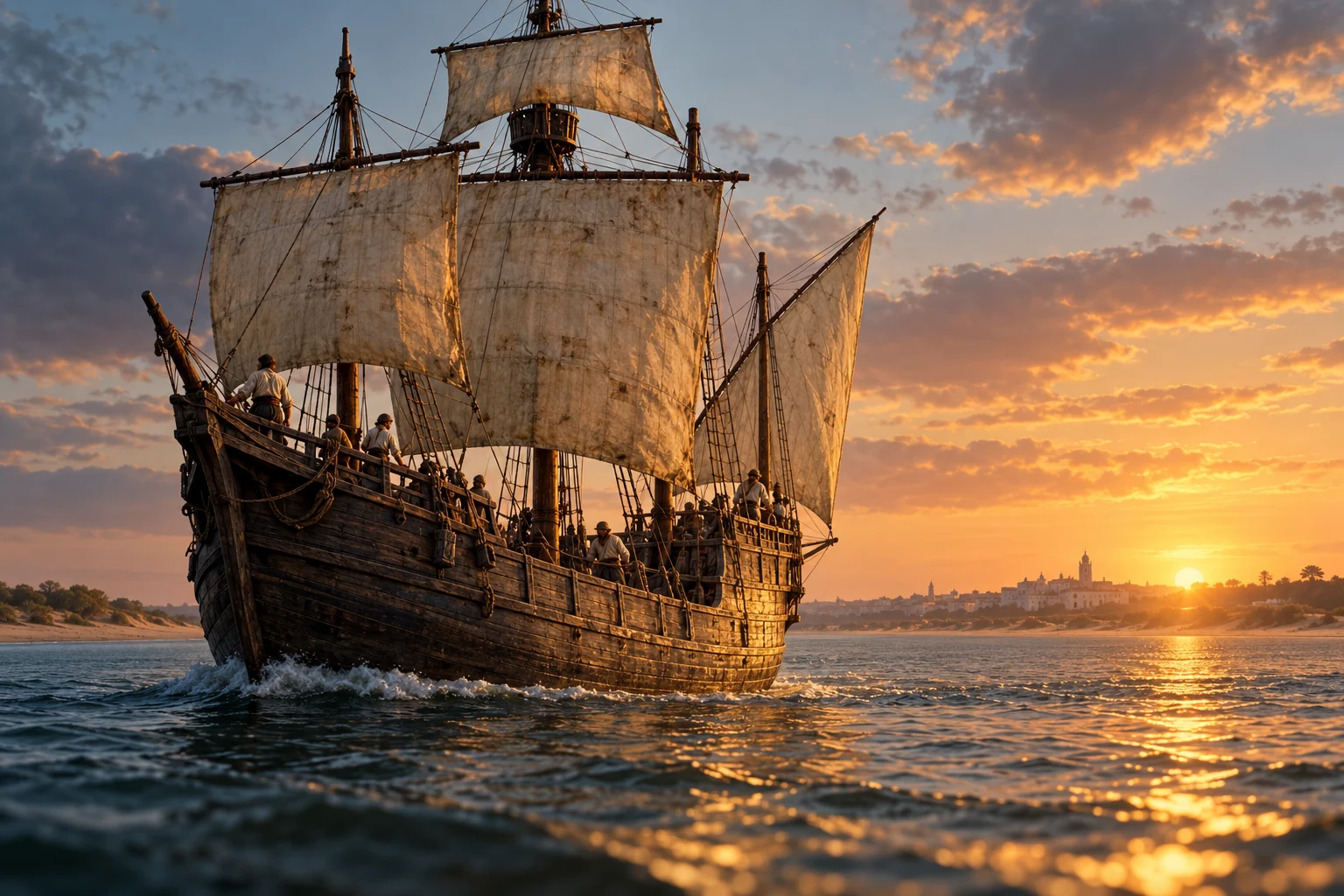
The surviving ship made an extraordinary connection visible, but the voyage also involved hunger, disease, coercion and violent encounters. Its completion should not be presented as an uncomplicated triumph shared equally by everyone involved. Elcano's dated letter and the arrival records provide a secure basis for the return event. They do not supply an exact visual record of the ship at every moment. The illustration imagines a weathered nao entering the estuary rather than claiming to reconstruct an eyewitness picture. Army Museum.
La Spagna (live)
Nora Thiele
Thiele's modern solo interpretation uses a melody associated with fifteenth- and sixteenth-century European dance and improvisation. It provides Renaissance cultural context, not a reconstruction of music aboard Victoria.
Listen on SoundCloud ↗Follow the evidence.
- Spanish Army Museum: Completion of the first circumnavigation ↗
- Fundación Nao Victoria: Return to Sanlúcar, 6 September 1522 ↗
AI-assisted writing, with institutional and primary sources. Illustration is a reconstruction, not an archival photograph. Published October 31, 2026; updated October 31, 2026. Our approach