A rhinoceros arrives in Lisbon as a royal gift in 1515
On 20 May 1515, a living Indian rhinoceros arrived in Lisbon as a gift for King Manuel I. Its sensational appearance generated reports and images across Europe, including Albrecht Dürer's influential woodcut of an animal he had never seen.
A diplomatic gift from India
The rhinoceros that reached Lisbon had first been presented by Sultan Muzaffar Shah II of Gujarat to Afonso de Albuquerque, governor of Portuguese India. Albuquerque sent it onward to King Manuel I. The animal thus moved through a chain of diplomatic gifts before arriving in Portugal on 20 May 1515. The Wellin Museum's collection account establishes both the exact arrival date and the royal destination. Its journey connected Indian rulers, Portuguese imperial officials and a European court.
An extraordinary arrival
A living rhinoceros had not reached Europe since antiquity, making the arrival a remarkable public event. Europeans knew such animals through inherited texts and representations, but a living example presented something different. The large one-horned animal offered an immediate encounter with a creature many people had never expected to see. A specialist study in Pachyderm traces the surviving early depictions and treats the Lisbon arrival as the starting point for a new European visual record.
The animal becomes an image
News and sketches travelled farther than the rhinoceros itself. In Nuremberg, Albrecht Dürer produced a drawing and woodcut without personally seeing the animal. His print exaggerated the folded skin into armour-like surfaces and added an extra horn on the back. The National Gallery of Art explains how these departures from anatomy helped create a compelling, widely circulated image. The print's influence shows that a persuasive representation could shape understanding even when its maker lacked direct observation.
Separating arrival from aftermath
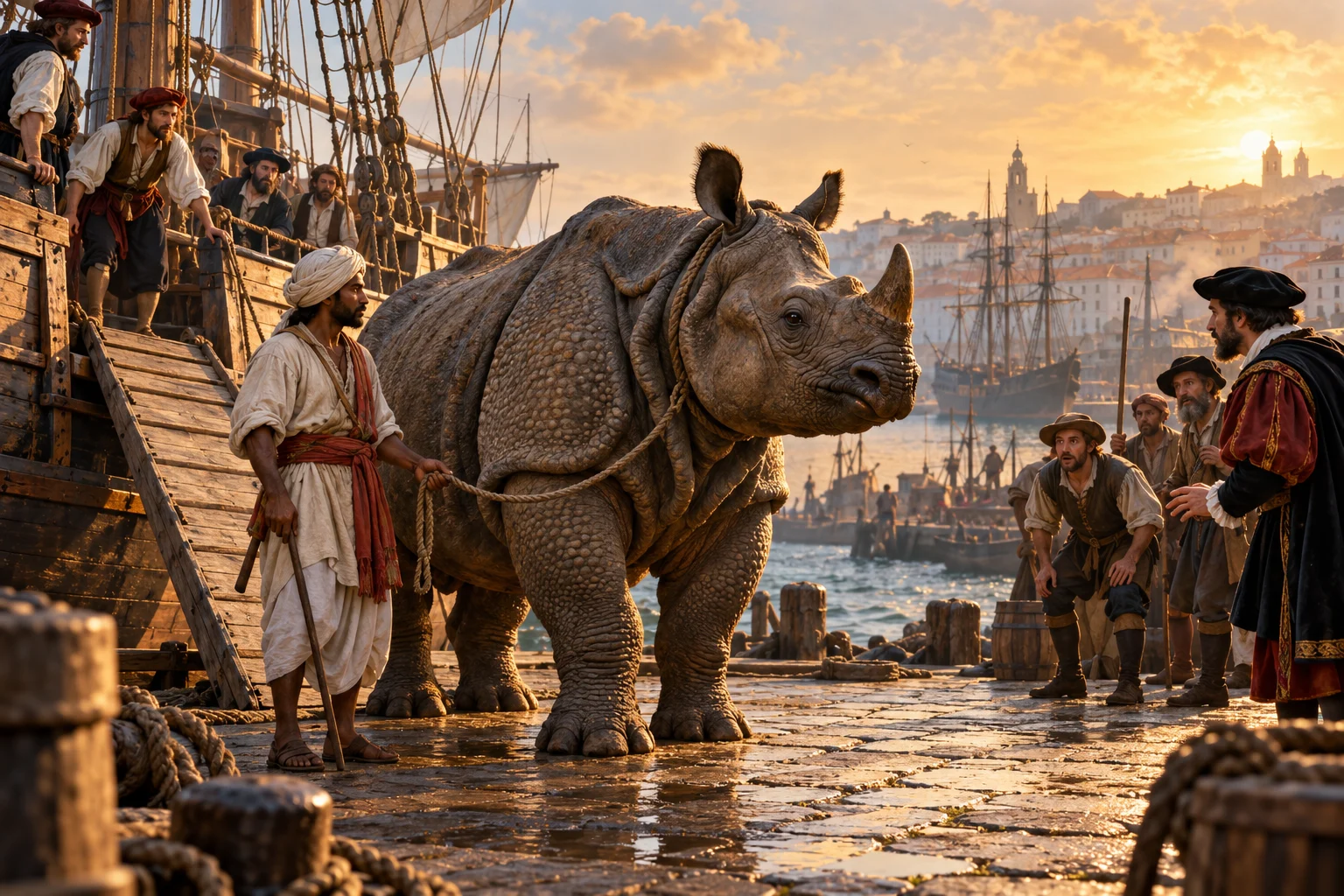
Manuel later sent the animal toward Rome as a gift for Pope Leo X. It died when the transporting ship was wrecked in early 1516. That later tragedy should not be confused with its successful arrival in Lisbon the previous May. Nor should Dürer's imagined features be read back into the animal's actual anatomy. The accompanying illustration interprets the unloading with a natural one-horned rhinoceros. The quay, spectators and keeper's appearance are reconstructed visual choices, not a newly discovered eyewitness record.
Fantasia by Alonso Mudarra
F. Hiemenz
Hiemenz's modern guitar performance of Mudarra's sixteenth-century Iberian music evokes the broader Renaissance setting. The Spanish piece is later than the arrival and is not documented as music played on the Lisbon quay.
Listen on SoundCloud ↗Follow the evidence.
- Wellin Museum, Hamilton College: The Rhinoceros ↗
- Pachyderm: Early depictions of the first Lisbon rhinoceros ↗
- National Gallery of Art: Horns, Scales, and Armor ↗
AI-assisted writing, with institutional and primary sources. Illustration is a reconstruction, not an archival photograph. Published October 31, 2026; updated October 31, 2026. Our approach