Dolly the sheep is born at the Roslin Institute
Born on 5 July 1996, Dolly demonstrated that an adult mammal's specialised cell could provide the nuclear information needed to develop a new animal.
A birth before a public sensation
Dolly was born at the Roslin Institute in Scotland on 5 July 1996. Her arrival remained out of public view until the research was announced in February 1997. Keeping those dates separate avoids a common confusion between the experiment's successful outcome and the moment it became international news. The institute's work involved a team of researchers and animal-care staff, and grew from efforts to develop methods for modifying livestock. Roslin account
What the experiment transferred
The source was a cell from the mammary gland of an adult Finn Dorset ewe. Its nucleus was transferred into an egg cell whose own nucleus had been removed. Following early development, the embryo was placed in a surrogate Scottish Blackface ewe. The egg, the donor cell and the surrogate therefore played different roles. Calling the process copying can be useful shorthand, but it should not erase those biological contributions or suggest that an adult animal appeared fully formed. Museum explanation
Why an adult cell mattered
Animals had already been cloned using cells from earlier developmental stages. Dolly's distinction was the adult, specialised source cell. Such a cell normally performs a particular job, rather than building an entire organism. The experiment demonstrated that its nuclear state could be reset sufficiently for development to proceed. This made Dolly evidence about the flexibility of cell specialisation, not merely another example of animals resembling one another. Her white face also differed visibly from that of the surrogate breed.
An ordinary flock and an unusual legacy
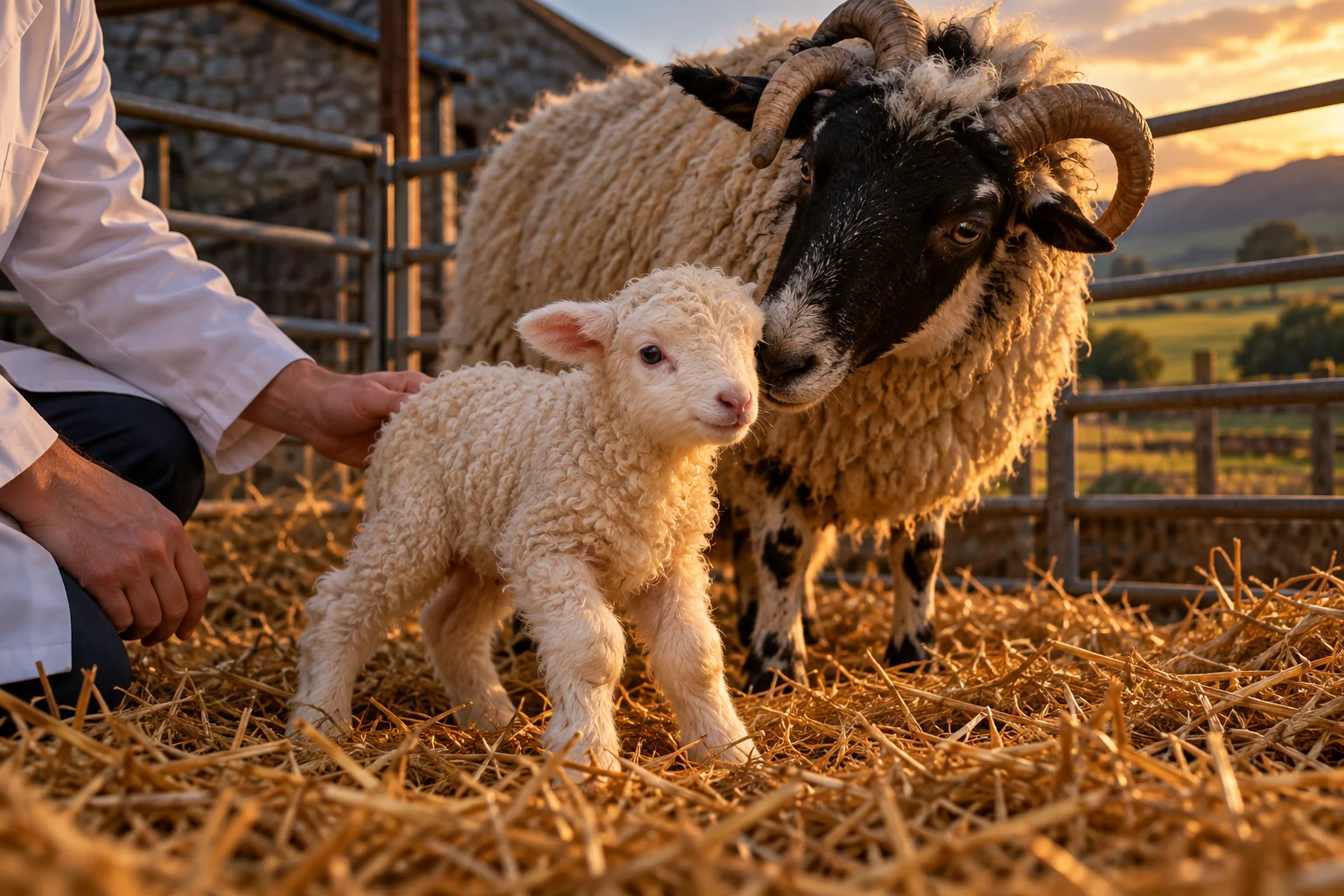
Dolly lived among other sheep at Roslin and later had six lambs. Her arthritis and eventual illness attracted attention because scientists were investigating whether cloning could affect health or ageing. Roslin reports that her lung disease was linked to a virus also affecting other sheep, and that the cause of her arthritis was not established. Those limits matter: one famous animal cannot settle every question about cloning. The illustration imagines a research-farm scene; it does not document her actual delivery.
Sheep May Safely Graze — Bach, arranged by Egon Petri
David Shimoni
Shimoni's piano performance, recorded at the Banff Centre, gives Dolly a pastoral musical setting. It is a separate performance of Bach, not music from the Roslin birth.
Listen on SoundCloud ↗Follow the evidence.
- Roslin Institute — The Life of Dolly ↗
- National Museums Scotland — The story of Dolly ↗
- Roslin Foundation — Dolly the Sheep ↗
AI-assisted writing, with institutional and primary sources. Illustration is a reconstruction, not an archival photograph. Published October 31, 2026; updated October 31, 2026. Our approach