Beijing Declaration adopted on 15 September 1995
The Beijing agreement framed women's equality as a concern of public institutions, economic life and responsibilities within the family.
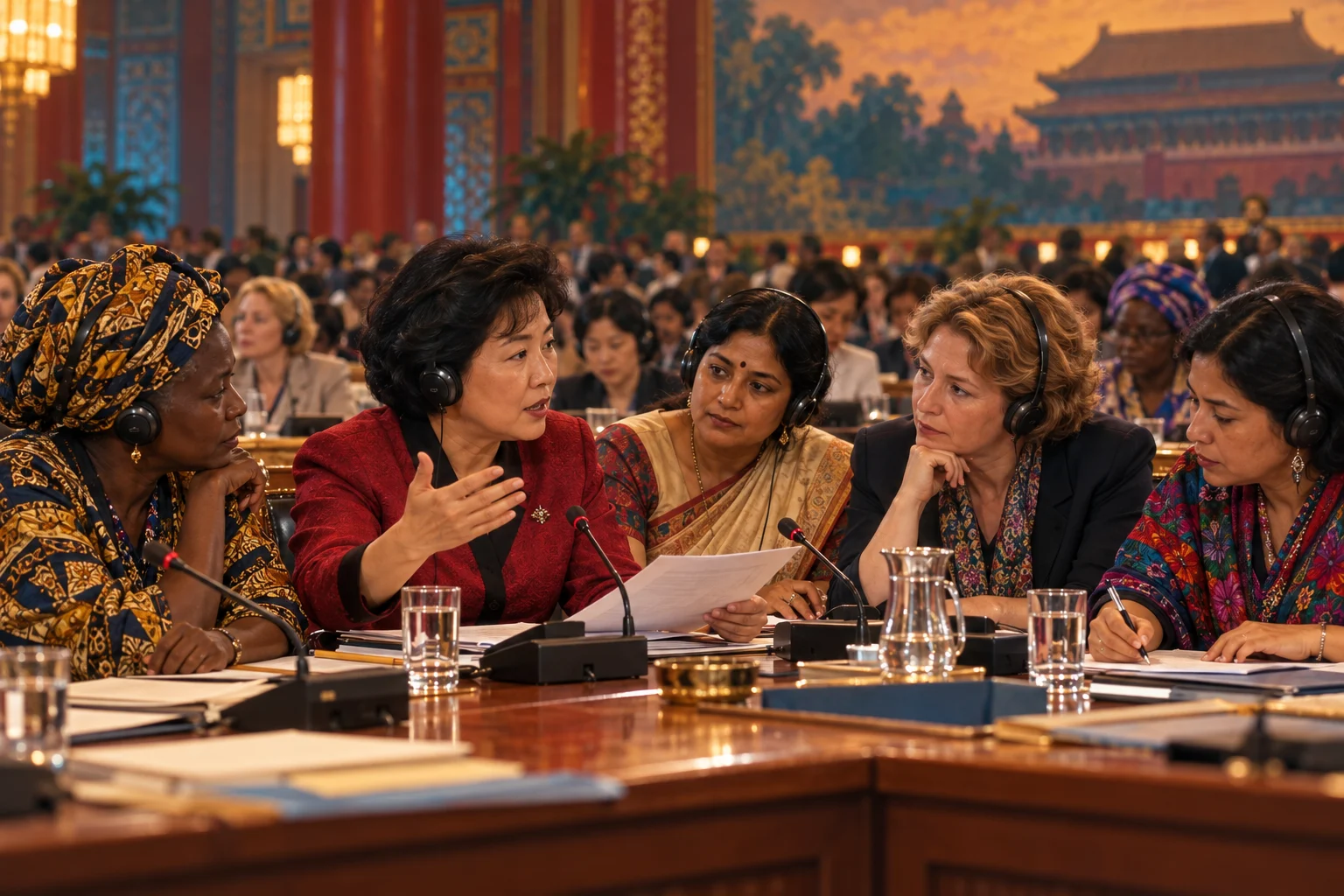
A global conference and a shared commitment
The Fourth World Conference on Women concluded in Beijing in September 1995 with a declaration and an accompanying programme for action. The declaration dated 15 September placed women's equality within the wider framework of human rights and development. It built on earlier United Nations meetings rather than presenting inequality as a newly discovered problem. Its language acknowledged both progress and the persistence of barriers that affected women differently across countries and communities. Declaration
Equality inside everyday life
One notable commitment concerned the family. The declaration connected equal rights and access to resources with equal sharing of family responsibilities by women and men. That formulation made the household relevant to a global policy agreement: care, domestic work and responsibility could affect participation outside the home. It also connected equality with family well-being and democratic life, rather than treating women's advancement as an isolated concern belonging to a single ministry or profession.
From principles to public action
The accompanying commitments addressed employment, poverty, education, health, violence and participation in decision-making. They called for practical measures and resources, not simply approval of an abstract ideal. The texts also recognised that women and girls could face overlapping barriers associated with factors such as age, disability, ethnicity or indigenous status. Their breadth helps explain why Beijing became a reference point for work spanning civil, political, economic, social and cultural inequalities. Action commitments The emphasis was on structural change rather than isolated symbolic recognition.
A framework whose implementation still matters
Adoption by consensus gave the agreement international authority, but agreement alone could not redistribute resources or change institutions. Those tasks required implementation, funding and accountability at different levels. The United Nations describes Beijing as a continuing expression of the commitment to equality and opportunity for women and girls. Its historical significance rests in that shared framework, alongside the continuing distance between commitments and lived conditions. The illustration is an imagined conference discussion, not an identified meeting or documentary photograph. UN account
One Woman: A Song for UN Women
UN Women international ensemble
This international ensemble song was launched for UN Women on 8 March 2013. Its message of solidarity connects to Beijing's equality agenda; it was not performed at the 1995 conference. This upload is by Radio La Fórmula Bcn.
Listen on SoundCloud ↗Follow the evidence.
- University of Minnesota Human Rights Library — Beijing Declaration ↗
- United Nations — Beijing Declaration ↗
- Human Rights Library — Beijing commitments and action ↗
AI-assisted writing, with institutional and primary sources. Illustration is a reconstruction, not an archival photograph. Published October 31, 2026; updated October 31, 2026. Our approach