Antonio Rebollo lights Barcelona's Olympic cauldron
At the opening ceremony on 25 July 1992, a flaming arrow ignited the Olympic cauldron while flying over its rim rather than landing inside.
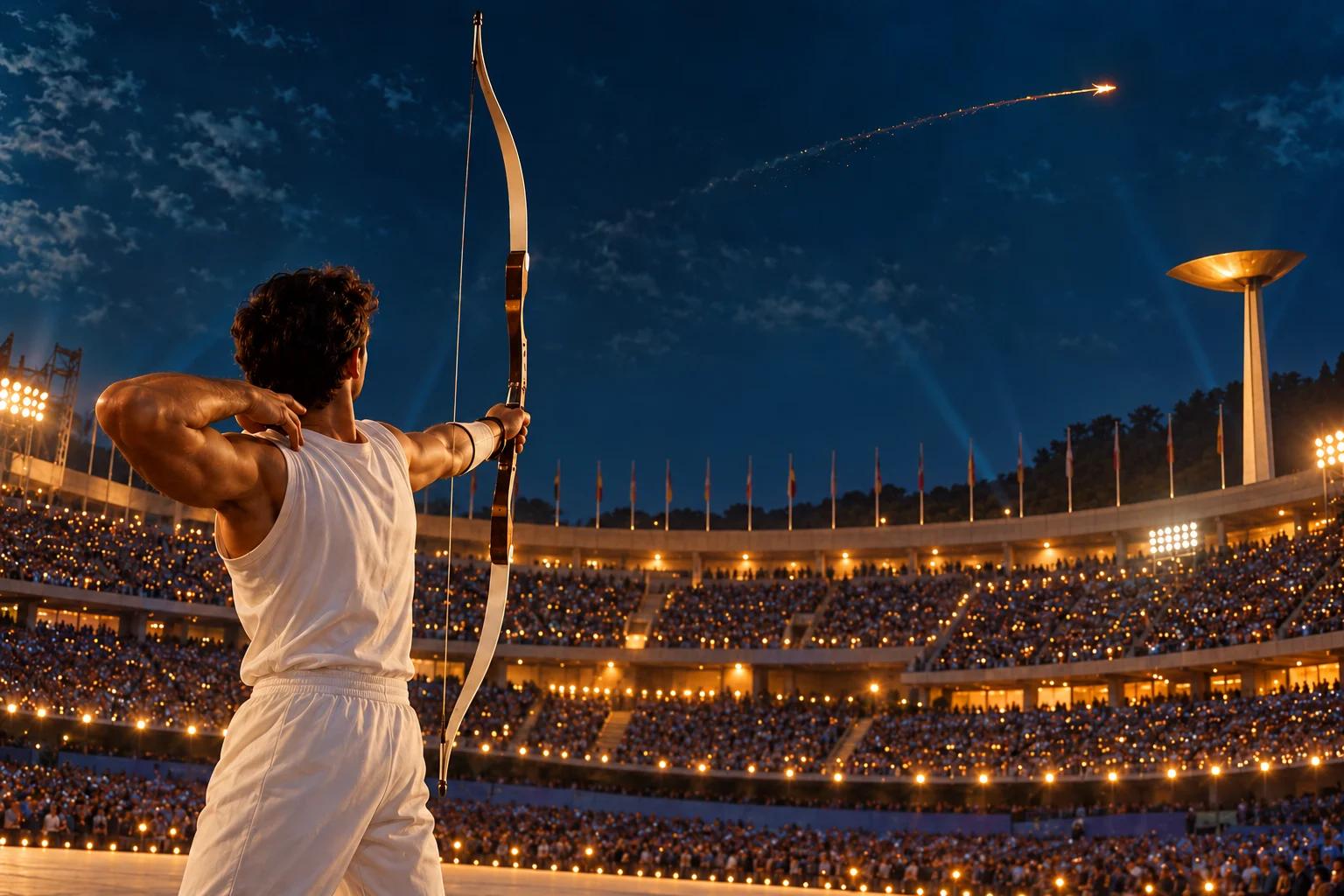
The final stage of the Olympic relay
Barcelona's Olympic opening ceremony took place on 25 July 1992. The torch relay concluded at the Olympic Stadium, where the final lighting sequence put a Paralympic archer at the centre of the spectacle. Antonio Rebollo used an arrow carrying fire from the Olympic flame to ignite the high cauldron. The moment linked an ancient sporting tool with the modern ceremony watched by an international audience. Olympic Studies Centre reference
The arrow did not have to land in the bowl
The Olympic Museum's record of the surviving arrow explicitly says it lit the cauldron as it flew over the top. That is a different mechanism from shooting a burning object into a container and leaving it there. Gas issuing from the cauldron could ignite during the arrow's passage. The distinction explains a visual puzzle that has followed the ceremony: an arrow continuing beyond the target was consistent with the intended effect, rather than evidence that the ceremony failed. Museum object record The gas ignition is also described in the official report.
A carefully made piece of equipment
The arrow was a designed ceremonial object, not ordinary sporting equipment with an improvised flame attached. The Olympic Studies Centre describes its heat-resistant construction, roughly metre-long form and design intended to protect the archer from the fire. The cauldron also formed part of the visual design of the Games, mounted outside the stadium wall. Preserving the actual arrow allows historians to connect an apparently fleeting television image with the materials and preparation that made the performance possible.
A memorable beginning to the Games
The Canadian Olympic Committee identifies Rebollo's cauldron lighting as one of Barcelona's iconic images. Its lasting appeal comes from a clear human action: a person releases a small arrow, and a distant flame suddenly rises above a stadium. Understanding the gas and flight path adds to that achievement without removing its drama. The illustration reconstructs the general setting and action; it is not an archival photograph or a precise record of the arrow's trajectory. Games account
Olympic Fanfare and Hymn
Belgian Brass, conducted by Dirk Brossé
This separate Belgian Brass recording supplies an Olympic ceremonial connection. It is not the music played beneath Rebollo's shot at Barcelona in 1992.
Listen on SoundCloud ↗Follow the evidence.
- IOC Olympic Studies Centre — Summer Games torches and relays, Barcelona section ↗
- Olympic Museum — Barcelona 1992 ignition arrow ↗
- Canadian Olympic Committee — Barcelona 1992 ↗
- Barcelona organising committee — Official Report, volume 4, page 72 ↗
AI-assisted writing, with institutional and primary sources. Illustration is a reconstruction, not an archival photograph. Published October 31, 2026; updated October 31, 2026. Our approach