Sue Hendrickson discovers the T. rex SUE
A flat truck tyre interrupted a South Dakota fossil expedition on 12 August 1990. Sue Hendrickson used the delay to investigate a promising bluff.
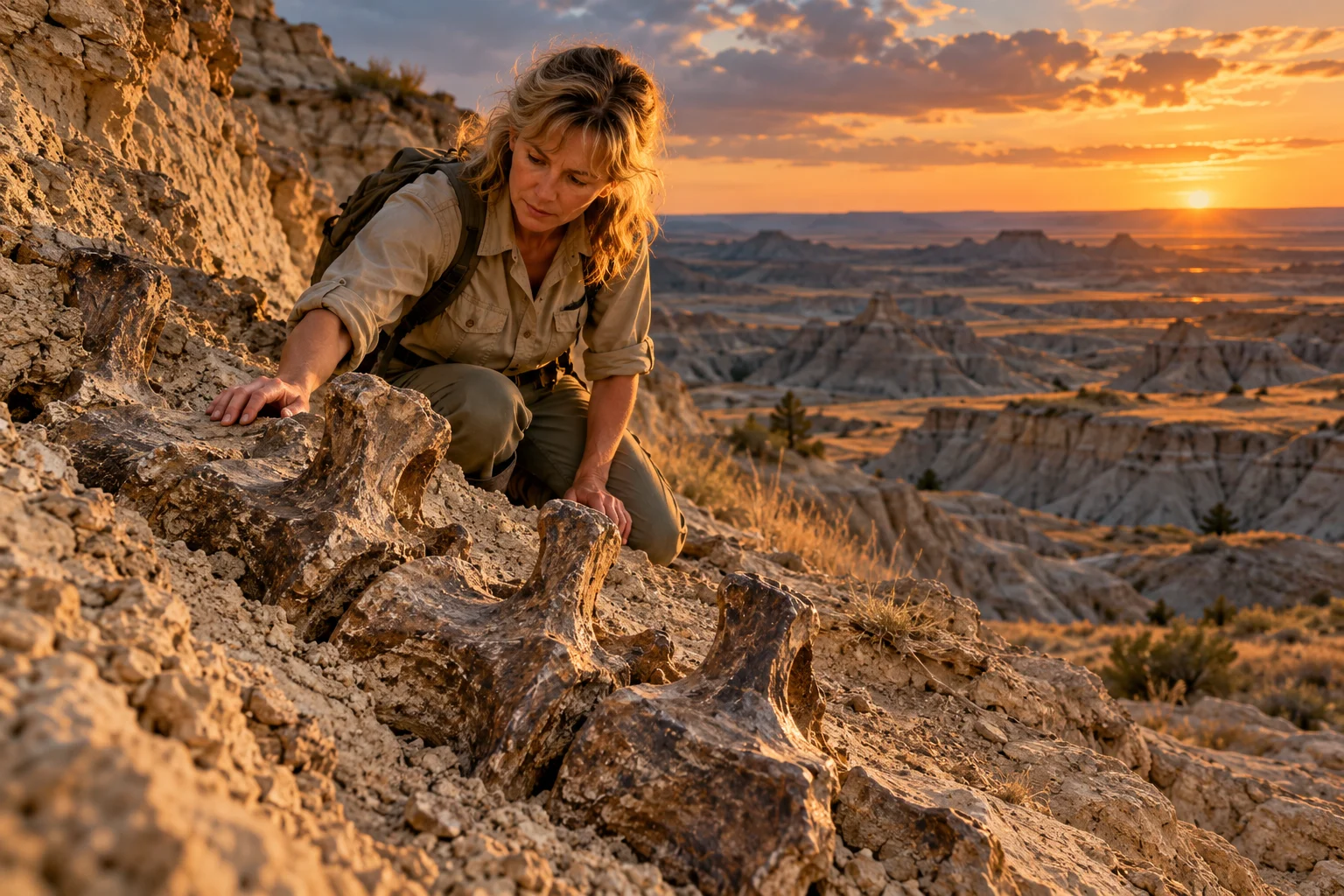
An expedition interrupted
On 12 August 1990, Sue Hendrickson was working with a commercial fossil-collecting team near Faith, South Dakota. A truck had a flat tyre, and most of the group went into town for repairs and a break. Hendrickson remained behind. An account of the discovery reproduced from the Field Museum's original exhibition describes how she used the unexpected interval to walk toward sandstone bluffs that had already attracted her attention. Discovery account
Following fragments to their source
Hendrickson noticed fragments on the ground and searched the slope above for their source. Large exposed bones suggested something much more substantial remained within the bluff. When the other collectors returned, they confirmed that the find was a Tyrannosaurus rex and named the specimen after its discoverer. The memorable detail is the relationship between interruption and observation: the tyre problem created an opportunity, but recognising and following the evidence still required a skilled fossil hunter.
A skeleton becomes a research resource
The Field Museum describes SUE as a remarkably complete and well-preserved specimen. Extracting the bones required six people and seventeen days, followed by preparation and study. A skeleton preserving so much of one animal allows researchers to investigate features and growth together rather than assembling an interpretation from scattered individuals. Study of growth rings in the bones has helped estimate SUE's age and the rapid growth that occurred during its adolescence. Field Museum That makes the specimen unusually valuable for comparisons between individual animals.
The name does not establish the animal's sex
SUE's name commemorates Hendrickson; it does not identify the dinosaur as female. The museum explicitly treats the specimen's sex as unknown. That distinction matters because a vivid personal name can quietly turn an uncertainty into an assumed fact. Likewise, discovery, excavation and later museum display are separate stages of the specimen's history. The illustration imagines the moment of field observation, showing only exposed bones rather than a complete skeleton waiting above ground. It is not an archival photograph.
Fossils — The Carnival of the Animals
London Sinfonietta; Pascal Rogé and Cristina Ortiz; Charles Dutoit
Saint-Saëns's fossil-themed miniature playfully suits a fossil discovery. The uploader credits these performers; it is a separate concert recording, not sound from the 1990 excavation.
Listen on SoundCloud ↗Follow the evidence.
AI-assisted writing, with institutional and primary sources. Illustration is a reconstruction, not an archival photograph. Published October 31, 2026; updated October 31, 2026. Our approach