Nelson Mandela leaves prison: February 11, 1990
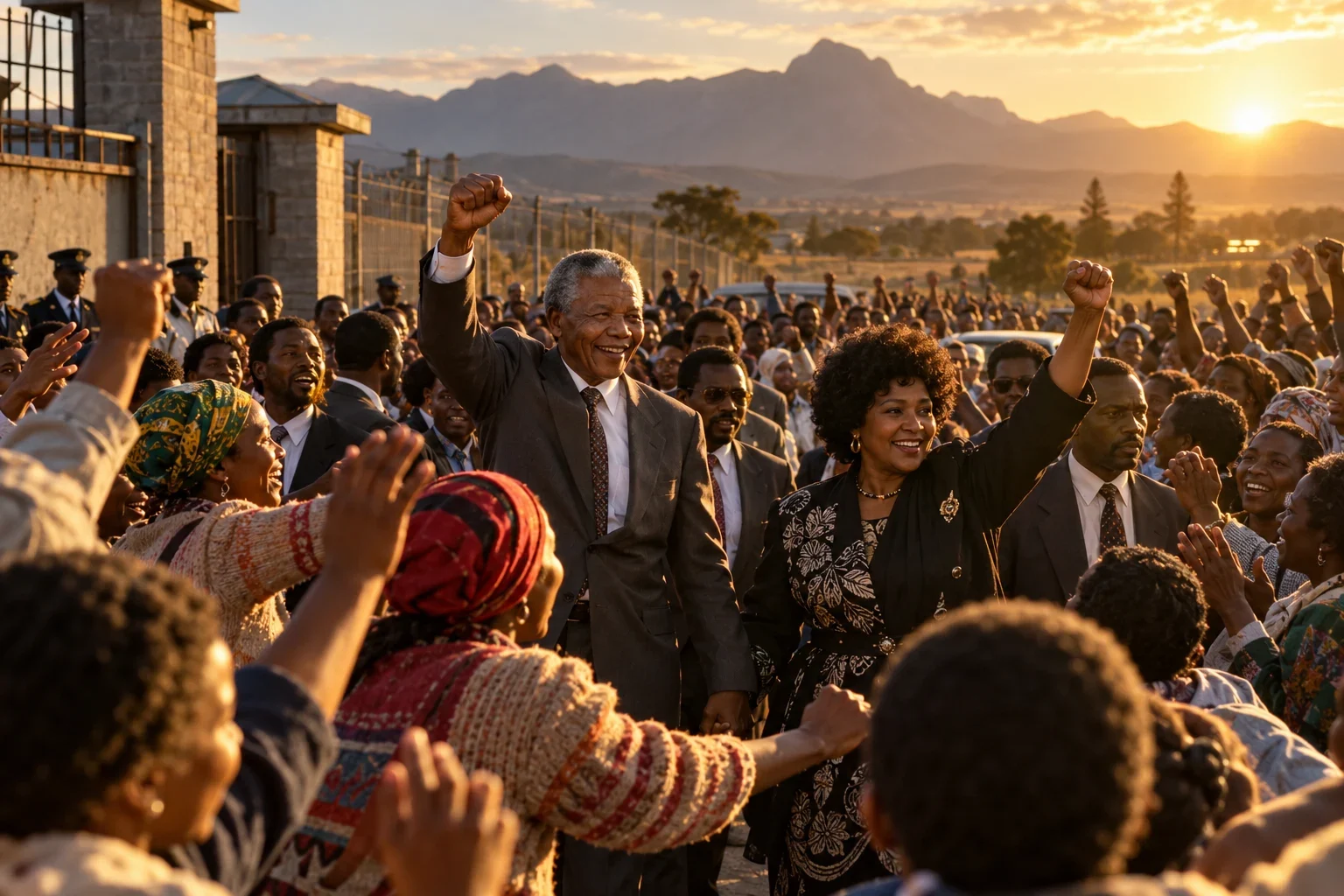
Nelson Mandela left Victor Verster Prison on February 11, 1990, after approximately twenty-seven years in custody. His unconditional release became a defining moment in South Africa’s transition, but apartheid had not ended: negotiations and the struggle for democratic government still lay ahead.
The years behind the gate
Mandela’s imprisonment began in 1962. Following the Rivonia Trial, he and other defendants received life sentences in 1964. His incarceration included Robben Island, Pollsmoor and, finally, a house within Victor Verster Prison near Paarl. He had rejected conditional release offers, making the terms of freedom politically significant. By February 1990, the government had lifted bans on the African National Congress and other organizations. His release nine days later formed part of a changing political landscape, while bringing an internationally prominent opponent of white minority rule back into public political life.
Freedom in front of the crowd
The release was both a personal departure from prison and an intensely public event. Mandela’s later recollections describe surprise at the crowds outside Victor Verster. He travelled to Cape Town, where a large gathering awaited his address at City Hall. Accounts preserved by the Nelson Mandela Foundation also describe the practical difficulties created by that crowd and the arrangements needed to reach the building. These details keep the day human: the familiar image of liberation belonged to a complicated afternoon of movement, expectation and immediate public responsibility.
An opening toward democracy
Release did not itself establish majority rule or resolve South Africa’s conflicts. Mandela entered official talks aimed at ending white minority government, and in 1991 became president of the ANC. Negotiations continued toward the democratic elections of April 1994, when he voted for the first time. His inauguration as president followed in May. February 11 is therefore best understood as an essential opening in a longer transition. Its significance combines individual freedom with the renewed possibility of political participation and a negotiated transformation of the state.
Bring Him Back Home (Nelson Mandela)
Hugh Masekela
Masekela’s 1987 anti-apartheid anthem explicitly called for Nelson Mandela’s release. It directly connects the music to the day’s event.
Listen on SoundCloud ↗Follow the evidence.
- Nelson Mandela Foundation: Release from prison, 33 years on ↗
- Nelson Mandela Foundation: Biography of Nelson Mandela ↗
- South African Government: Life and Times of Mandela ↗
AI-assisted writing, with institutional and primary sources. Illustration is a reconstruction, not an archival photograph. Published October 31, 2026; updated October 31, 2026. Our approach