Japan opens the Shinkansen: October 1, 1964
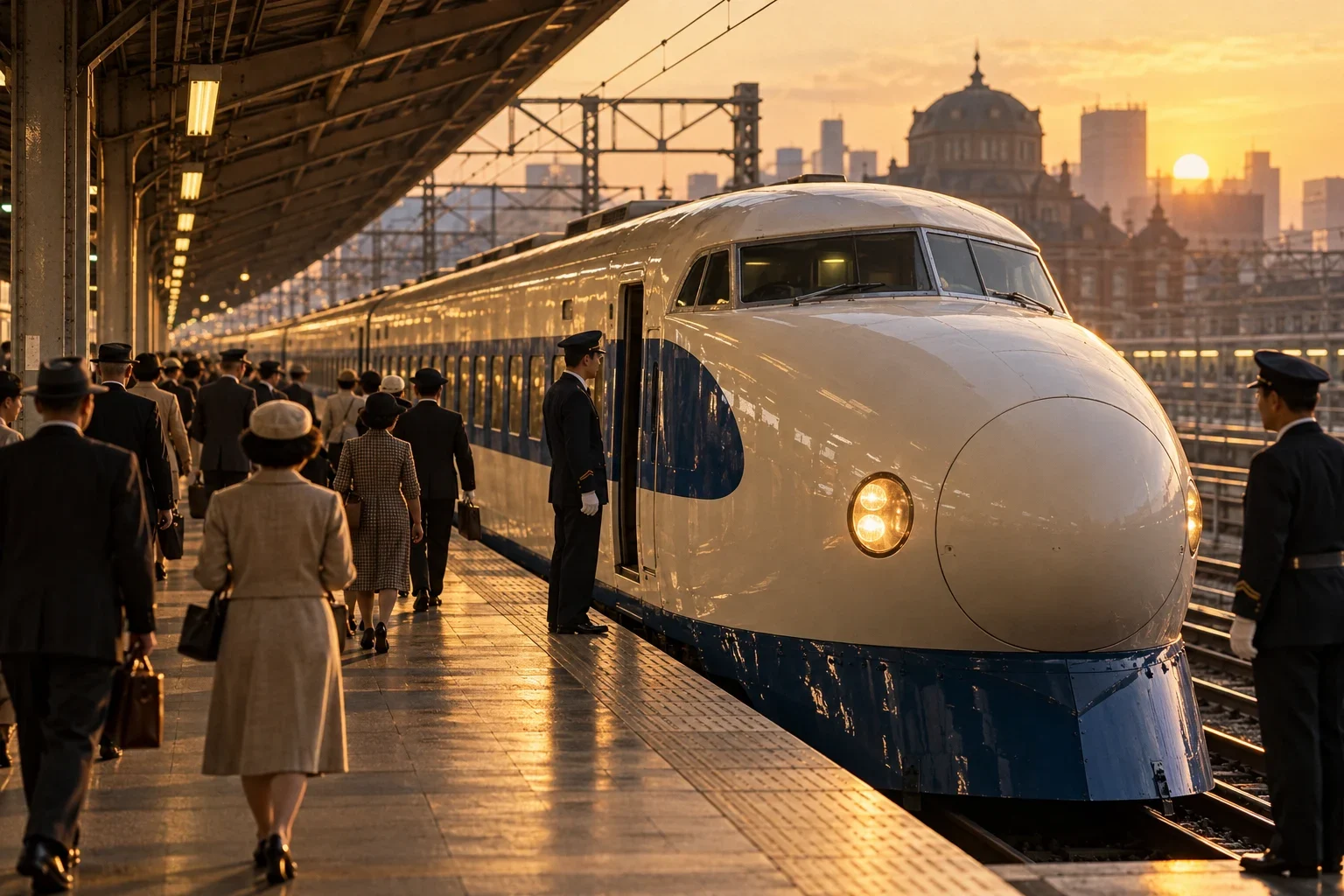
Japan’s Tōkaidō Shinkansen began operating between Tokyo and Shin-Osaka on October 1, 1964. Its original 0 Series trains introduced a purpose-built high-speed railway system. The fastest opening timetable covered the journey in four hours; the familiar three-hour-ten-minute service followed in 1965.
A new route through a growing country
The opening joined Tokyo and Shin-Osaka with a railway designed to add substantial transport capacity. It arrived in the year of the Tokyo Olympics, when major infrastructure projects were reshaping Japan’s transport network. Hikari and Kodama services offered different stopping patterns along the corridor. The new line therefore represented more than a faster train: it created another means of moving large numbers of passengers between major cities. Japan’s transport ministry places the project within a wider effort to prevent transport shortages from constraining economic development.
Engineering the railway as a system
The Shinkansen combined changes to trains, track and operating infrastructure. Japan’s conventional railways generally used a track gauge of 1,067 millimetres, while the new route adopted the wider international standard gauge of 1,435 millimetres. Engineers also developed new signalling arrangements and eliminated level crossings. Together, these decisions supported stable high-speed operation and greater capacity. The original trains were associated with a maximum speed of 210 kilometres per hour. Their significance lay in making high-speed passenger travel a regular railway service rather than merely demonstrating a record-breaking vehicle.
The opening timetable was a beginning
The first timetable was an early stage in continuing improvements. JR Central’s history records a fastest Tokyo–Shin-Osaka journey of four hours in 1964 and three hours ten minutes in 1965. Later generations of trains and revised services reduced travel times further. These distinctions help prevent later performance figures from being projected backwards onto opening day. The route’s wider importance also developed over time: progressively shorter journeys changed the practical possibilities for business trips and leisure travel, including journeys that could be completed without an overnight stay.
Sukiyaki — a cappella cover
Stanford Raagapella
A later a cappella performance based on 4 P.M.’s adaptation of Kyu Sakamoto’s early-1960s hit. The original melody evokes Japan’s popular culture around the Shinkansen’s opening; this recording is not from 1964 or about the railway.
Listen on SoundCloud ↗Follow the evidence.
- Japan Society of Mechanical Engineers: 0-Series Tōkaidō Shinkansen ↗
- JR Central: Shinkansen history ↗
- Ministry of Land, Infrastructure, Transport and Tourism: Opening of the Tokaido Shinkansen Line ↗
AI-assisted writing, with institutional and primary sources. Illustration is a reconstruction, not an archival photograph. Published October 31, 2026; updated October 31, 2026. Our approach