Apollo 11 lands on the Moon: July 20, 1969
Apollo 11’s Eagle landed on the Moon on July 20, 1969, carrying Neil Armstrong and Buzz Aldrin while Michael Collins remained in lunar orbit. The landing and the first moonwalk were separate milestones, occurring on different dates in universal time.
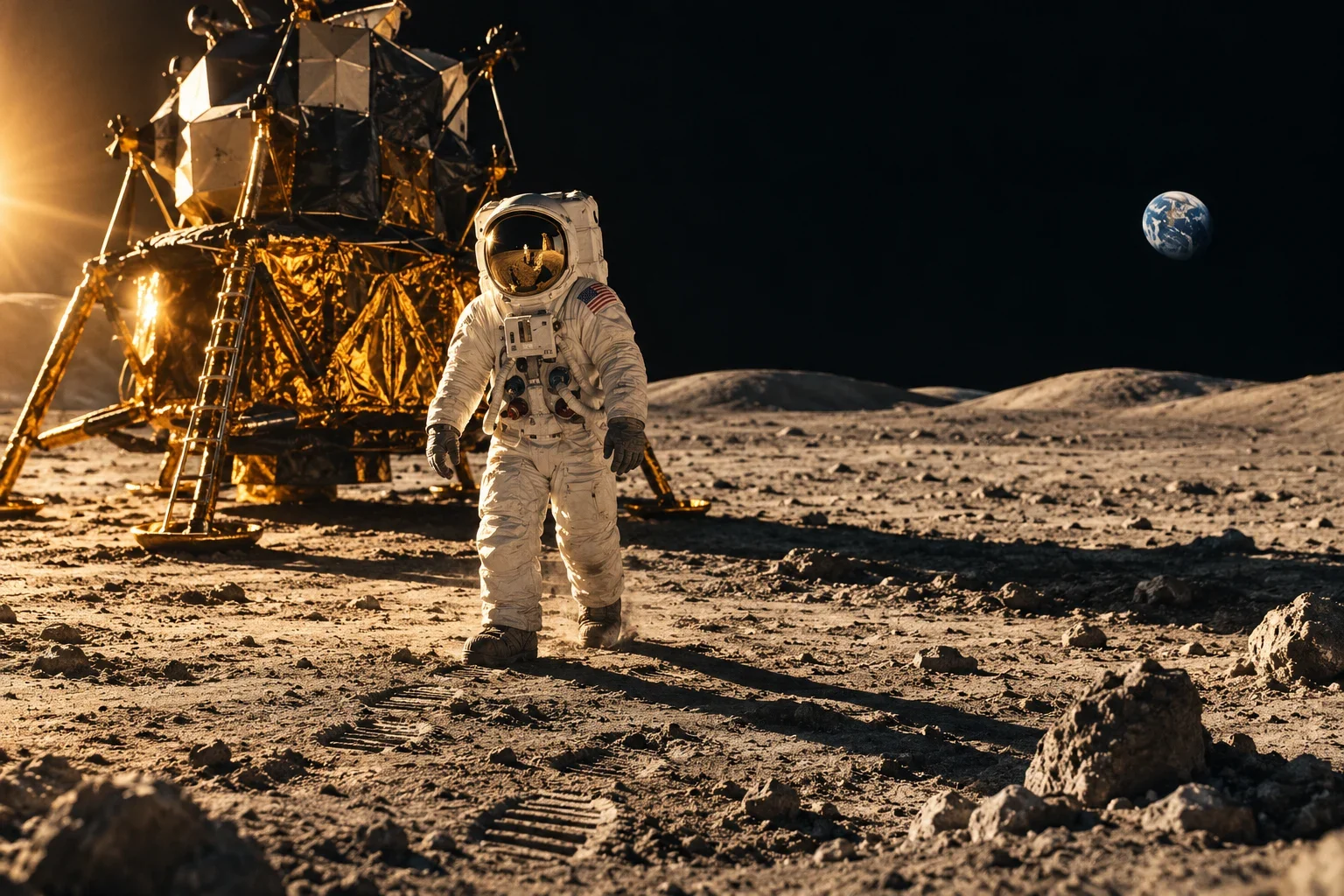
Two spacecraft, three essential roles
Apollo 11 launched on July 16 with the goal of landing people on the Moon and returning them safely. Near the Moon, Armstrong and Aldrin transferred to Eagle and separated from Columbia. Collins continued orbiting in the command and service module, which they would need for the journey home. Eagle descended to the Sea of Tranquility, with Armstrong adjusting its final approach to avoid a crater. The achievement therefore involved both reaching the surface and preserving a workable route back to the orbiting spacecraft.
One mission, two calendar dates
NASA’s mission timeline records touchdown at approximately 20:17 GMT on July 20. Armstrong’s first step followed at approximately 02:56 GMT on July 21, still the evening of July 20 in the eastern United States. These dates describe different moments rather than conflicting accounts. Between landing and stepping outside, the astronauts prepared for their excursion and opened the hatch. A television camera transmitted the scene as Armstrong descended. Aldrin subsequently joined him, turning a successful landing into the first human exploration of another world’s surface.
More than a footprint
The surface visit combined exploration, documentation and scientific work. Armstrong and Aldrin photographed their surroundings, collected lunar material and deployed instruments, including equipment for seismic observations and laser ranging. Their activity outside Eagle lasted roughly two and a half hours, within a total surface stay of about twenty-one and a half hours. The lunar module’s ascent stage then carried them back into orbit to rendezvous with Collins. The rocks, measurements and photographs made the expedition a scientific event as well as an extraordinary demonstration of engineering.
Space Oddity — live Bowie tribute
Wilco
A 2016 live cover of David Bowie’s space-flight song, originally released in July 1969, the month of Apollo 11. Its fictional Major Tom story is an era connection, not a description or recording of the mission.
Listen on SoundCloud ↗Follow the evidence.
- NASA: Apollo 11 Mission Overview ↗
- NASA: Apollo 11 Timeline ↗
- NASA: Apollo 11 Lunar Surface Journal, mission overview ↗
AI-assisted writing, with institutional and primary sources. Illustration is a reconstruction, not an archival photograph. Published October 31, 2026; updated October 31, 2026. Our approach