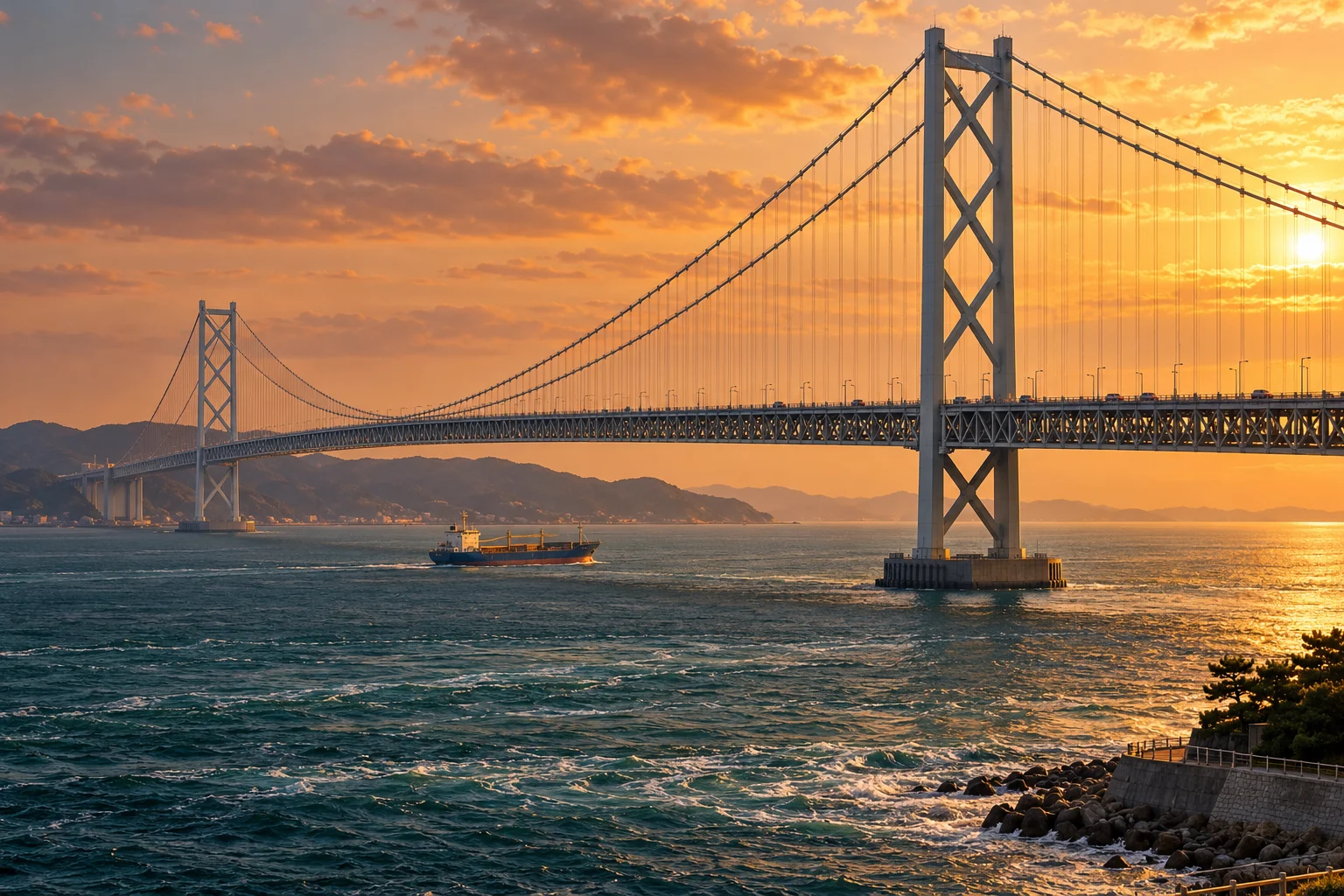
Seto-Ohashi road and rail crossing opens, 10 April 1988
The Seto-Ohashi crossing joined Honshu and Shikoku with road traffic above a railway. Its bridges and connecting structures turned an island-hopping engineering project into a continuous transport route.
An island route
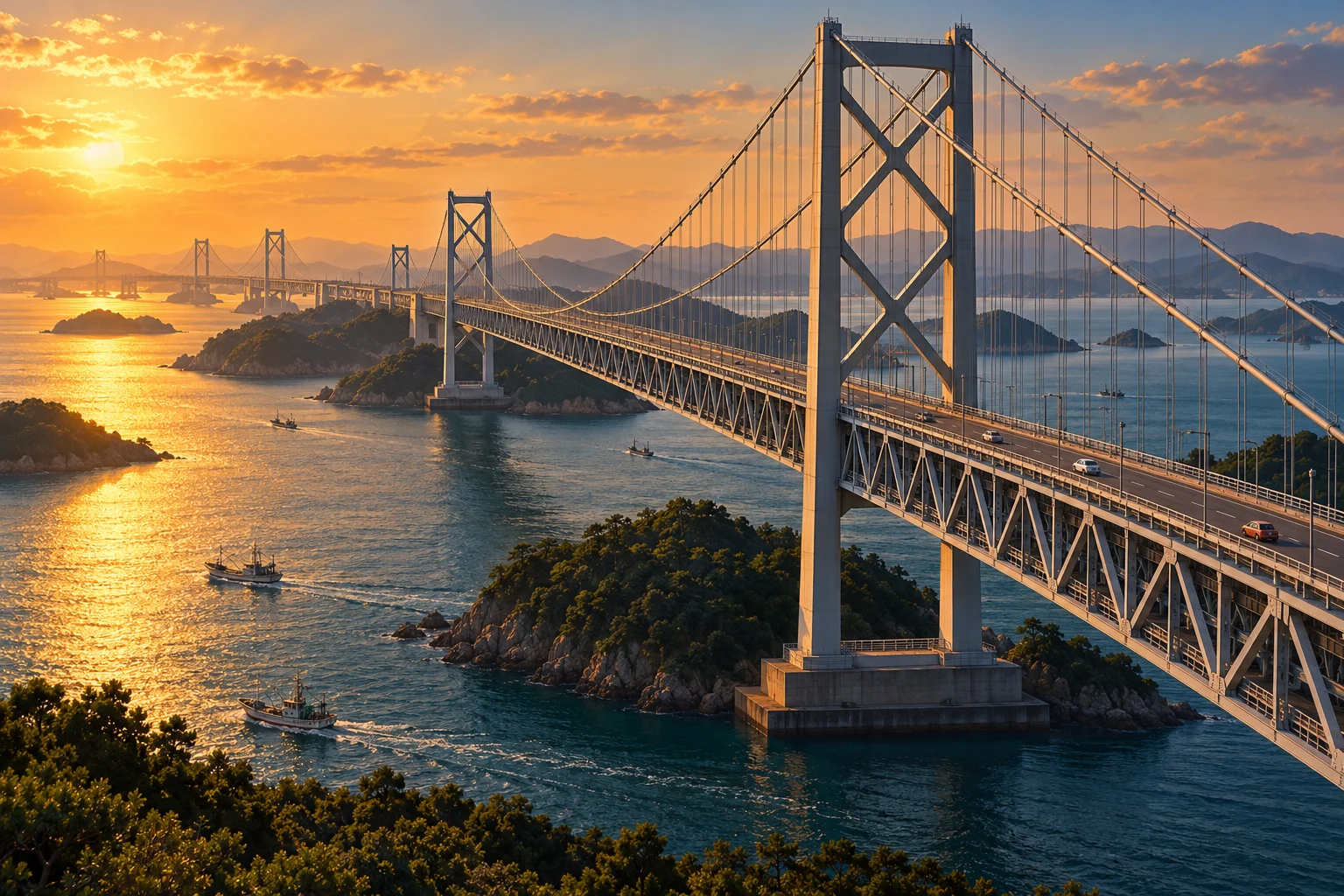
The Seto Inland Sea separates parts of Japan's main island, Honshu, from Shikoku. The Seto-Ohashi project used a chain of islands to carry a continuous route between Okayama and Kagawa prefectures. The crossing is often discussed as a single great bridge, but the sea section comprises six major bridges. Connecting viaducts and land approaches complete the wider system. Different published lengths describe these different portions, rather than necessarily contradicting one another. It brought both forms of transport together within one continuous corridor.
Opening a double-deck crossing
The route opened on 10 April 1988 after construction that had begun in 1978. Its most readily understood feature is the separation of transport onto two levels: an expressway occupies the upper deck and a railway the lower deck. The bridge operator's records give the exact opening date for individual structures, including Shimotsui-Seto Bridge. Kagawa's commemorative hall explains how the completed crossing fits into the road and railway networks on the Shikoku side.
Several kinds of bridge
The six principal sea bridges include three suspension bridges, two cable-stayed bridges and a truss bridge. These are different ways of supporting a deck across water, selected for the route's varied spans and geography. The project also required attention to wind, earthquake motion and the effects of trains moving over long structures. Kagawa's engineering displays describe repeated wind-tunnel tests and investigations into vibration, showing how much work lay behind the apparently simple two-level arrangement.
Infrastructure in a landscape
Engineering choices also reflected the crossing's scenic setting. At the Honshu end, the operator describes a tunnel anchorage and the Washuzan Tunnel as measures intended to limit damage to the surrounding landscape. The tunnel continues the stacked arrangement with separate upper road and lower rail bores. The opening therefore represented more than a dramatic span: it connected two transport systems across a complicated environment. The accompanying illustration evokes that landscape without claiming to depict the opening procession.
Koto Nation: "Sakura" (Traditional) arr. Will Roget, II
Will Roget II / Impact Soundworks
A later sampled-instrument arrangement of the Japanese spring melody Sakura provides a cultural and seasonal setting for the April opening. It is not music documented at the ceremony.
Listen on SoundCloud ↗Follow the evidence.
- HSBE: Shimotsui-Seto Bridge ↗
- HSBE: Seto-Chuo Expressway route overview ↗
- Kagawa Prefecture: Seto Ohashi Commemorative Hall ↗
- Japan Tourism Agency: Seto Ohashi Bridge ↗
AI-assisted writing, with institutional and primary sources. Illustration is a reconstruction, not an archival photograph. Published October 31, 2026; updated October 31, 2026. Our approach