Bruce McCandless makes the first untethered space flight, 7 February 1984
Bruce McCandless flew freely outside Challenger using a nitrogen-propelled backpack. The carefully tested manoeuvring unit let him leave the shuttle without a connecting tether while remaining in essentially the same orbit.
Beyond the shuttle
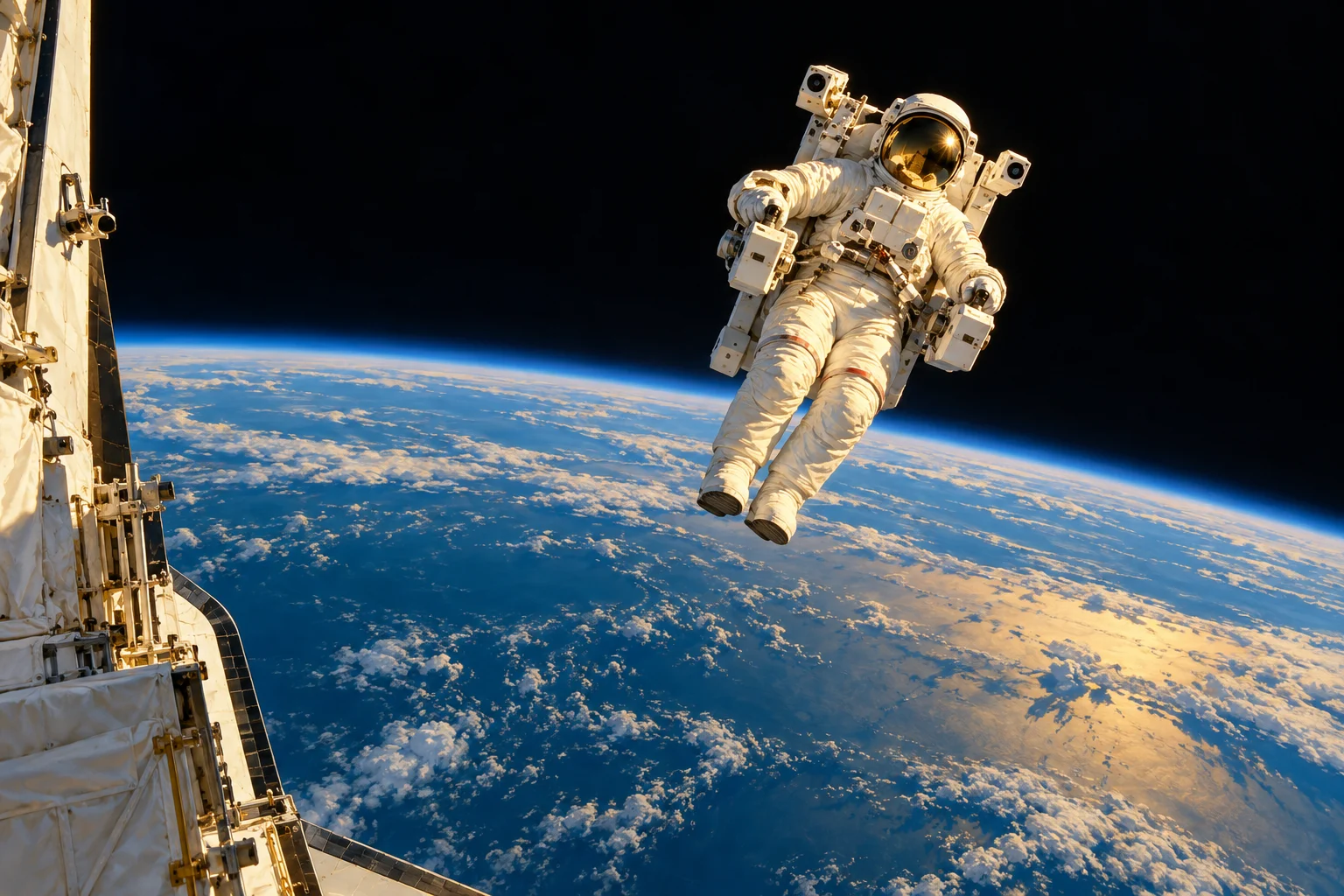
On 7 February 1984, Bruce McCandless tested the Manned Maneuvering Unit outside the Space Shuttle Challenger during mission STS-41B. He became the first person to fly untethered in space. The familiar image of a lone astronaut above Earth captures the unusual freedom of the experiment, but a large engineering and operational effort stood behind it. The shuttle remained nearby, and the test took place within a planned sequence of checks and manoeuvres.
Propulsion without flames
The backpack used compressed gaseous nitrogen released through small thrusters. Expelling gas produced a push in the opposite direction, allowing controlled translation and rotation without burning rocket fuel. Hand controls let the astronaut command the unit. NASA's engineering history describes duplicated propulsion arrangements and electrical power supplies, reflecting the need for reliability when the user had no physical tether. The spacesuit continued to provide life support; the manoeuvring unit supplied a separate capability for movement.
Two astronauts test the equipment
McCandless travelled roughly 100 metres from the orbiter. Fellow mission specialist Robert Stewart also flew the unit, becoming the second person to do so. In the US Army's later account, Stewart recalled the experience with confidence in the orbital mechanics: the astronauts and shuttle were already travelling around Earth together. Moving away slowly did not mean being left motionless while the spacecraft raced onward. Careful control of relative motion was the practical problem the equipment had to solve.
A dramatic engineering demonstration
The flights tested equipment intended to support work outside spacecraft, including satellite operations. The astronaut's apparent solitude should therefore be understood alongside the nearby crew, communications and recovery possibilities. NASA's image account records the distance and the nitrogen-powered pack, while the engineering history explains its development and redundancy. The illustration is a modern reconstruction of the achievement, rather than the famous mission photograph. Its empty space emphasizes the separation that made the test so visually arresting.
Stardust Drift / Sound Space Ambient
tavamusic
A modern instrumental space-ambient composition accompanies the orbital scene. It is a thematic choice, not a recording carried or transmitted during the mission.
Listen on SoundCloud ↗Follow the evidence.
- NASA history: The Manned Maneuvering Unit in Space ↗
- NASA: Bruce McCandless on the first untethered spacewalk ↗
- US Army: Robert Stewart and the first MMU flights ↗
AI-assisted writing, with institutional and primary sources. Illustration is a reconstruction, not an archival photograph. Published October 31, 2026; updated October 31, 2026. Our approach