Australia II wins the America’s Cup with its concealed winged keel
Australia II won the deciding America’s Cup race on 26 September 1983. Its much-discussed winged keel, kept hidden before the victory, became the emblem of a successful campaign that also depended on crew work, sails and tactics.
A challenger facing a long tradition
The America’s Cup took its name from the schooner America, winner of an English race in 1851. The New York Yacht Club subsequently defended the trophy through repeated challenges. Australia II arrived in 1983 representing the Royal Perth Yacht Club, with John Bertrand as skipper. After four completed races against the American defender Liberty, the Australians trailed three wins to one. They therefore had to win all three remaining races to take the series. National Museum of Australia
The part hidden under covers
Australia II’s most famous feature was beneath the waterline: a keel with winglets. The team concealed it when the yacht was lifted from the water, cultivating curiosity about its design. Ben Lexcen worked on the project with testing assistance in the Netherlands. The Australian National Maritime Museum preserves drawings showing the development of the profile. Its account also records his playful Star Wars references during testing, a glimpse of the imaginative engineering culture behind the carefully guarded shape. Maritime Museum
The deciding race on 26 September
Off Rhode Island on 26 September 1983, Australia II won the seventh race and the match, four wins to three. The National Museum records the finishing time as 5:21 p.m. local time and the margin as 41 seconds. The victory ended the New York Yacht Club’s 132-year possession of the trophy. Viewers in Australia watched in the early hours of the following day, so Australian celebrations often carry 27 September dates even though the race occurred on the twenty-sixth in Newport. Race chronology
An emblem rather than a complete explanation
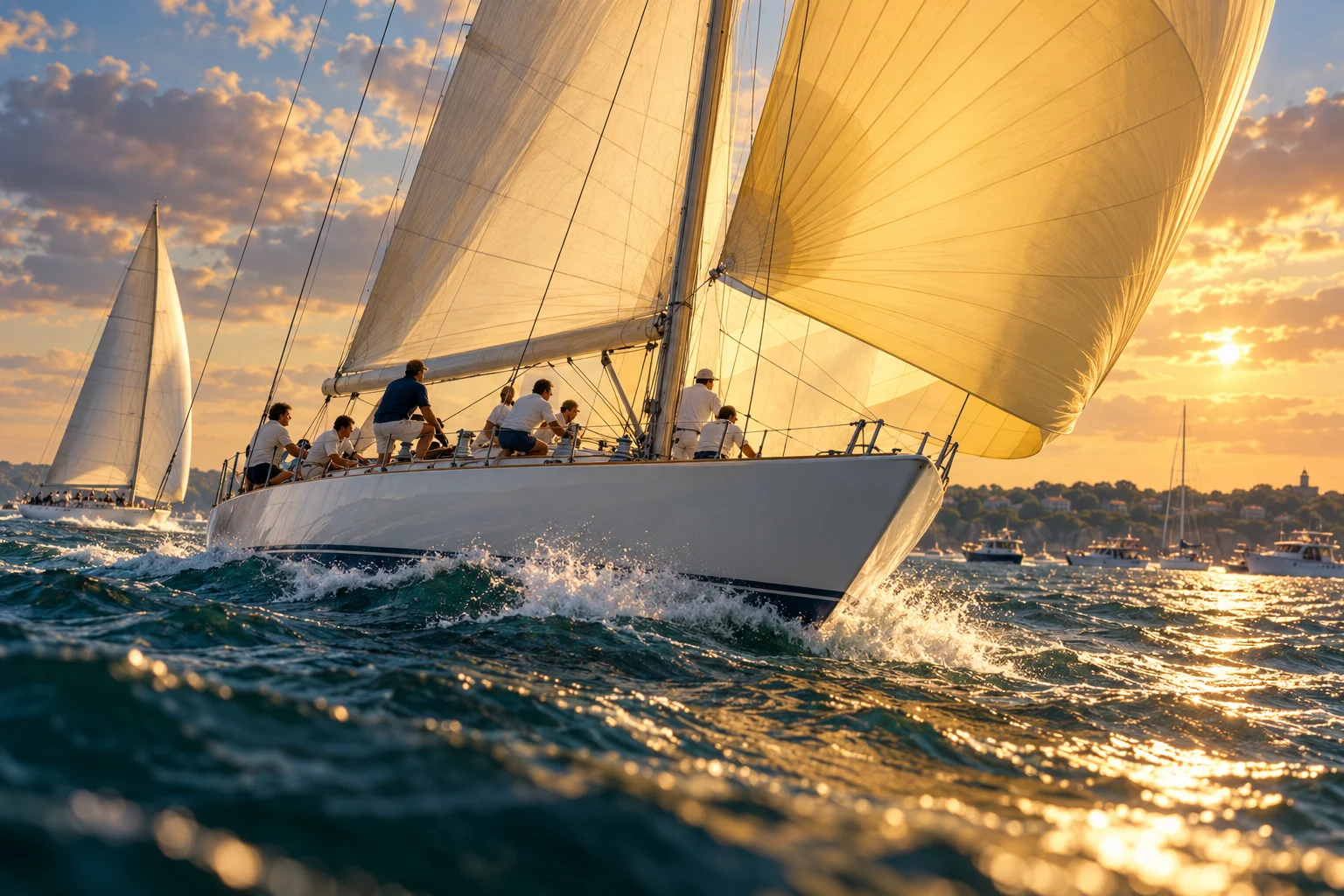
The keel’s secrecy made it a powerful symbol, but a winning yacht is a system rather than one ingenious part. Sailing accounts emphasize hull dimensions, sail development, measurement rules and the psychological effect of withholding information. The result should not be attributed to the keel alone, nor should collaborative design work become an uncomplicated lone-inventor legend. The illustration shows the yacht racing with its underwater shape concealed by the sea. It is an interpretive scene, not a technical drawing or an archival photograph of the finish. Sailing World
Quick March Waltzing Matilda
Royal Australian Navy Band
The Navy band’s later march arrangement of an Australian standard connects with the national celebration of Australia II’s win. It is not a recording from the race or the 1983 celebrations.
Listen on SoundCloud ↗Follow the evidence.
- National Museum of Australia: America’s Cup win ↗
- Australian National Maritime Museum: Show us the keel ↗
- Sailing World: In the Age of Secrecy ↗
- SoundCloud: Quick March Waltzing Matilda ↗
AI-assisted writing, with institutional and primary sources. Illustration is a reconstruction, not an archival photograph. Published October 31, 2026; updated October 31, 2026. Our approach