The first London Marathon and its shared men's victory, 29 March 1981
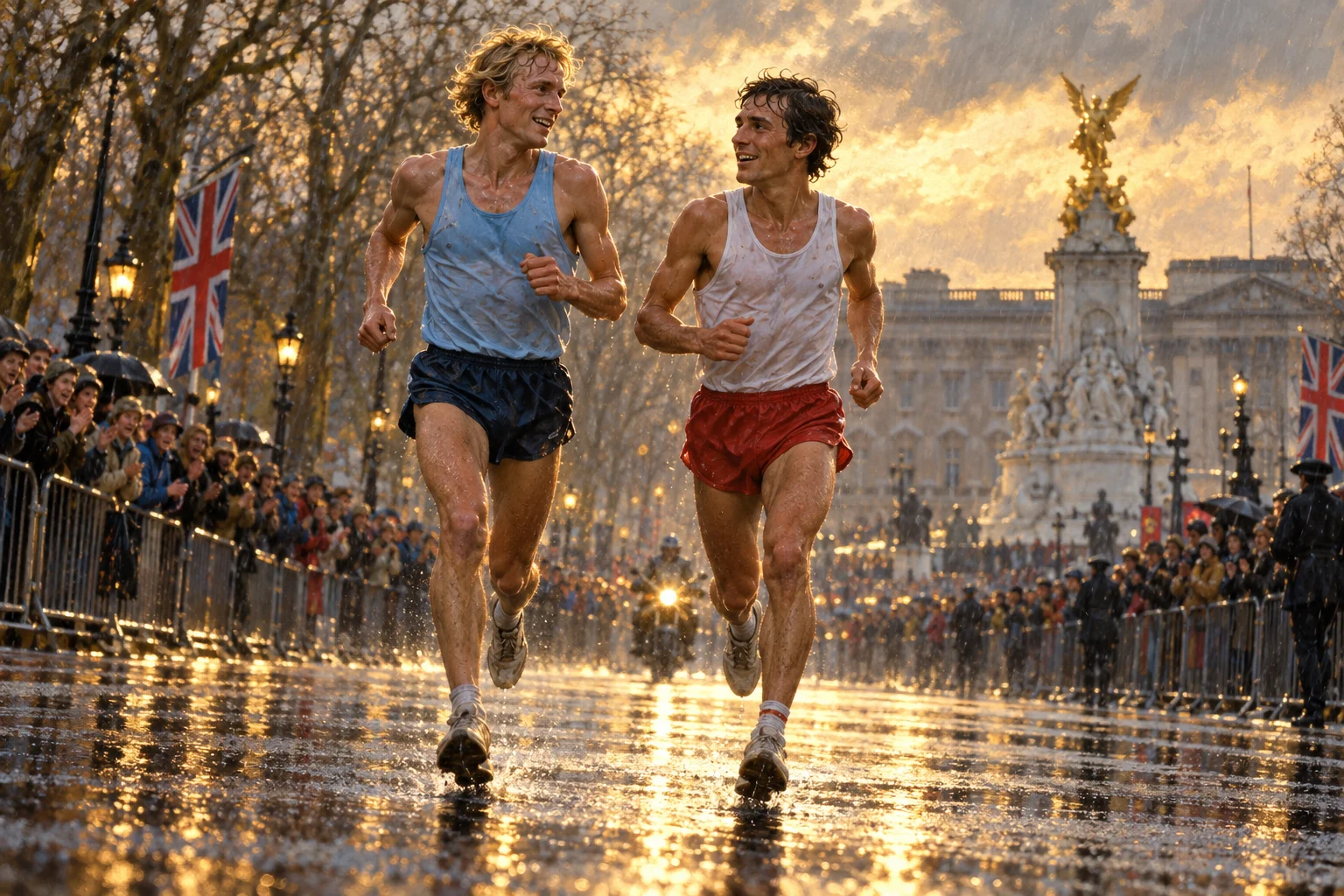
Dick Beardsley and Inge Simonsen crossed the inaugural London Marathon finish line holding hands. Their shared victory became an enduring image of a race conceived as both elite competition and a public festival.
A new race for London
The first London Marathon took place on 29 March 1981, starting at Blackheath and finishing on Constitution Hill. Chris Brasher and John Disley had helped turn an ambitious idea into a major public event. Brasher's experience of the New York City Marathon encouraged the vision of a race that brought a city and its visitors together. From its beginning, the London event combined serious athletic competition with an invitation to participate in a shared urban occasion.
Rivals choose a shared finish
American Dick Beardsley and Norway's Inge Simonsen emerged as the leading men. They had tried to break away from one another before deciding to share the moment. As the organizers' later account explains, Beardsley suggested the symbolic joint victory and Simonsen agreed. They crossed holding hands and were both recorded at 2 hours, 11 minutes and 48 seconds. The result was an actual shared win, rather than a photograph of two runners who received different finishing places.
The work beyond the leaders
The first race also depended on a large support operation. The Museum of the Order of St John documents the work of more than 600 St John Ambulance members, mobile first-aid units and medical staff. At the finish, volunteers distributed hot drinks and foil blankets. Recovery facilities helped exhausted runners after a wet day's effort. These practical arrangements made a mass-participation marathon possible and remind us that its history includes volunteers and ordinary entrants as well as its champions.
A lasting sporting image
The official medallists record preserves the shared men's time, while the race's institutional history emphasizes the generosity of the hand-in-hand finish. Together they establish both the sporting outcome and its later meaning. The moment did not erase the competition that preceded it; its appeal lies in the rivals' deliberate choice at the end. The illustration imagines the runners approaching the finish, rather than reproducing the famous photograph or claiming to show an exact instant.
Vangelis - Chariots of Fire [cover]
Piano in a Living Room
Olivier Lebra's later cover recalls the running film released in 1981, the inaugural marathon's year. It provides period and sporting context, without claiming the music accompanied the race.
Listen on SoundCloud ↗Follow the evidence.
- London Marathon Events: anniversary of the first race ↗
- London Marathon Events: elite medallists ↗
- Museum of the Order of St John: inaugural marathon medical support ↗
AI-assisted writing, with institutional and primary sources. Illustration is a reconstruction, not an archival photograph. Published October 31, 2026; updated October 31, 2026. Our approach