Zimbabwe gains internationally recognized independence, 18 April 1980
Zimbabwe's independence followed negotiations, a ceasefire and elections. The new republic's international recognition distinguished it from the earlier unilateral declaration made by Rhodesia's white-minority government.
Two meanings of independence
Southern Rhodesia had been under British sovereignty. In 1965, Ian Smith's white-minority government issued a unilateral declaration of independence, commonly called UDI. Britain rejected that action as illegal, and international sanctions followed. The existence of that declaration can make later references to Zimbabwe's independence confusing: the crucial issues were who exercised political power and whether other states recognized the constitutional settlement, rather than whether a declaration had previously been made. An internationally recognized state could exchange ambassadors and establish diplomatic relations in its own name.
A negotiated transition
Years of armed struggle and external pressure preceded negotiations at Lancaster House in London in 1979. The resulting settlement provided for a ceasefire, a transitional return to British administration and elections under a new constitution. Commonwealth participation included ceasefire monitoring and election observation. Robert Mugabe's ZANU (PF) won the February 1980 elections. This transition established the basis for majority rule and for the new country's acceptance internationally, rather than continuing the arrangements behind UDI.
The new republic
The Republic of Zimbabwe was proclaimed at Salisbury, now Harare, on 18 April 1980. Mugabe became prime minister. The United States recognized Zimbabwe that day and established an embassy, a diplomatic step documented by its Office of the Historian. The new national name and flag made the transition visible, while recognition and the transfer of governing authority gave it constitutional and international significance. A public celebration marked the beginning of a new state.
Celebration and historical perspective
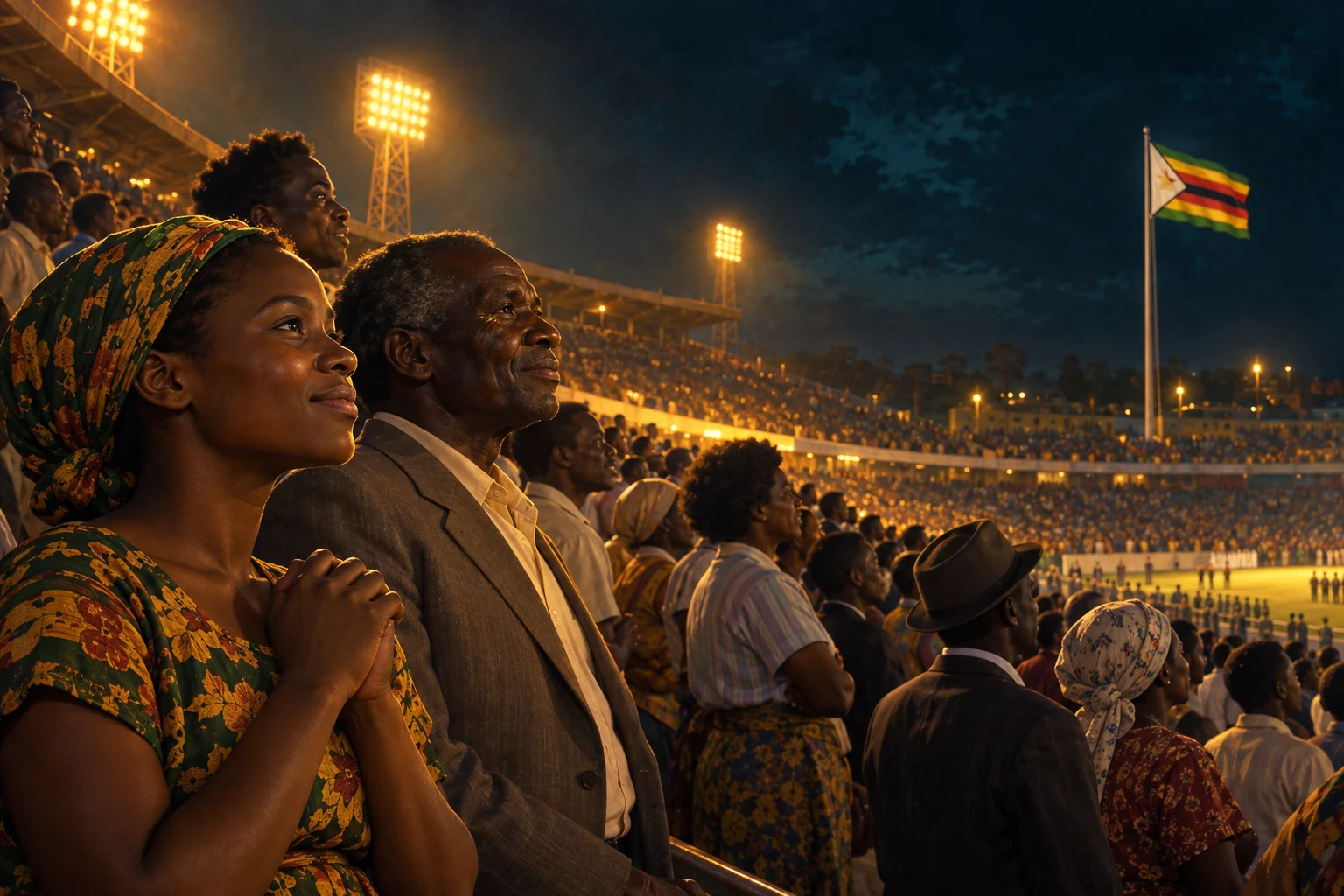
Music formed part of the independence celebrations, including a performance by Bob Marley and the Wailers. Marley's song Zimbabwe had expressed solidarity with the liberation struggle, giving his presence a particular resonance. Independence was a major political transformation, but it should not be treated as a guarantee about every development that followed. The illustration emphasizes ordinary people witnessing the occasion; it is an imagined historical scene, not a photograph of identified spectators.
Zimbabwe [Bob Marley]
Joanna Teters and Balam Garcia
A later artist-uploaded interpretation of Bob Marley's Zimbabwe. Marley and the Wailers performed at the independence celebrations; this cover is not their 1980 stadium recording.
Listen on SoundCloud ↗Follow the evidence.
- National Archives of Australia: Independence of Zimbabwe ↗
- US Office of the Historian: Zimbabwe recognition and diplomatic relations ↗
- Bob Marley: Life and legacy ↗
AI-assisted writing, with institutional and primary sources. Illustration is a reconstruction, not an archival photograph. Published October 31, 2026; updated October 31, 2026. Our approach