Launch of the Sony Walkman TPS-L2 in Japan
Sony’s first Walkman went on sale in Japan on 1 July 1979. Its lightweight headphones helped make music portable and private, but two headphone sockets and a conversation button also made the original model surprisingly sociable.
A new use for familiar technology
The Walkman combined technologies that already existed into an unfamiliar everyday habit. Sony cofounder Masaru Ibuka wanted stereo music while travelling, and engineers adapted the company’s compact Pressman recorder for playback. A separate team’s lightweight headphones supplied the other crucial component. Removing recording capability initially worried colleagues who doubted that customers would buy a machine with fewer functions. The proposal depended on making listening while moving sufficiently attractive to create its own market. Sony’s company history
The launch on 1 July 1979
The blue-and-silver TPS-L2 went on sale in Japan on 1 July 1979. Sony’s corporate account describes a slow first month, with approximately 3,000 units sold, followed by stronger demand after demonstrations helped explain the idea. Employees showed the player on trains and in busy Tokyo districts. The launch illustrates a distinction between having working technology and establishing a new social practice: customers needed to experience what portable stereo listening actually felt like. Sony’s launch account
Listening together
The original player provided two headphone sockets, allowing two people to hear the same cassette simultaneously. An orange hotline button used a built-in microphone to let listeners converse while keeping their headphones on. Sony associates these features with Akio Morita’s interest in shared enjoyment. The design complicates the familiar picture of headphones as a barrier between people: this first model explicitly allowed companionship within the listening experience. Later designs increasingly emphasised individual use and smaller size. Sony on the two sockets
A lasting design idea
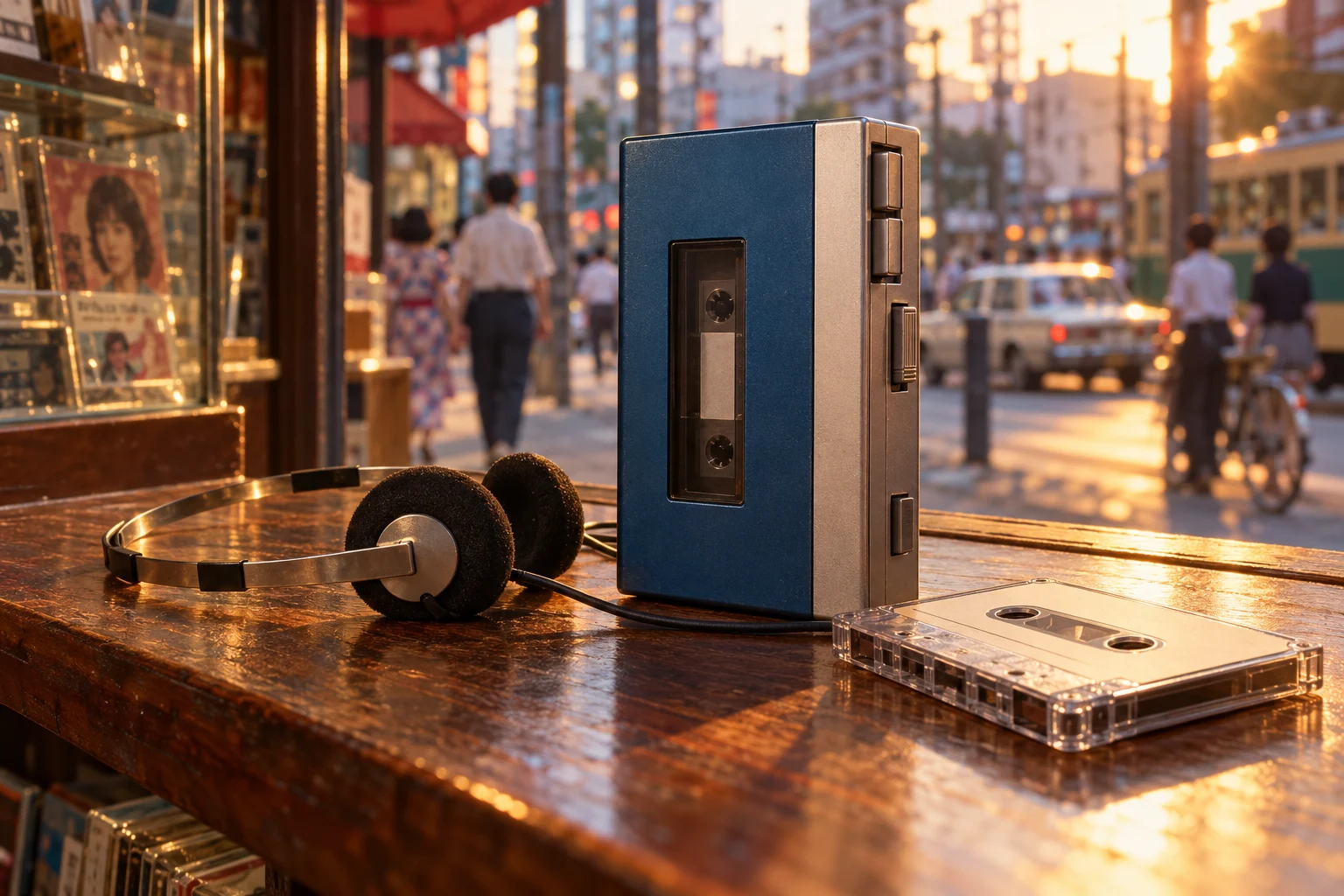
The Museum of Modern Art places the TPS-L2 within the history of personal listening devices that let people carry private acoustic space into public settings. Its importance lay in the combination of portability, light headphones and user choice over recorded music. The accompanying still life is a modern illustration of the equipment and its period setting, rather than a photograph of the launch. Its unlettered surfaces avoid presenting invented product markings as historical evidence. MoMA’s collection entry
Rydeen (studio cover)
TOM-BOYS
TOM-BOYS’ later studio cover of Yellow Magic Orchestra’s Rydeen evokes the Japanese electronic-pop world of the Walkman’s launch era. This is a later cover, not audio from Sony’s launch.
Listen on SoundCloud ↗Follow the evidence.
- Sony — A New Market Born from the Walkman ↗
- MoMA — Walkman TPS-L2 ↗
- Sony — Getting to Know Sony by the Numbers: 2 ↗
- TOM-BOYS — Rydeen studio cover ↗
AI-assisted writing, with institutional and primary sources. Illustration is a reconstruction, not an archival photograph. Published October 31, 2026; updated October 31, 2026. Our approach