Louise Brown’s birth and the first successful IVF treatment
Louise Brown was born on 25 July 1978 after conception through in vitro fertilisation. Her birth demonstrated that a human embryo formed outside the body could lead to a successful pregnancy.
A birth in Oldham
Louise Brown was born at Oldham and District Hospital in Greater Manchester at 11:47 p.m. on 25 July 1978. She was delivered by caesarean section and weighed 5 pounds 12 ounces. Her parents, Lesley and John Brown, had experienced years of infertility. The circumstances of her conception made the birth a landmark in reproductive medicine. The baby herself needed the same care as other newborns; the scientific novelty lay in how the pregnancy had begun. Science Museum: IVF icon goes on display.
What in vitro meant
In vitro means “in glass.” The treatment involved collecting an egg, fertilising it with sperm in a culture dish, and maintaining the early embryo under suitable laboratory conditions. After several days, the embryo was transferred into the uterus. Pregnancy then continued inside the mother’s body. The popular expression “test-tube baby” obscured these distinctions. Neither conception in an actual test tube nor the growth of a baby entirely outside the body describes what the treatment achieved.
The people and equipment
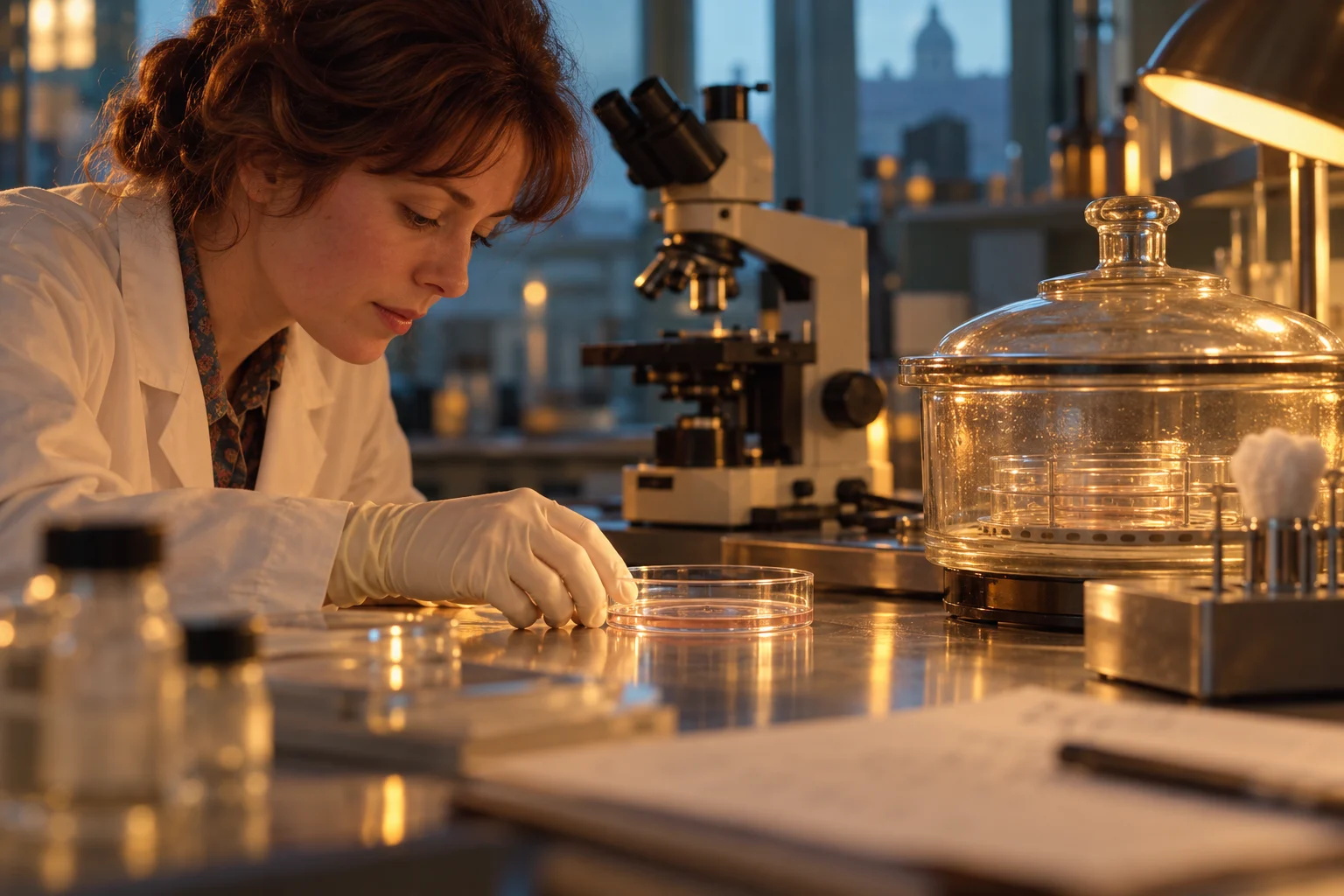
Physiologist Robert Edwards, gynaecologist Patrick Steptoe and nurse and embryologist Jean Purdy developed the work together. Steptoe’s skill in keyhole surgery helped make egg collection possible, while Purdy monitored developing eggs and their cell divisions. Equipment could be surprisingly ordinary. A glass desiccator jar was adapted as an incubator to maintain a suitable environment for culture dishes. The Science Museum preserves this object, linking a major medical development to the practical demands of experimental laboratory work. Science Museum: Happy Birthday Louise Brown.
A continuing medical and social change
The birth followed years of research and unsuccessful attempts. It demonstrated a possibility rather than an immediate guarantee of success for every patient. IVF subsequently became an established route to parenthood and generated continuing ethical debate. Edwards received the Nobel Prize in Physiology or Medicine in 2010 for developing the technique. Understanding the achievement also requires remembering collaborators and patients. The illustration interprets the laboratory process and its equipment; it is not a photograph of Louise’s conception or birth. Bangor University: Robert Edwards wins Nobel Prize.
Isn’t She Lovely — piano cover
Gonzalo Molina
Molina’s later piano cover of Stevie Wonder’s 1976 song provides a thematic connection to celebrating a daughter’s birth and the period’s music. It is not about Louise Brown or a recording from her birth.
Listen on SoundCloud ↗Follow the evidence.
- Science Museum: IVF icon goes on display ↗
- Science Museum: Happy Birthday Louise Brown ↗
- Bangor University: Robert Edwards wins Nobel Prize ↗
AI-assisted writing, with institutional and primary sources. Illustration is a reconstruction, not an archival photograph. Published October 31, 2026; updated October 31, 2026. Our approach