Voyager 1 launches toward Jupiter and Saturn
Voyager 1 launched on 5 September 1977, beginning a mission that used planetary gravity to visit the giant planets and carried a cultural message from Earth.
A rare opportunity
Voyager’s mission designers recognized that the outer planets’ arrangement in the late 1970s offered an unusually efficient route for exploration. Passing close to one planet could alter a spacecraft’s trajectory toward another. NASA approved a reduced version of an ambitious Grand Tour concept, initially concentrating on Jupiter and Saturn. The project combined astronomical timing with engineering decisions about cost, instruments and the spacecraft’s expected working life. NASA mission history
The launch of 5 September
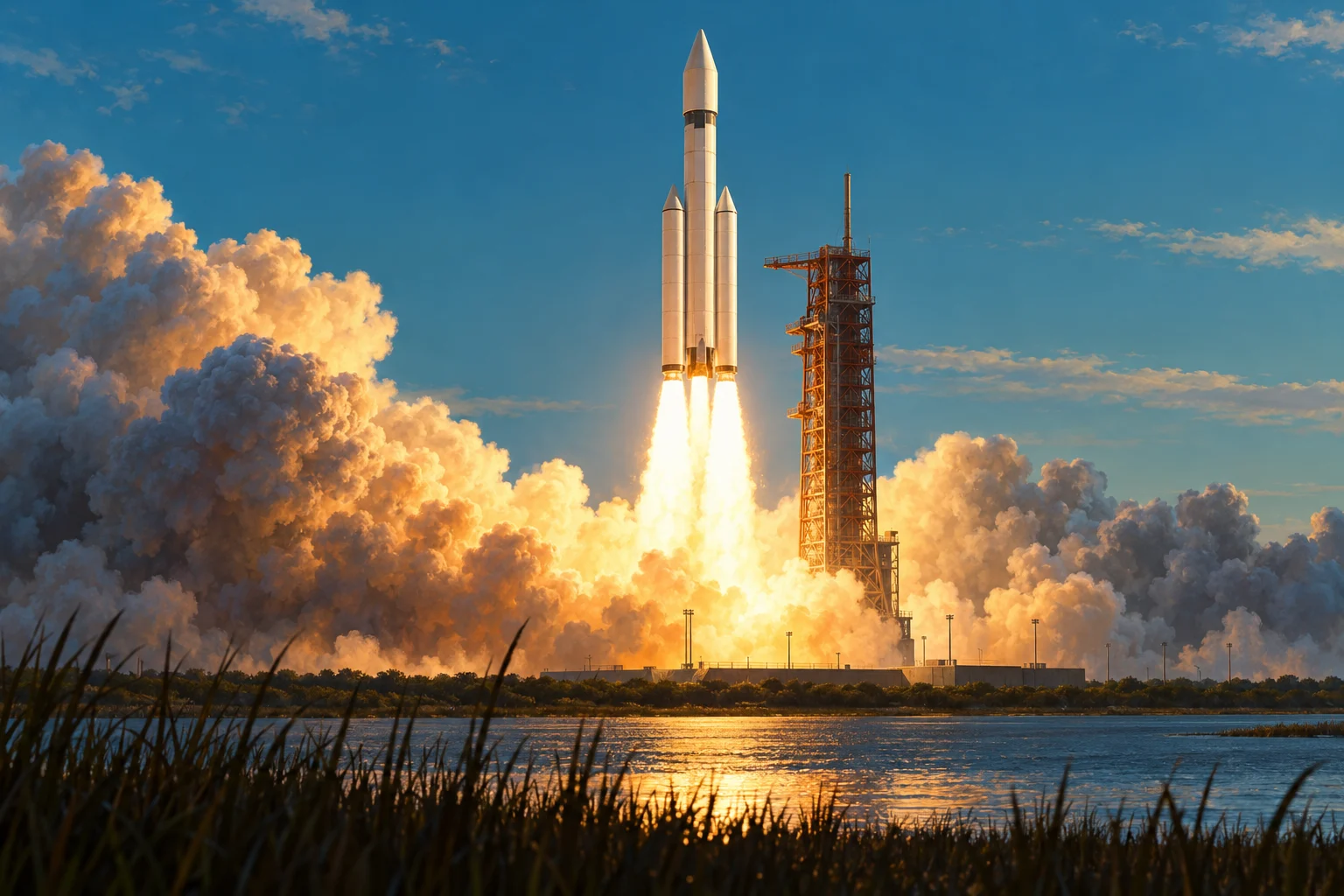
Voyager 1 lifted off from Cape Canaveral, Florida, on 5 September 1977 aboard a Titan IIIE-Centaur rocket. Despite its number, it launched after Voyager 2, which had departed sixteen days earlier. The spacecraft were designed as complementary explorers. Voyager 1’s route would carry it to Jupiter and then Saturn, including a close examination of Saturn’s large moon Titan. The launch began the journey; those encounters occurred later.
Borrowing a turn from a planet
During a gravity assist, a spacecraft’s path bends as it passes a planet. Relative to the Sun, the interaction can also change its speed by exchanging a tiny amount of momentum with the moving planet. Voyager 1 used Jupiter to shape its onward journey to Saturn, avoiding the need to supply the entire change with onboard propulsion. This does not mean the spacecraft needed no launch rocket or course corrections. Careful encounter geometry was essential: the useful onward route depended on where and how the spacecraft passed the planet. JPL mission overview
Science and a cultural time capsule
The mission carried instruments for imaging and measuring planetary environments, alongside a gold-plated record of sounds, images and greetings from Earth. That record included music from many cultures, among it Bach’s Gavotte en rondeaux performed by Arthur Grumiaux. Its purpose differed from the scientific instruments: it represented a message for possible finders rather than a means of navigation. The illustration depicts a period launch scene and is not an archival photograph. The accompanying guitar performance is a later version of music represented on the record. NASA record contents
Bach: Gavotte en rondeau, BWV 1006a — guitar transcription
David Orvek
Orvek’s 2016 recital uses Frank Koonce’s guitar transcription. The same Bach movement appears on Voyager’s Golden Record in Arthur Grumiaux’s violin performance; this is a different, later recording.
Listen on SoundCloud ↗Follow the evidence.
- NASA: Voyager 1 begins its journey ↗
- NASA JPL: Voyager 1 mission overview ↗
- NASA: Golden Record sounds and music ↗
AI-assisted writing, with institutional and primary sources. Illustration is a reconstruction, not an archival photograph. Published October 31, 2026; updated October 31, 2026. Our approach