Viking 1’s first photograph from the surface of Mars
On July 20, 1976, Viking 1 landed on Mars and sent back a close view of rocks, soil and one of its own footpads. The apparently modest scene established a new ground-level view of the planet and provided practical scientific evidence.
A landing followed by a picture
Viking 1 successfully landed on Mars on July 20, 1976. At NASA’s Jet Propulsion Laboratory, controllers learned that the spacecraft had survived its descent, then watched its first image arrive. The picture formed progressively, revealing rocks and granular ground before part of the lander’s footpad appeared at the right. It was a close view of the immediate landing area rather than a broad scenic panorama. NASA’s account of the first view.
Why the spacecraft’s own foot mattered
Looking down at a footpad helped show the nature of the surface supporting the lander. The photograph recorded the relationship between hardware and ground, as well as nearby rocks and particles disturbed during descent. NASA’s description notes dust and fine material deposited on the footpad at landing. Such details turned a seemingly unglamorous engineering view into evidence about the physical environment. NASA’s image description. The spacecraft itself became a measuring tool in contact with an unfamiliar surface.
A laboratory and an observing system
The first photograph was only the beginning. The Viking programme combined landers with orbiters, linking observations from the ground with information gathered above the planet. Cameras examined the surroundings while instruments investigated atmosphere and soil. The landers’ biological experiments produced puzzling chemical responses, but did not provide conclusive evidence of living organisms. A successful touchdown and a convincing photograph therefore should not be confused with a discovery of life. NASA’s mission overview.
Reading a historic image carefully
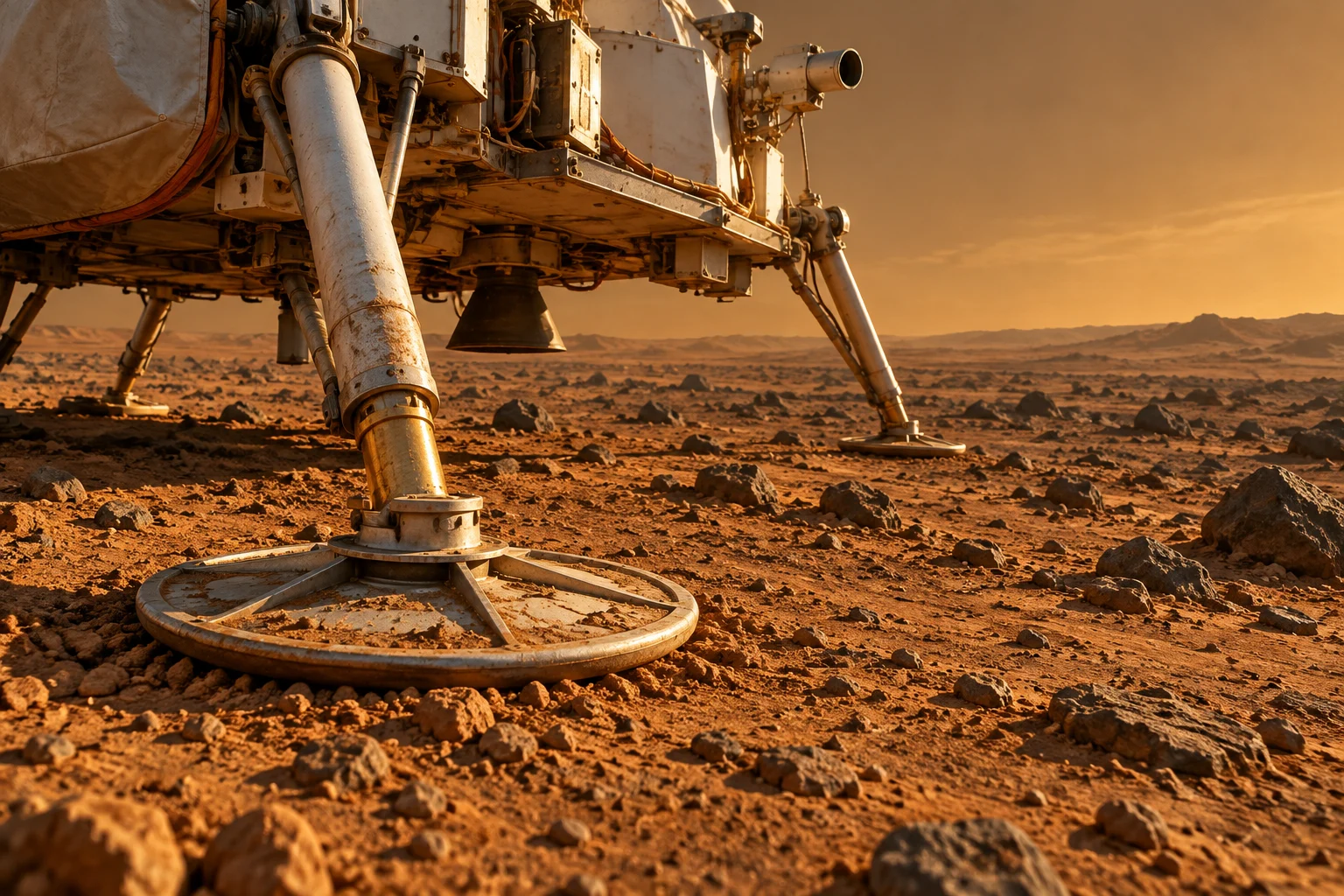
Viking 1 was programmed to begin imaging soon after touchdown, giving Earth an early assessment of its new surroundings. The original first image was monochrome; later views added different coverage and colour. Its importance lies in what it could establish directly: the lander had arrived, and its immediate environment could be inspected at close range. NASA’s fiftieth-anniversary history. The accompanying warm-coloured illustration is an imagined exterior view of the lander and terrain, not the actual camera frame or a claim about its original colours.
Life on Mars - David Bowie Cover
Jean-Michel GEORGE
Jean-Michel GEORGE’s later cover of David Bowie’s Life on Mars supplies a thematic connection to the planet. It is not mission audio or a claim that Viking found life.
Listen on SoundCloud ↗Follow the evidence.
- NASA: Our First View of the Surface of Mars ↗
- NASA: First Photograph Taken On Mars Surface ↗
- NASA: Viking Project ↗
- NASA: Viking — 50 Years on Mars ↗
AI-assisted writing, with institutional and primary sources. Illustration is a reconstruction, not an archival photograph. Published October 31, 2026; updated October 31, 2026. Our approach