Nadia Comăneci’s first Olympic perfect 10 and the 1.00 display
Nadia Comăneci earned the first perfect 10 in Olympic gymnastics on 18 July 1976 in Montreal. The scoreboard displayed 1.00 because it could not accommodate 10.00, turning a technical limitation into an enduring sporting image.
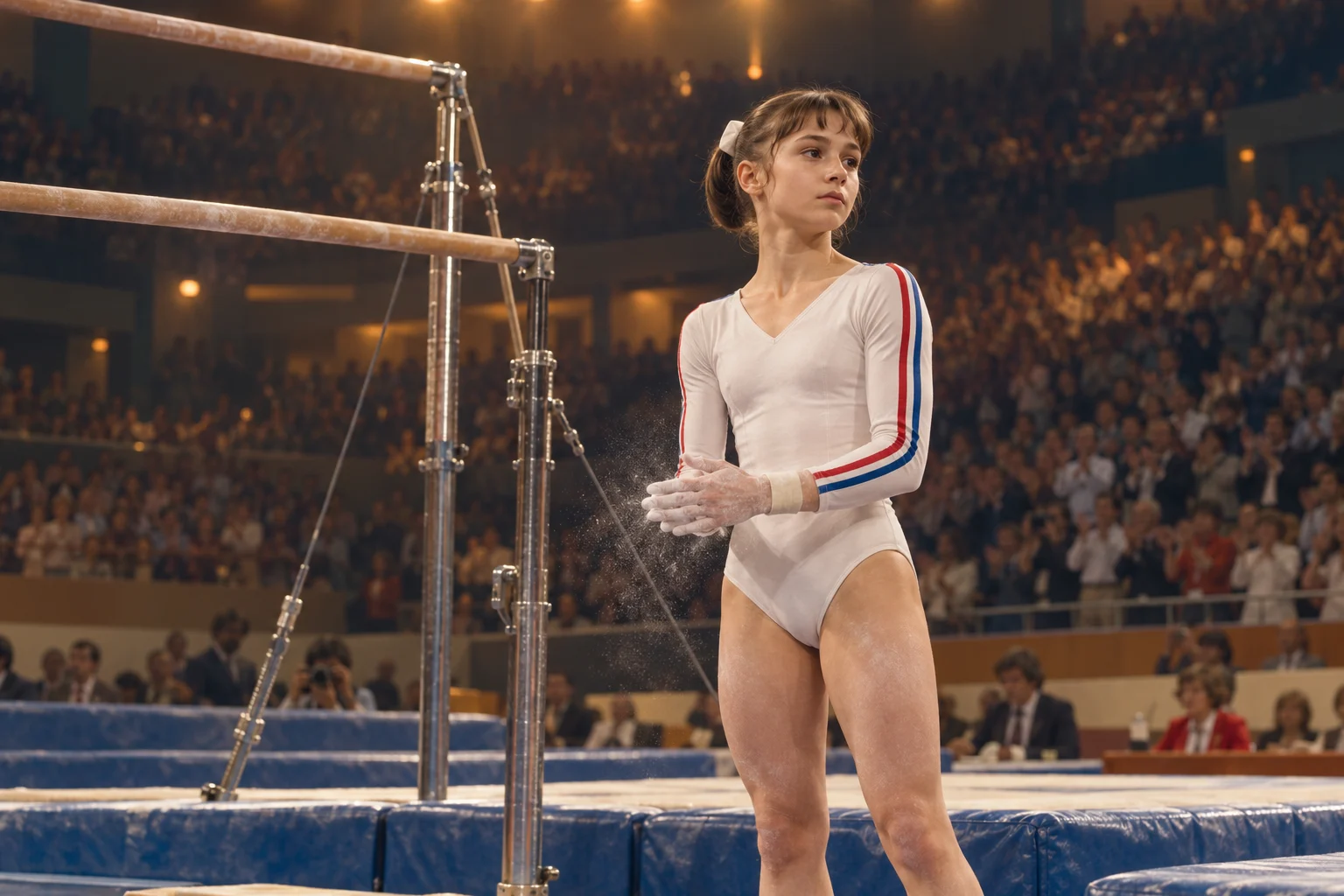
An extraordinary Olympic debut
Fourteen-year-old Nadia Comăneci arrived at the Montreal Games representing Romania. On 18 July 1976, her uneven-bars performance received the first perfect 10 awarded in Olympic gymnastics. This was an Olympic milestone, a distinction that should be retained when describing the achievement. In a later interview, she remembered the young gymnast who had already trained for eight years and came to the Games with confidence in the work she and her team had done. Comăneci’s recollections
The number the display could show
The electronic scoreboard was not configured to display 10.00. Instead, the historic score appeared as 1.00, beside the gymnast’s competition number. The apparently disappointing figure consequently represented the highest possible mark. The Romanian National Archives’ later exhibition, presented at the Țării Crișurilor Museum, used this contradiction as a central visual theme: the system recording a performance had less capacity than the performance required. The displayed number became almost as recognizable as the athletic achievement itself. Museum exhibition account
More than a single routine
Comăneci went on to receive seven perfect 10s during those Games. The International Olympic Committee’s account credits her with raising the standard of the sport. Artistic gymnastics combines performances on different apparatus, with team and individual competitions; a single memorable routine forms only part of that larger programme. Her achievement nevertheless offered television audiences a particularly clear moment to remember. The numerical ceiling, the athlete’s youth and the confusing display made a complex judged sport suddenly legible to people who rarely watched it. IOC overview
Remembering an athlete, not just a number
The famous display should not reduce Comăneci’s career to a fortunate malfunction. Her own recollections emphasize preparation, confidence and the collective effort of a team. Nor did the displayed 1.00 alter what the judges had awarded: it was a limitation of presentation. Later photographs, interviews and archival exhibitions preserve different kinds of evidence about the moment. The illustration accompanying this article is an interpretation of the arena setting, with the scoreboard outside the frame, rather than a reproduction of an archival photograph. Interview; archival exhibition
Nadia's Theme - THE GIMNAST & THE DICTATOR
Selma Mutal
Selma Mutal’s later documentary theme provides a musical portrait of Comăneci. It is not music played during the uneven-bars routine, and it is distinct from the better-known tune also called Nadia’s Theme.
Listen on SoundCloud ↗Follow the evidence.
- AGERPRES: Interview with Nadia Comăneci on her first perfect 10 ↗
- Țării Crișurilor Museum: Nadia Comăneci exhibition ↗
- International Olympic Committee: World Gymnastics ↗
- SoundCloud: Nadia's Theme - THE GIMNAST & THE DICTATOR ↗
AI-assisted writing, with institutional and primary sources. Illustration is a reconstruction, not an archival photograph. Published October 31, 2026; updated October 31, 2026. Our approach