Whina Cooper and the Māori Land March reach Parliament
On 13 October 1975, the Māori Land March reached New Zealand's Parliament in Wellington. Led by Whina Cooper, it brought a petition against continuing land loss and made a collective claim visible across the country.
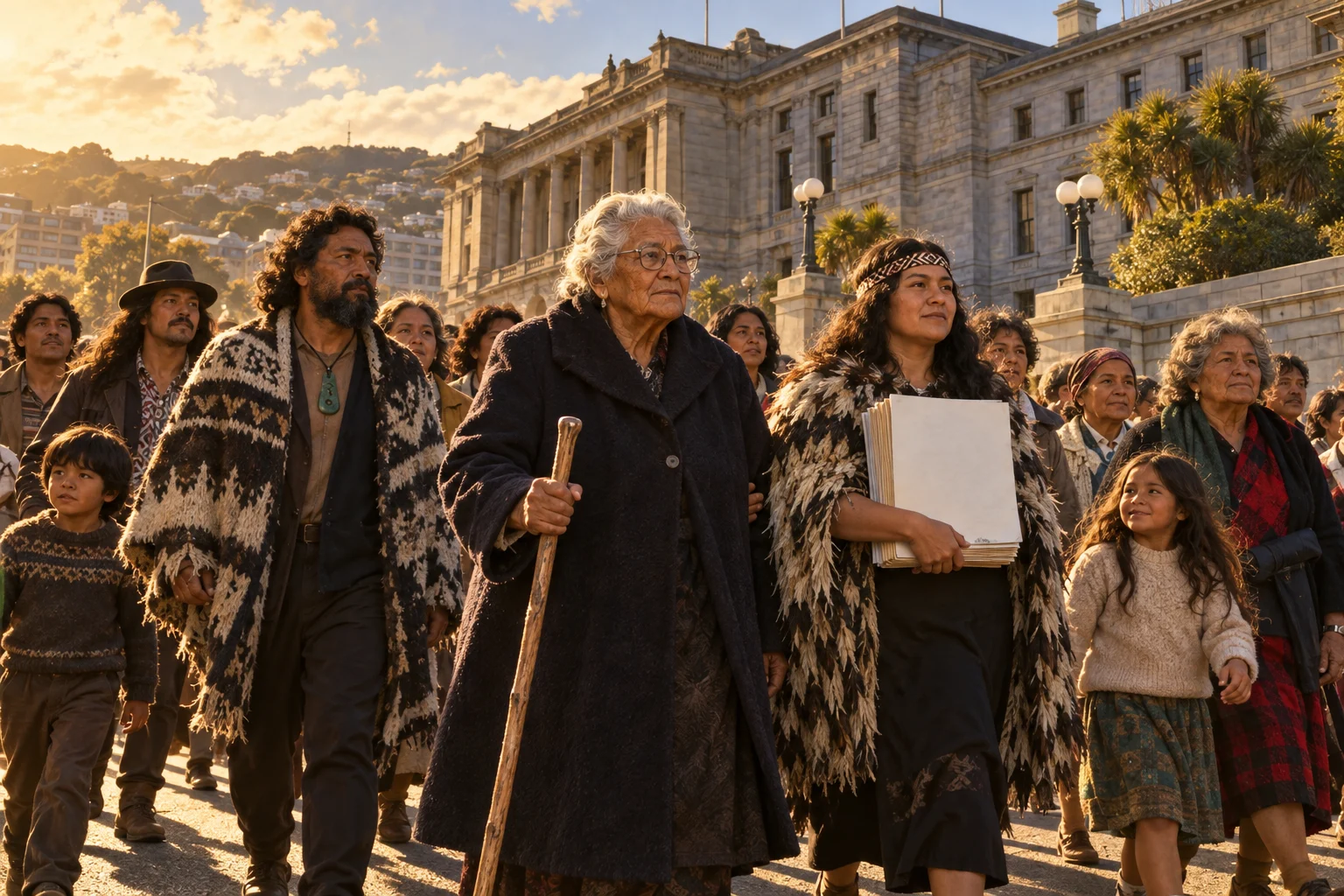
Organizing around remaining land
Te Rōpū Matakite o Aotearoa emerged in 1975 amid concern about continuing alienation of Māori land. The campaign sought to protect what remained in Māori ownership and control. Whina Cooper, a Te Rarawa community leader with decades of public experience, became its most recognizable figure. NZ History places the movement's formation at a meeting at Māngere Marae. The campaign's purpose was collective, reaching beyond one leader's biography or a single disputed property.
Walking to the capital
Fifty marchers left Te Hāpua in the far north on 14 September. The journey to Wellington covered roughly 1,000 kilometres. Cooper was 79, and the march drew support from communities along the route. Overnight stops at marae provided accommodation and opportunities to discuss the campaign. Participation expanded as people joined for different stages. The walk connected geographically separated communities while allowing the wider public to see that concerns about land remained immediate and unresolved.
The petition on 13 October
About 5,000 marchers arrived at Parliament on 13 October 1975. Cooper presented Prime Minister Bill Rowling with a petition containing 60,000 signatures, alongside a memorial of rights from Māori elders. The Dictionary of New Zealand Biography describes the arrival as the march's climax. The different figures measure different things: those present in Wellington and the much larger body of signatories. Delivering the documents translated a public procession into a formal appeal to government.
An influential but unfinished campaign
The march did not immediately resolve land grievances. Some participants remained on Parliament's grounds in a tent embassy against Cooper's wishes, and later divisions complicated the coalition's work. The wider context included the Treaty of Waitangi Act, which had received royal assent three days before the arrival. Parliament's account explains the new tribunal's role in examining treaty grievances. The march's visibility and solidarity remained influential. Its illustration interprets the collective arrival; it is not an archival photograph. This created another institutional route through which grievances could be heard.
Te Aroha (NZ Māori ballad) — Rarotonga youth
Rarotonga youth, shared by Haylee Ala'i
This later youth performance of a Māori waiata about love, faith and peace connects with the march's community solidarity. It was uploaded in 2016 and is not a recording of the 1975 hīkoi.
Listen on SoundCloud ↗Follow the evidence.
- NZ History: Whina Cooper leads land march to Parliament ↗
- Te Ara: Cooper, Whina — Dictionary of New Zealand Biography ↗
- New Zealand Parliament: Whina Cooper and Māori land rights ↗
- SoundCloud: recording and performer credits ↗
AI-assisted writing, with institutional and primary sources. Illustration is a reconstruction, not an archival photograph. Published October 31, 2026; updated October 31, 2026. Our approach