The first commercial UPC barcode scan in Troy, Ohio
On 26 June 1974, a supermarket transaction turned a packet of chewing gum into a technological milestone. The first commercial UPC scan demonstrated how standardized product numbers and optical readers could transform the checkout.
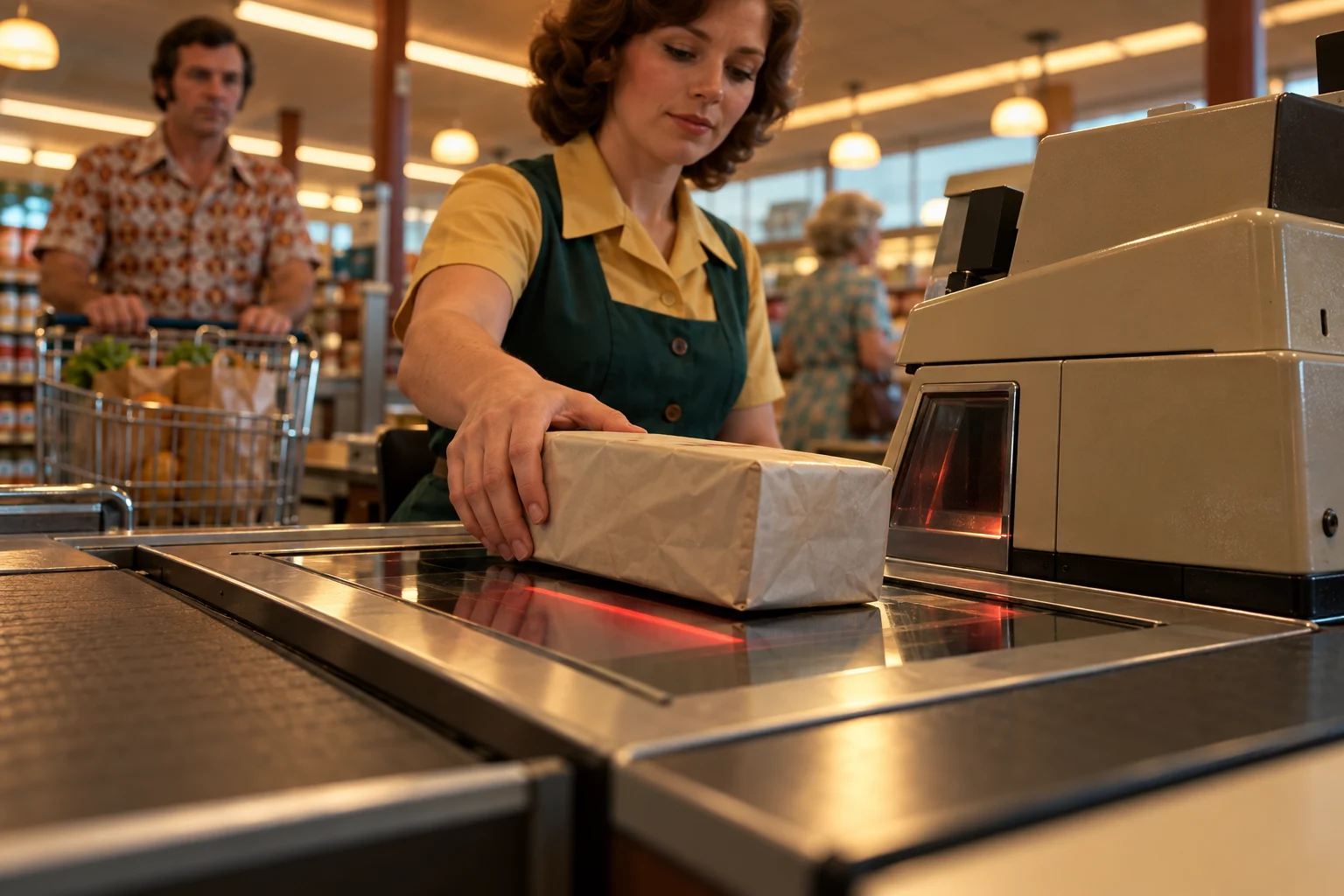
An ordinary item goes first
At a Marsh supermarket in Troy, Ohio, cashier Sharon Buchanan passed a ten-pack of Wrigley’s Juicy Fruit chewing gum across a scanner on 26 June 1974. The customer was Clyde Dawson, a Marsh research executive. The purchase cost 67 cents. Other products in the shopping cart also carried codes, but the gum became the memorable first item in a commercial checkout transaction using the Universal Product Code.
What the stripes actually did
The barcode identified a product; it did not contain a miniature written price. A scanner interpreted the contrasting bars and spaces as a number, and the checkout system associated that number with the store’s product information. This distinction allowed prices to change without requiring a new product identity. The crucial achievement combined a reliable reader with an agreed numbering system that manufacturers and retailers could both use. It separated the stable identity of an item from the changing price attached to it, making the same manufacturer’s code useful in different shops with different prices.
A standard requires cooperation
IBM engineer George Laurer helped develop the rectangular symbol adopted by the American grocery industry. Earlier barcode experiments had included circular designs, and optical scanning required further technical improvement before it could become routine. The National Science Foundation’s history emphasizes work that improved the reliability and practicality of scanners. The Troy transaction therefore marked a working commercial system, rather than the first moment anyone imagined machine-readable product labels.
From checkout to supply chain
Automatic identification reduced repeated manual entry and made sales information more useful for inventory management. The same general approach spread beyond grocery shops into distribution and other industries. Its importance lay as much in shared standards as in the laser itself: an isolated code would have been far less valuable than one recognized across businesses. The accompanying illustration evokes a 1970s checkout; its concealed package and reconstructed setting are interpretive details, not a photograph of Buchanan’s transaction.
The Entertainer
Bastian Lee Jones
Jones’s later piano performance recalls the ragtime revival surrounding The Sting, part of the cultural soundscape of 1973–74. This is not the film recording or audio from the checkout.
Listen on SoundCloud ↗Follow the evidence.
- GS1: Fortieth anniversary of the first barcode scan ↗
- IBM: The UPC ↗
- National Science Foundation: Researchers improve barcode scanners ↗
- Bastian Lee Jones: The Entertainer ↗
AI-assisted writing, with institutional and primary sources. Illustration is a reconstruction, not an archival photograph. Published October 31, 2026; updated October 31, 2026. Our approach