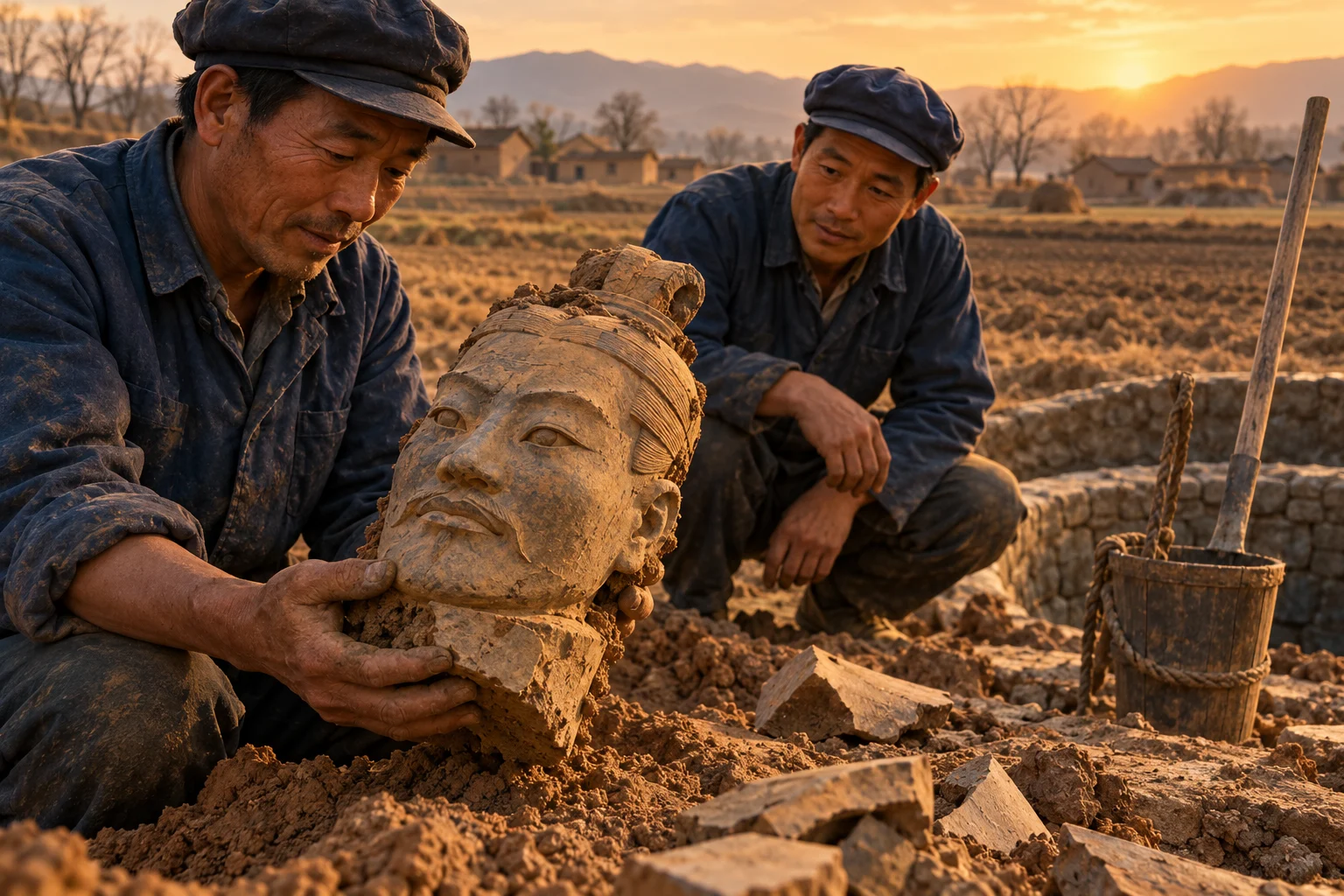
Farmers uncover the Terracotta Army near Xi’an in 1974
A well-digging project at Lintong on 29 March 1974 uncovered terracotta fragments. Archaeological work revealed an extraordinary funerary army and opened new ways to study the resources, workshops and organisation of China’s first imperial state.
Water was the original objective
The farmers working near Xi’an were seeking water rather than antiquities. On 29 March 1974, their well-digging brought up fragments belonging to the buried Terracotta Army. The modest scale of that first encounter matters: the familiar museum view of ranks of standing warriors emerged from subsequent investigation. No complete underground army suddenly appeared in the open. Recognition, excavation and conservation transformed scattered finds into an archaeological discovery with international significance.
A landscape built for an emperor
The warriors belonged to the enormous mausoleum complex of Qin Shihuang, the ruler associated with the first unification of China in 221 BCE. He died in 210 BCE. Soldiers, horses, chariots and weapons formed part of a much larger funerary landscape. UNESCO describes the complex as reflecting the organisation of an imperial capital. The army therefore belongs to a conception of power and provision extending beyond the emperor’s lifetime.
What the objects reveal about work
The figures are compelling artworks, but their materials also provide evidence about labour and supply. UCL and the mausoleum museum’s Imperial Logistics collaboration studies the making of the statues and their bronze weapons. Clay, timber, metal and other resources had to be acquired, moved and processed. Comparing objects and their distribution can help researchers investigate workshops, specialist skills and administration. The archaeological value extends from individual faces to the systems that made production on this scale possible.
From accident to sustained research
UCL’s account of the discovery distinguishes finding something by chance from recognising its importance and securing the means to investigate it. Archaeologists, conservators and museum staff made the finds intelligible over decades. The discovery was a beginning rather than the completion of knowledge about the site. The illustration condenses this first encounter into a scene of farmers examining clay fragments; its exact poses, surroundings and arrangement are interpretive rather than a documented view of the discovery moment.
Flowing Waters (Liu Shui)
Shawn How / SilkStringsGuqin
A later artist-performed guqin recording connects the package with China’s long zither tradition. It is cultural accompaniment, not a reconstruction of Qin court music or audio from the 1974 discovery.
Listen on SoundCloud ↗Follow the evidence.
- UCL: Serendipity and the Terracotta Army ↗
- UCL: Imperial Logistics project introduction ↗
- UNESCO: Mausoleum of the First Qin Emperor ↗
- SilkStringsGuqin: Flowing Waters ↗
AI-assisted writing, with institutional and primary sources. Illustration is a reconstruction, not an archival photograph. Published October 31, 2026; updated October 31, 2026. Our approach