Motorola’s 1973 handheld cellular telephone demonstration
Motorola demonstrated its handheld cellular telephone system in New York on April 3, 1973. Martin Cooper later recalled marking the occasion with a call to a rival at Bell Laboratories, a memorable human detail in a larger engineering achievement.
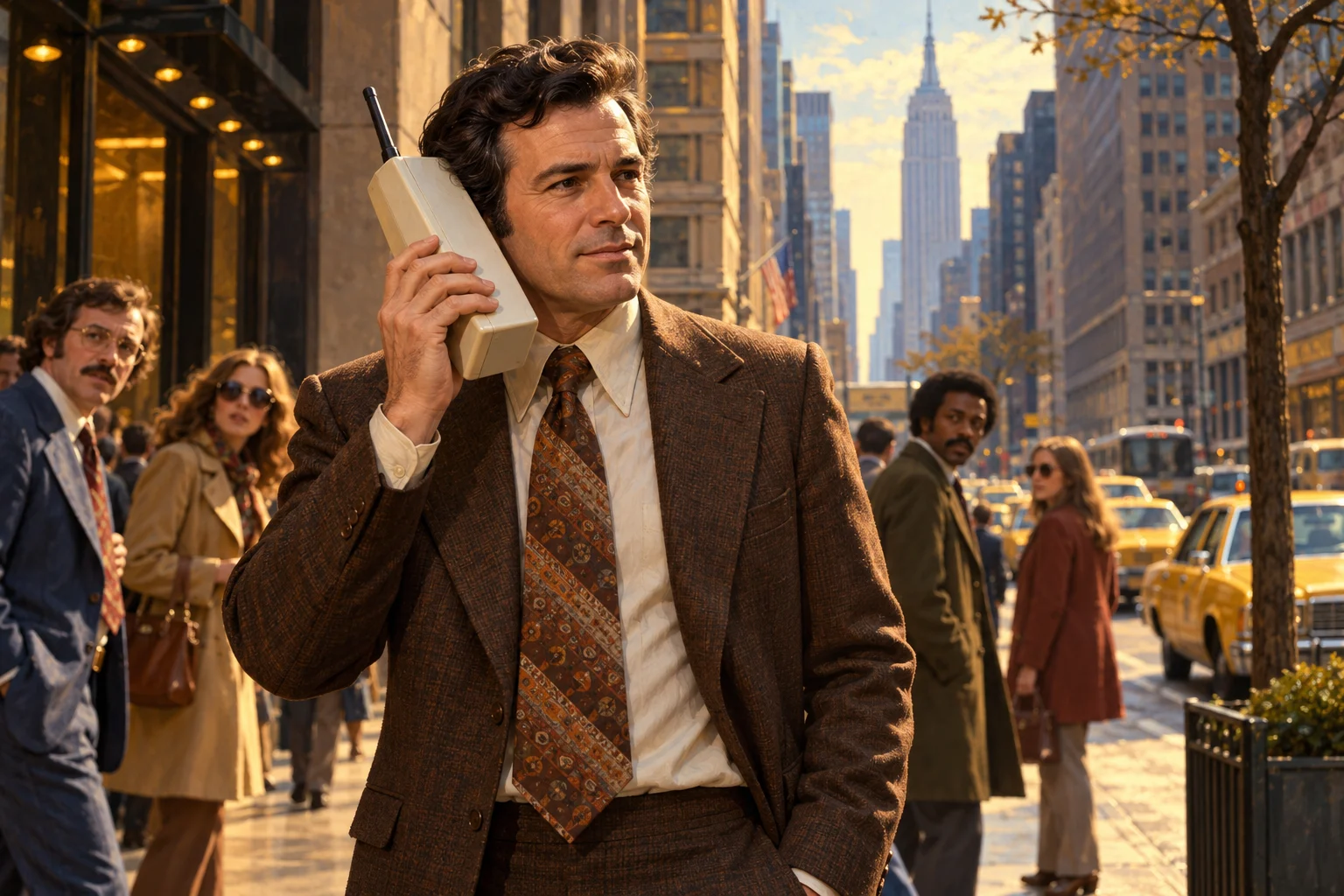
A public demonstration in New York
On April 3, 1973, Motorola publicly demonstrated a handheld portable telephone and its supporting cellular system in New York. The original press release described a device that could make and receive calls within a suitably equipped metropolitan area. Its promise was personal mobility: a caller would no longer need to remain beside a fixed telephone or use equipment installed in a car. Motorola’s dated announcement. The announcement described radio equipment and network coverage as well as the handset. Portability at the user’s end still depended on substantial infrastructure elsewhere.
Calling the competition
Martin Cooper later described using the prototype to ring Joel Engel at Bell Laboratories, part of the competing AT&T organisation. The recipient did not need another handheld mobile device: Motorola’s system connected with conventional telephones. The call became an enduring anecdote because a technical demonstration also served as a personal announcement to a rival. Ericsson’s historical account identifies Engel and dates the call to April 3. Ericsson’s history.
A prototype was not yet a consumer service
The 1973 apparatus demonstrated an idea and a functioning system, rather than announcing immediate mass ownership. Motorola’s release expected public availability by 1976, but commercial introduction took longer. The DynaTAC 8000X reached the commercial stage in 1983 after further engineering and regulatory work. Separating the demonstration from the later product avoids treating a single phone call as the instantaneous arrival of a mature network. Ericsson’s chronology.
What the records can establish
The dated company release firmly establishes the public demonstration. Details of the exchange with Engel largely depend on later recollections, and published versions do not agree on every word. Pew Research Center’s discussion explicitly notes incomplete corroboration of Cooper’s account. The anecdote is best presented as his recollection, without invented dialogue or a claim to possess a contemporary recording. Pew’s discussion. The street scene is an imagined illustration of the era, not a photograph of the call.
ELO Telephone Line (Instrumental Cover)
Benjamin Emery
Benjamin Emery’s later keyboard-based instrumental cover of ELO’s Telephone Line connects thematically with telephone communication. It is not audio from the 1973 demonstration, and its player labels do not name the recipient.
Listen on SoundCloud ↗Follow the evidence.
- Motorola: Original April 3, 1973 press release ↗
- Ericsson and Centre for Business History: Handheld telephones ↗
- Pew Research Center: The first cell phone call ↗
AI-assisted writing, with institutional and primary sources. Illustration is a reconstruction, not an archival photograph. Published October 31, 2026; updated October 31, 2026. Our approach