Ling-Ling and Hsing-Hsing arrive in Washington in 1972
Ling-Ling and Hsing-Hsing arrived at Washington’s National Zoo on April 16, 1972, as gifts from China. Their celebrated arrival formed one half of a diplomatic animal exchange: the United States gave China two musk oxen.
The pandas arrive
On April 16, 1972, two young giant pandas, the female Ling-Ling and male Hsing-Hsing, reached their new home at the Smithsonian’s National Zoo. Their arrival followed President Richard Nixon’s February visit to China. The zoo was selected as the American home for the animals, bringing a highly visible outcome of international diplomacy into a public institution with free admission. The exact arrival date is recorded in the zoo’s panda history.
An exchange of very different animals
During the visit to Beijing, Pat Nixon expressed her enthusiasm for giant pandas. Premier Zhou Enlai offered a pair as a gift to the American people. The United States reciprocated with Milton and Matilda, two musk oxen from the San Francisco zoo. The animals were goodwill gifts, not equivalent purchases in an ordinary commercial transaction. Their strikingly different appearances make the exchange memorable while showing how diplomacy can employ living symbols. National Archives account.
Arrival was separate from the ceremony
Pat Nixon formally accepted the pandas on April 20, four days after they arrived. This distinction prevents photographs of the welcome ceremony from being mistaken for the arrival itself. Contemporary publicity turned the animals into celebrities, and visitors came in large numbers to see them. The National Archives preserves photographs, film and a recorded presidential telephone call related to the arrangements. These records connect the popular spectacle with the planning behind it. Archival account and ceremony film.
From public fascination to research
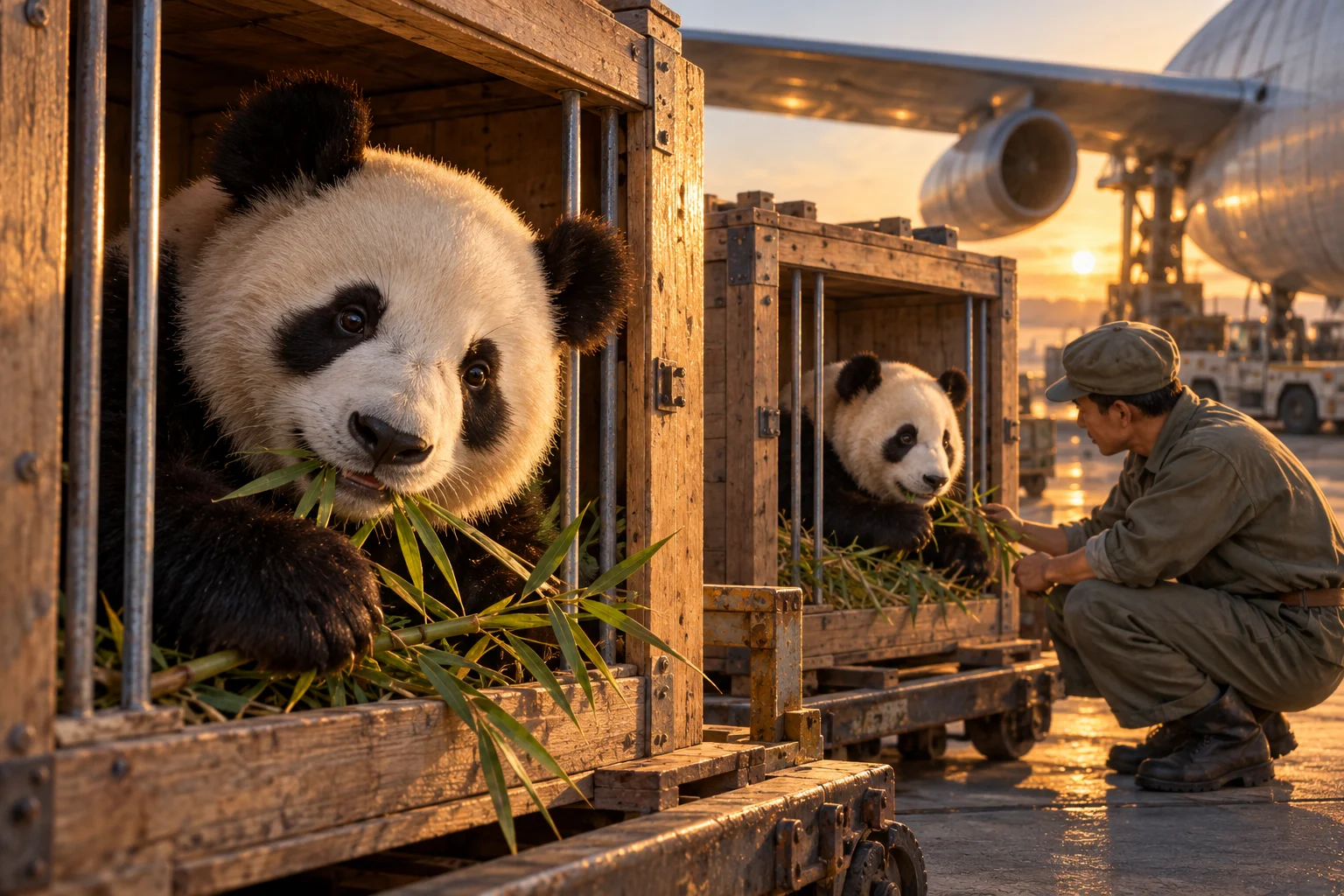
The panda programme also created opportunities to study behaviour, health and reproduction. The zoo’s later conservation work drew on experience caring for the first pair and on collaboration with Chinese partners. Ling-Ling and Hsing-Hsing were gifts; later panda arrangements used different legal and conservation frameworks, including loans. The circumstances should not be treated as interchangeable across decades. Smithsonian history. The accompanying airfield scene is an imagined illustration of animal transport, not a record of the actual crate arrangement or unloading moment.
"Mo Li Hua"
Qian Yi, Li Sun and Liang Wu
Carnegie Hall’s complete performance of the Chinese folk song Mo Li Hua provides a cultural connection to the pandas’ country of origin. It is a later performance, not music documented at their arrival.
Listen on SoundCloud ↗Follow the evidence.
- Smithsonian National Zoo: History of giant pandas ↗
- U.S. National Archives: The 50th pandaversary ↗
- U.S. National Archives: Pandamonium at the National Zoo ↗
AI-assisted writing, with institutional and primary sources. Illustration is a reconstruction, not an archival photograph. Published October 31, 2026; updated October 31, 2026. Our approach