The first human-to-human heart transplant in Cape Town
On 3 December 1967, a team led by Christiaan Barnard transplanted a human heart at Groote Schuur Hospital in Cape Town. The operation demonstrated a remarkable surgical possibility while exposing the continuing difficulty of keeping transplant recipients alive.
Two families and a decision
Louis Washkansky was a Cape Town patient whose badly damaged heart left him gravely ill. Conventional surgery could not provide the help his doctors believed he needed. The donor, Denise Darvall, suffered a fatal brain injury in a road accident. Her father, Edward Darvall, agreed to donation. The event therefore depended on a bereaved family’s decision as well as the recipient’s willingness to undergo a procedure that had never previously succeeded between human beings.
The operation on 3 December
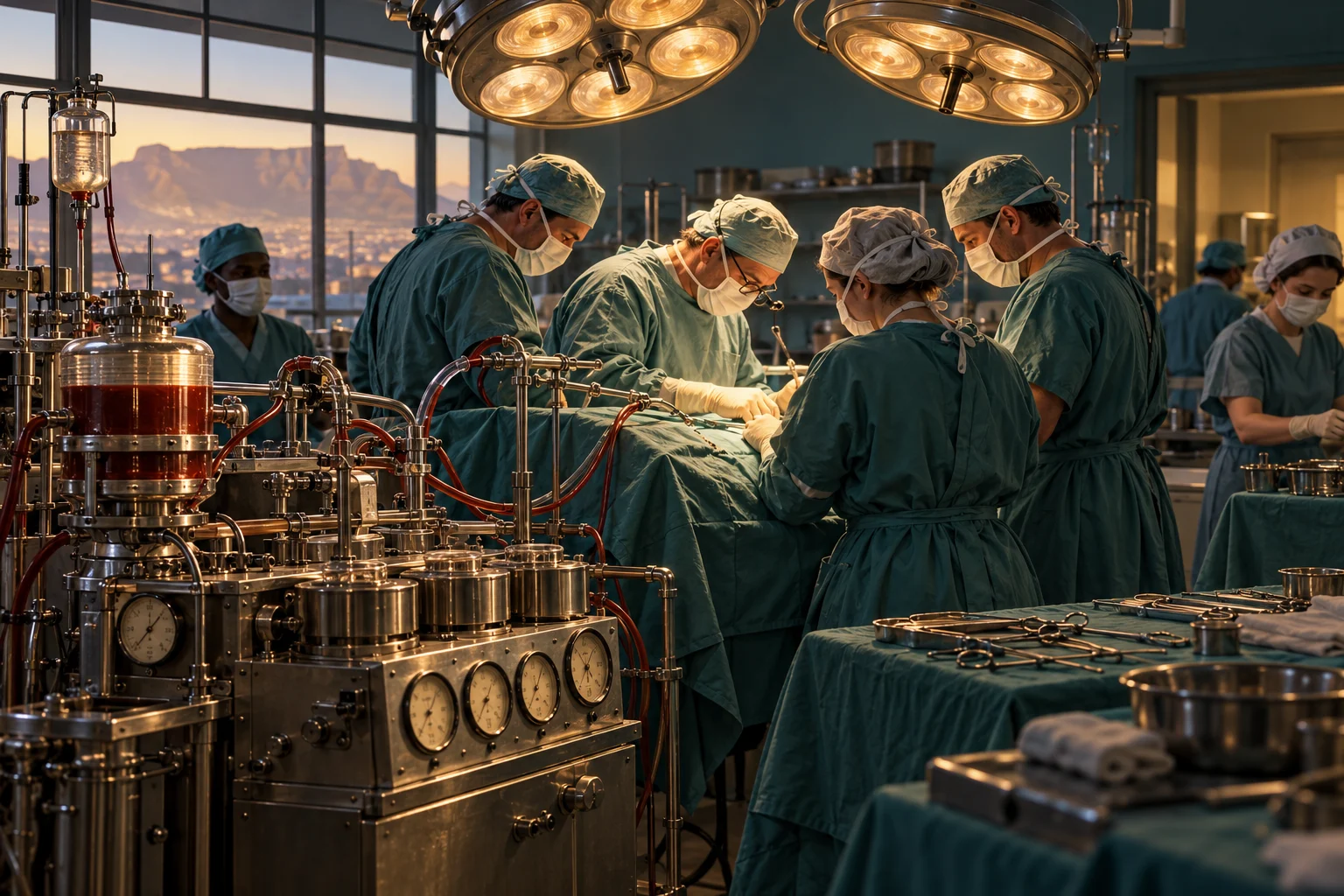
Surgery began after midnight at Groote Schuur Hospital. According to the University of Cape Town’s account, the transplanted heart was electrically stimulated into action shortly before six in the morning on Sunday 3 December 1967. Christiaan Barnard led the operation, but replacing a heart required far more than a single surgeon’s skill. The working donor organ had to become part of the recipient’s circulation, supported throughout by carefully coordinated hospital care.
The achievement behind the famous name
UCT’s history stresses the contribution of cardiologists, anaesthetists, nurses, laboratory specialists, radiographers and the technologists responsible for the heart-lung machine. A preserved team list gives the achievement a documentary identity beyond the celebrity attached to Barnard. These professions supplied diagnosis, blood, equipment, monitoring and postoperative care. The first transplant is a useful example of how an apparently individual breakthrough rests on a network of expertise and organised support.
What success did and did not mean
Washkansky survived for eighteen days and died of pneumonia. The operation had established that a transplanted human heart could function, but it had not established dependable long-term survival. Descriptions of the procedure as successful refer to that surgical achievement and need this qualification. Later advances would make transplantation a much more durable treatment. The illustration is a respectful interpretation of a period operating theatre, not a record of the exact personnel or arrangement on that morning.
Cape Town Jazz
Charles Segal
Segal’s artist-uploaded composition supplies a musical connection to the South African city where the operation took place. This later recording is a geographical association, not music from the operating theatre.
Listen on SoundCloud ↗Follow the evidence.
- University of Cape Town: World’s First Human Heart Transplant ↗
- UCT Alumni News 2018: Heart transplant, a world first ↗
- UCT Libraries: Heart transplant team list, 3 December 1967 ↗
- Charles Segal: Cape Town Jazz ↗
AI-assisted writing, with institutional and primary sources. Illustration is a reconstruction, not an archival photograph. Published October 31, 2026; updated October 31, 2026. Our approach