New Zealand's decimal currency launch and the Bahamas mule coins
New Zealand introduced dollars and cents on 10 July 1967. Amid the nationwide changeover, some two-cent pieces appeared with a New Zealand design on one side and a Bahamian design on the other, creating a memorable minting error.
A country learns new money
On 10 July 1967, New Zealand replaced pounds, shillings and pence with dollars and cents. The change reached almost every household and business. Schools taught the new arithmetic, households received explanatory material, and businesses prepared their equipment. The Decimal Currency Board's publicity character, Mr Dollar, helped make an unfamiliar system approachable. The Reserve Bank's preparation history describes a practical education campaign conducted in English and te reo Māori, as well as the enormous work of supplying banks.
Two countries on one coin
The first day brought an unexpected complication. Some copper two-cent pieces had New Zealand's reverse paired with the obverse intended for a Bahamian five-cent coin. Both currencies were being manufactured by Britain's Royal Mint, and the two denominations had very similar diameters. Four faulty examples were reported on launch day. Numismatists use the term mule for a coin made with dies that do not belong together. The Reserve Bank's account establishes the date and explains the mismatched designs.
Finding the faulty pieces
Officials offered to replace the errors, but talk of possible collectors' premiums encouraged some people to keep them. Sorting required individual inspection: roughly 600,000 two-cent coins were examined, and about 60,000 mules were found and subsequently melted. An investigation considered several explanations, including sabotage, but the bank's historical account identifies human error and inadequate checks as the likely combination. No individual culprit was established. The existence of an investigation should therefore not be mistaken for proof of deliberate interference.
The larger changeover
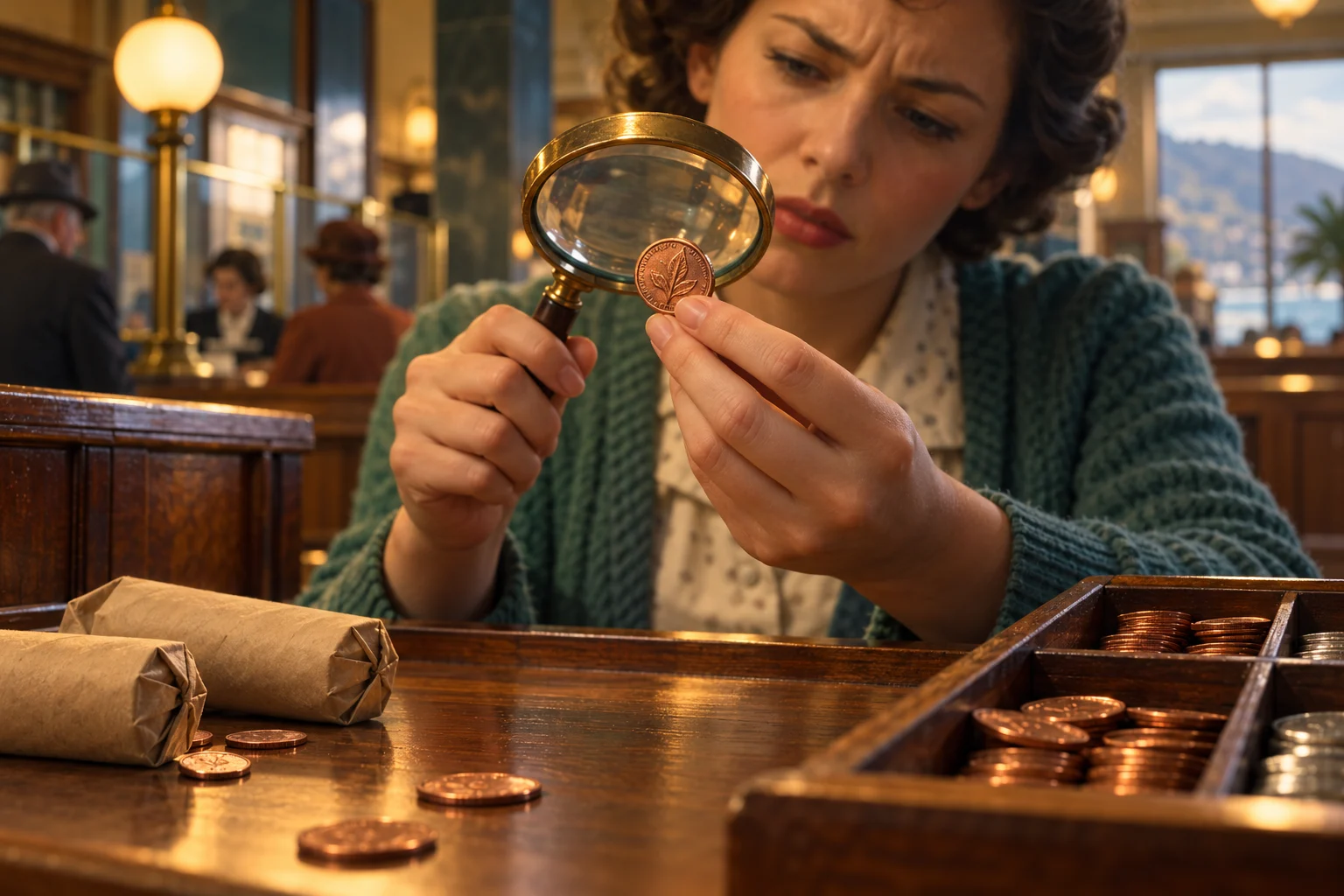
The minting accident was a small part of a much bigger transformation. According to NZHistory, the launch involved 27 million new banknotes and 165 million coins. The public also debated names for the currency before dollar was selected. Decimalisation shows how everyday standards depend on coordinated teaching, manufacturing and distribution. The accompanying illustration imagines someone inspecting unfamiliar change; it does not reproduce a documented individual encounter or display a verifiable specimen of the mule.
Pokarekare Ana
Jovanni-Rey de Pedro; arrangement by Christopher Norton
A piano performance from de Pedro's July 2015 Canberra recital, uploaded by arranger Christopher Norton. Its treatment of the Māori song provides New Zealand cultural context; it is not music recorded for the 1967 changeover.
Listen on SoundCloud ↗Follow the evidence.
- Reserve Bank of New Zealand: Problems with the 1967 decimal coinage ↗
- NZHistory: New Zealand adopts decimal currency ↗
- Reserve Bank of New Zealand: Preparing for decimal currency ↗
AI-assisted writing, with institutional and primary sources. Illustration is a reconstruction, not an archival photograph. Published October 31, 2026; updated October 31, 2026. Our approach