Australia's 1967 referendum on Aboriginal people and the Constitution
On 27 May 1967, Australian voters overwhelmingly approved removing two discriminatory constitutional provisions. The referendum changed federal lawmaking powers and official population calculations, but did not first establish Indigenous voting rights.
Two exclusions in the Constitution
Australia's Constitution contained two provisions that campaigners sought to remove. Section 51(xxvi) excluded Aboriginal people in the states from the federal parliament's power to make special laws concerning people of a particular race. Section 127 excluded Aboriginal people from the population totals specified by the Constitution. These provisions combined practical effects with a powerful message of exclusion. Changing them required constitutional amendment rather than an ordinary act of parliament, bringing the question before voters in a national referendum.
The vote on 27 May
On 27 May 1967, voters approved the proposal concerning Aboriginal people with 90.77 percent support and majorities in every state. The Australian Electoral Commission records the polling date and result. A separate proposal about the relative numbers of members of the two parliamentary chambers failed on the same day. The different outcomes matter: the public was answering two constitutional questions, rather than voting on one general declaration of support for reform.
What the result changed
The successful proposal removed the exclusion in section 51(xxvi) and repealed section 127. This enabled federal legislation concerning Aboriginal people in the states and removed the constitutional bar on including them in the relevant population totals. It is more precise to describe this as a change in official population reckoning than to claim that Aboriginal people had never previously been enumerated. The amendments formally took effect after assent on 10 August 1967, as the National Archives explains.
A milestone with specific limits
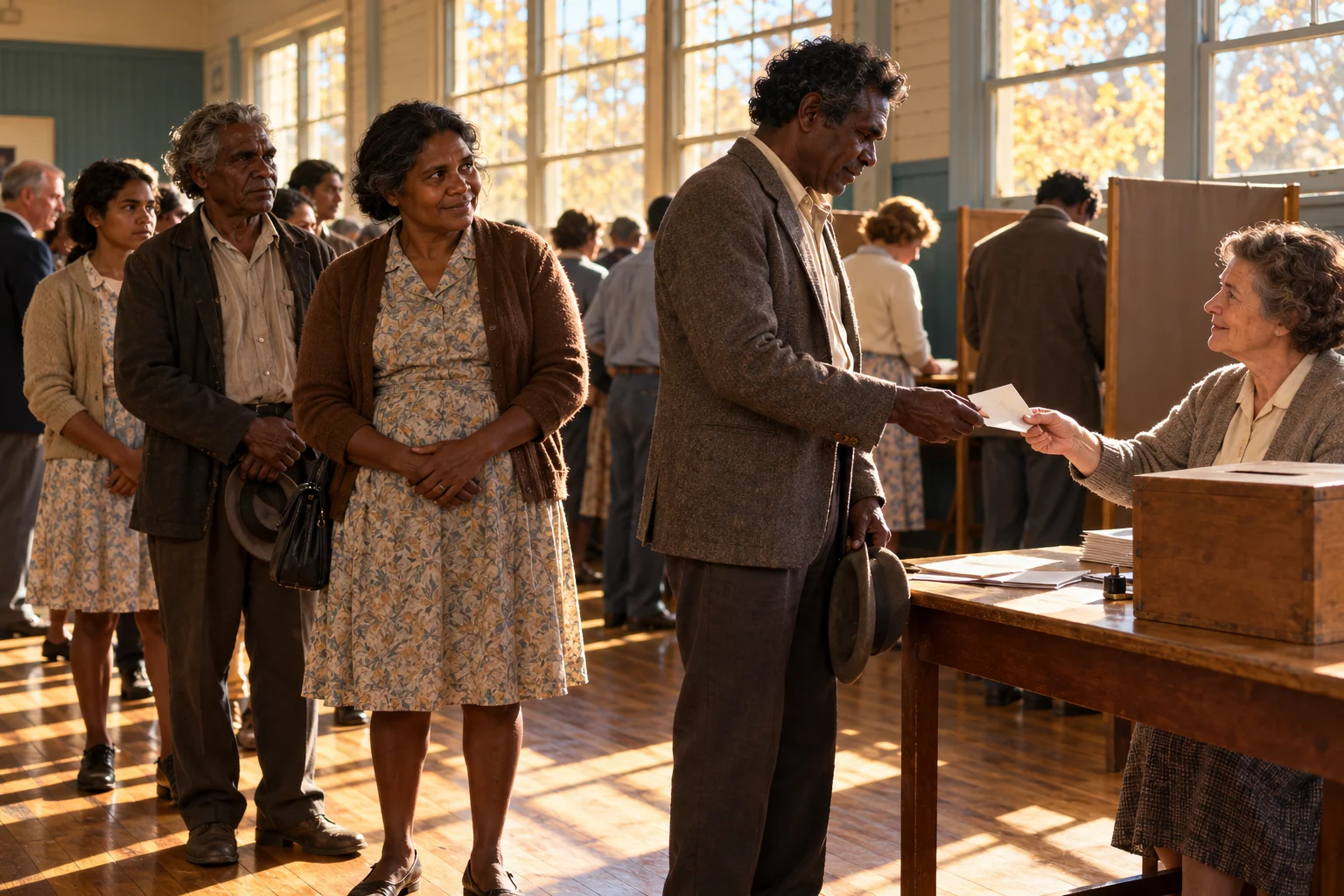
The referendum did not first grant Indigenous Australians a federal vote: legislation had extended that right in 1962. Nor did the result itself create a treaty or guarantee that new federal laws would be beneficial. Its importance lies in removing discriminatory constitutional language, expanding governmental responsibility and demonstrating exceptional public support for change. Translating the vote into improved lives required further action. The accompanying illustration represents an imagined polling-place scene, not a photograph of named campaigners or voters.
Treaty - Yothu Yindi (Filthy Lucre Remix) remaster
Yothu Yindi; remix by Filthy Lucre
This later remix of Yothu Yindi's Indigenous-rights song connects with the continuing struggle for recognition beyond the referendum. It is not a 1967 campaign recording.
Listen on SoundCloud ↗Follow the evidence.
- Australian Electoral Commission: Referendum dates and results ↗
- National Archives of Australia: The 1967 referendum ↗
- National Museum of Australia: Indigenous referendum ↗
- Australian Electoral Commission: Indigenous electoral milestones ↗
- SoundCloud: Treaty - Yothu Yindi (Filthy Lucre Remix) remaster by Razor Recordings ↗
- National Film and Sound Archive: Treaty by Yothu Yindi ↗
AI-assisted writing, with institutional and primary sources. Illustration is a reconstruction, not an archival photograph. Published October 31, 2026; updated October 31, 2026. Our approach