Gemini VI-A’s Jingle Bells performance in orbit
On 16 December 1965, the Gemini VI-A astronauts turned a playful radio report into a performance of Jingle Bells. A miniature harmonica and a strap of sleigh bells brought a brief musical surprise into an important spaceflight mission.
A mission about meeting in space
Gemini VI-A carried Wally Schirra and Tom Stafford into orbit in December 1965. Its revised mission involved rendezvous with Gemini VII, occupied by Frank Borman and Jim Lovell. The spacecraft approached one another and flew in formation, demonstrating skills that would be essential for later missions. This was rendezvous rather than a physical docking between the two capsules. Precise manoeuvring and relative control supplied the serious technical background to the crew’s lighter musical moment. NASA’s mission history
The surprise on 16 December
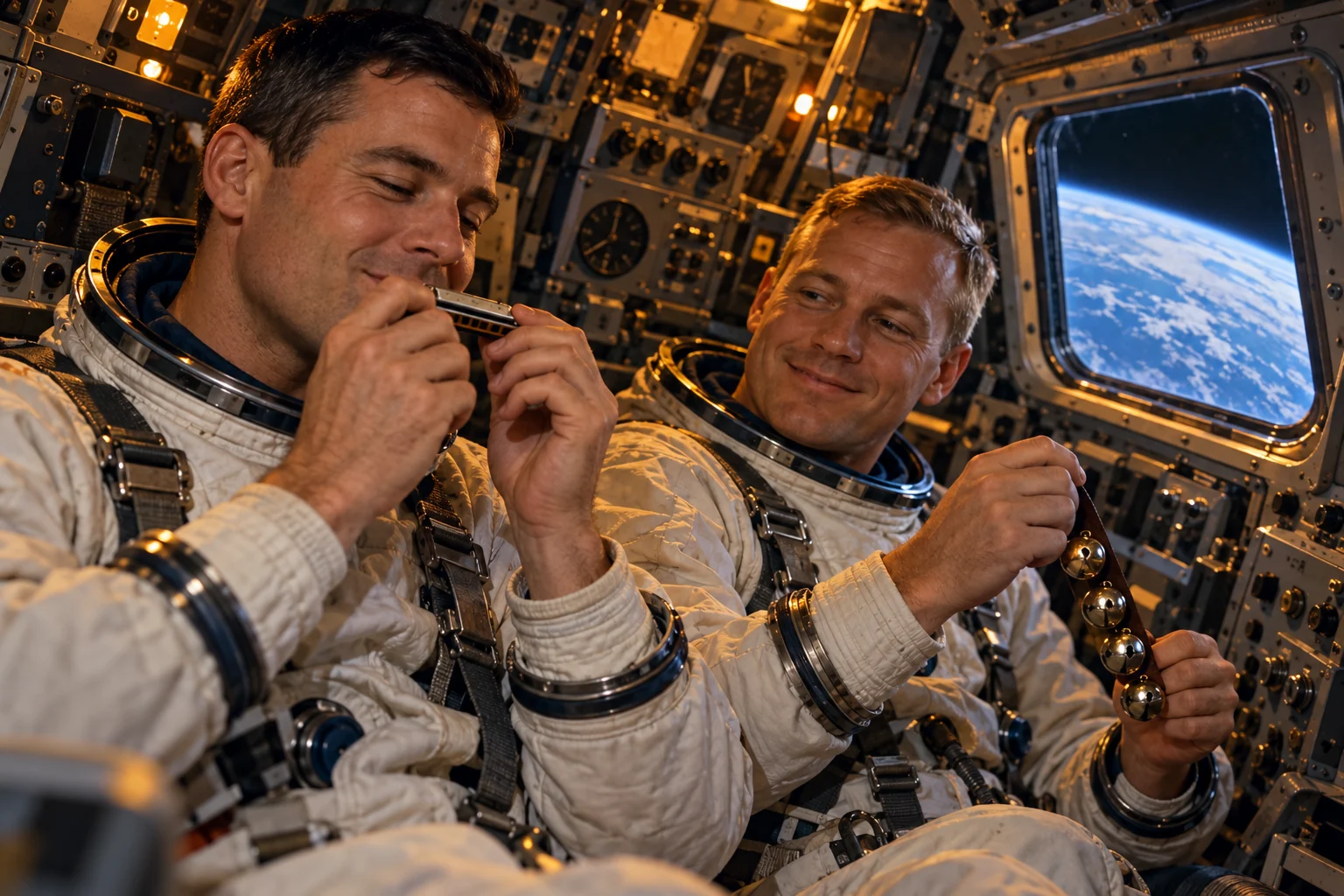
Before returning to Earth on 16 December 1965, the Gemini VI-A crew made a playful radio report about an unfamiliar object travelling in a polar orbit. The report led into a brief rendition of Jingle Bells. Schirra played a miniature harmonica while Stafford shook small sleigh bells. The joke worked through its timing and the unexpected sound of instruments from a spacecraft, rather than through any real sighting. The National Air and Space Museum preserves the account and the instruments. The museum’s performance history
A carefully prepared small band
The musical interlude was not entirely spontaneous. Stafford later recalled that the two astronauts had practised before launch without telling their colleagues on the ground. Their instruments were small enough to fit the confined spacecraft. The museum describes dental floss and Velcro attachments that helped keep them secured when unused. These ordinary materials are a reminder that life in orbit involved adapting even a tiny holiday performance to an environment where loose objects would float away. The crew’s preparations
Objects that preserve a human moment
The instruments were donated to the Smithsonian in 1967. As museum objects, they connect an audible episode with physical evidence carried on the flight. Their importance sits alongside the mission’s technical achievement: space crews were highly trained professionals who also brought humour, cultural traditions and personal relationships into their work. The accompanying cockpit image is an interpretive illustration, not a photograph of the musical exchange or a precise reconstruction of how the astronauts held their instruments. Smithsonian’s object and donation history
Jingle Bells
Scott Holmes Music
Scott Holmes Music’s modern instrumental arrangement supplies the same tune performed aboard Gemini VI-A. This is a later recording, not the astronauts’ radio transmission.
Listen on SoundCloud ↗Follow the evidence.
- National Air and Space Museum — Jingle bells and harmonica ↗
- NASA — Dual Gemini flights ↗
- Scott Holmes Music — Jingle Bells ↗
AI-assisted writing, with institutional and primary sources. Illustration is a reconstruction, not an archival photograph. Published October 31, 2026; updated October 31, 2026. Our approach