Yves Saint Laurent’s Mondrian dresses in the 1965 collection
Presented within Saint Laurent’s autumn-winter collection on August 6, 1965, the Mondrian-inspired dresses transferred modern abstract painting into couture through geometric shapes, bold contrasts and carefully constructed fabric panels.
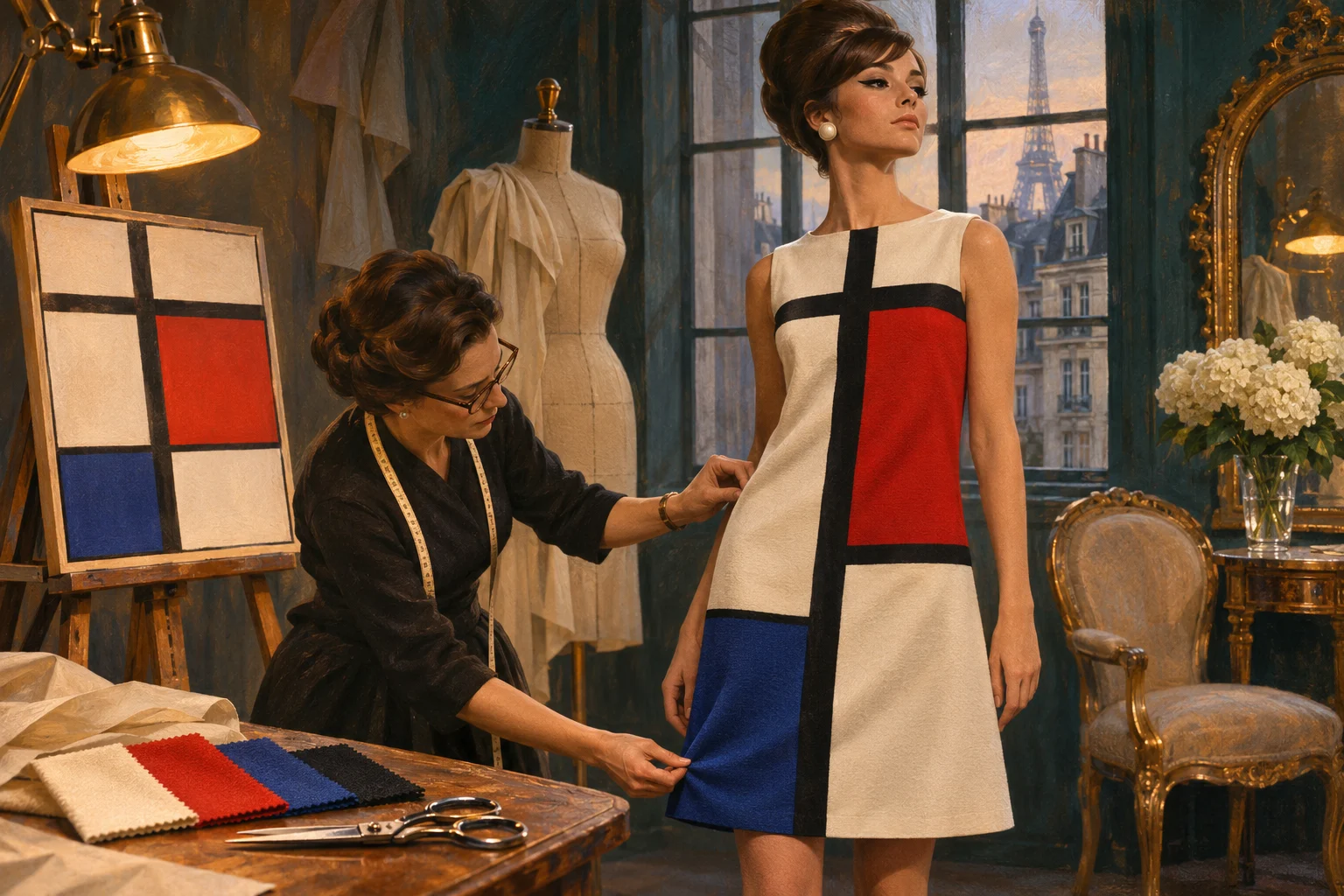
Modern painting enters couture
Yves Saint Laurent looked to modern art when seeking a new direction for his young fashion house. Piet Mondrian’s abstract paintings offered a striking language of rectangles, primary colors and black lines. The resulting dresses appeared within the autumn-winter 1965 collection, presented on August 6 according to the Musée Yves Saint Laurent Paris. They were part of a larger collection, rather than evidence that every garment shown that day followed the same artistic model.
Construction creates the image
The visual effect depended on more than applying a reproduction to a finished dress. Carefully joined sections of wool jersey allowed the boundaries between colors to work with the garment’s structure. The straight, simple silhouette helped preserve the clarity of the geometric arrangement when worn. In this translation, a flat composition became an object that could move with a body. The challenge was to maintain the apparent simplicity of the image through skilled cutting and assembly.
What surviving garments show
Museum collections preserve different versions of the design. LACMA’s dress is dated 1965 and catalogued as wool knit. The National Gallery of Victoria’s example uses wool with a silk lining and documents an abstract arrangement including a red square and black bands. These objects show that the collection was not one single standardized dress. Their materials also reveal the labor and fabric behind a look often remembered simply as a graphic pattern.
A connection across media
The dresses helped make the relationship between fashion and twentieth-century painting visible to a wide public. They also suggest why a successful adaptation changes its source: cloth has weight, seams and a wearer, whereas a painted canvas stays fixed. The illustration accompanying this article presents an imagined atelier fitting, not a photograph of the collection’s original presentation. Its pattern evokes the documented design vocabulary without claiming to reproduce one museum garment stitch for stitch.
Poupée de cire, poupée de son — piano and vibes cover
HaiLong
A later instrumental cover of the French-language pop song that won Eurovision in 1965. It shares the collection’s year and youthful French cultural context; it is not documented runway music.
Listen on SoundCloud ↗Follow the evidence.
- Musée Yves Saint Laurent Paris: The Mondrian Revolution ↗
- LACMA: Woman’s Dress, Mondrian, 1965 ↗
- National Gallery of Victoria: Mondrian dress ↗
- Eurovision: Naples 1965 ↗
- HaiLong: piano and vibes cover ↗
AI-assisted writing, with institutional and primary sources. Illustration is a reconstruction, not an archival photograph. Published November 4, 2026; updated November 4, 2026. Our approach