Valentina Tereshkova launches aboard Vostok 6
On 16 June 1963, Valentina Tereshkova launched from Baikonur aboard Vostok 6 and became the first woman in space. Her mission combined a major human milestone with the Cold War competition to demonstrate technological and social achievement.
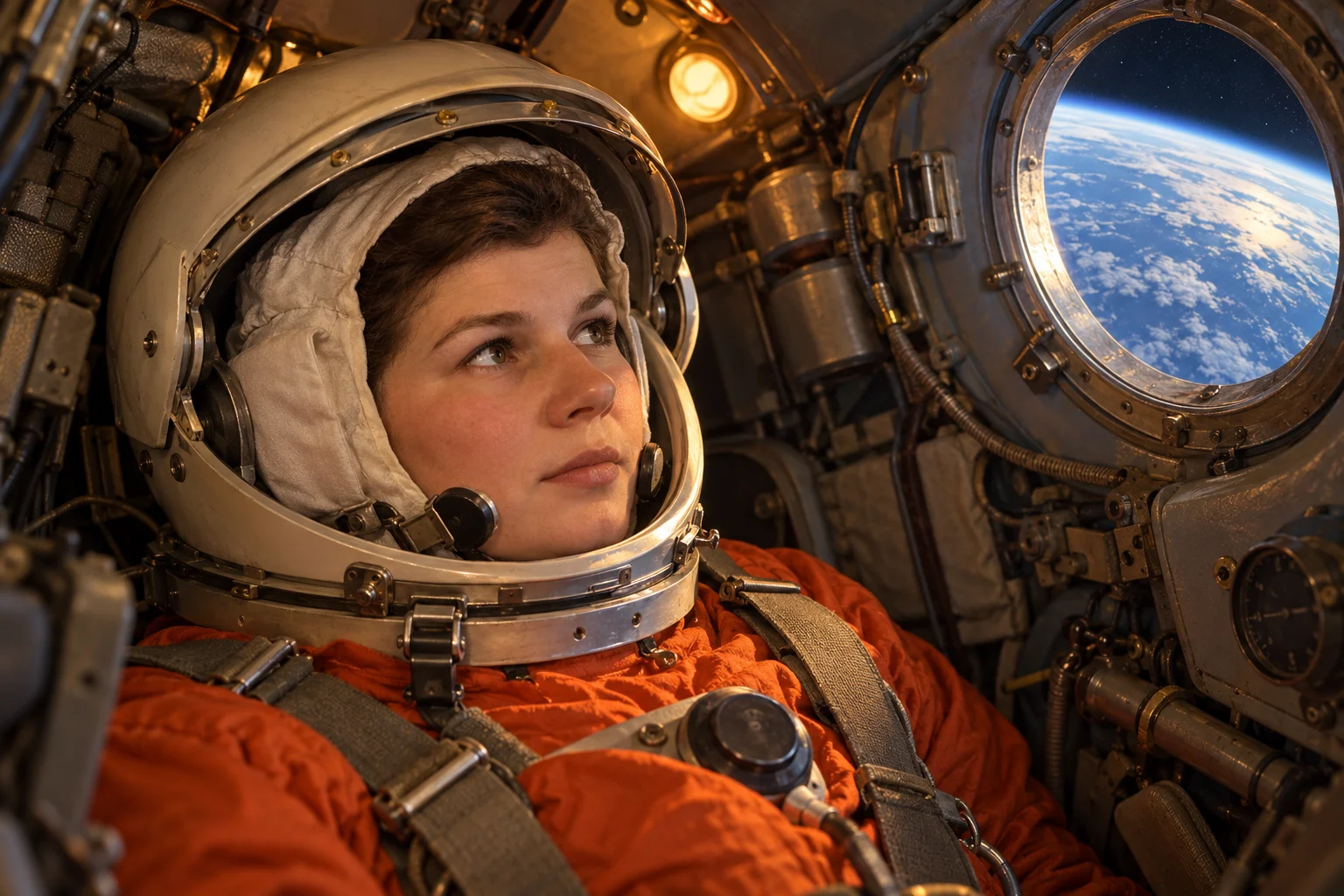
A different route into the spacecraft
Valentina Tereshkova worked in a textile factory and developed experience as an amateur parachutist before joining the Soviet space programme. After Yuri Gagarin’s flight, the Soviet government authorized the selection of female trainees. Five women were chosen in 1962 and underwent demanding preparation, including centrifuge work, isolation tests, weightless flights and parachute training. Her path illustrates how early space programmes selected for specific mission requirements as well as for conventional flying experience. The European Space Agency records that more than 400 women had applied for the five training places.
The launch on 16 June
On 16 June 1963, Tereshkova and her backup travelled to the launch site after putting on their pressure suits. Vostok 6 lifted off from Baikonur, in what is now Kazakhstan, with Tereshkova alone aboard. Using the call sign Chaika, meaning seagull, she communicated with Valeri Bykovsky, already in orbit in Vostok 5. This was a coordinated pair of flights, not a shared cabin or a docking between the two spacecraft.
Work in orbit
Tereshkova kept a flight log, carried out tests and photographed Earth and its horizon. The mission lasted almost three days. Space agencies report slightly different rounded totals for its duration, but agree on the launch date and the pioneering status of the flight. The achievement was also a powerful publicity success for the Soviet Union, which presented it as evidence of both technological capability and the opportunities available to women under its system.
A first did not mean equal access
The launch ended the period in which every person sent into space had been a man. It did not establish an immediate, continuous stream of female spacefarers. Tereshkova never flew again, and the next woman in space was Svetlana Savitskaya in 1982; Sally Ride followed as the first American woman in 1983. The accompanying cabin portrait is a historically informed illustration. Its lighting, porthole view and arrangement of equipment are artistic reconstruction, not a photograph taken inside Vostok 6.
Rocket Man (piano & vocals)
Dave Piano
Dave Piano’s later live cover of Elton John and Bernie Taupin’s 1972 song reflects the imagined human experience of space travel. It is a thematic association, not Soviet mission audio or a song from 1963.
Listen on SoundCloud ↗Follow the evidence.
- European Space Agency: First woman in space, Valentina ↗
- NASA: Sally Ride and Valentina Tereshkova ↗
- Smithsonian National Air and Space Museum: Reaching new heights in space ↗
- Dave Piano: Rocket Man, piano and vocals ↗
AI-assisted writing, with institutional and primary sources. Illustration is a reconstruction, not an archival photograph. Published October 31, 2026; updated October 31, 2026. Our approach