Vasa returns to daylight during the final salvage lift
On 24 April 1961, the seventeenth-century Swedish warship Vasa emerged from Stockholm harbour. Her return after almost 333 years underwater combined risky diving, staged lifting and the beginnings of a major archaeological investigation.
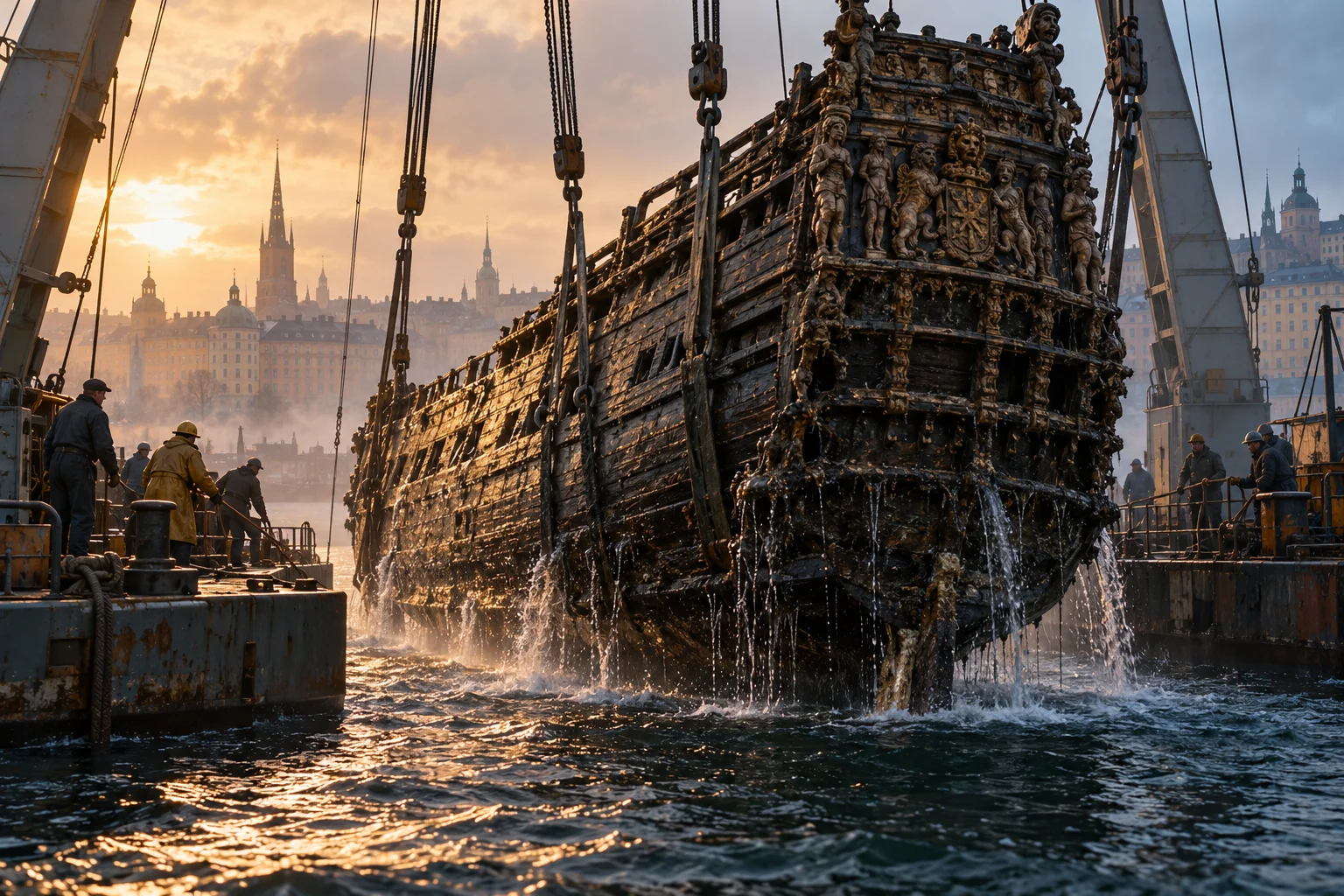
A remarkably long interval
Vasa sank in Stockholm in 1628 and remained underwater for more than three centuries. Early attempts to recover the ship did not bring the hull back to the surface. In the twentieth century, wreck researcher Anders Franzén searched for it, and naval divers confirmed a large, nearly intact wooden ship in the harbour mud. The return to daylight is often described as coming after 333 years; the museum gives the more exact interval as 332 years and eight months.
Moving a ship before revealing it
Recovery required much more than attaching a crane. Divers washed six tunnels through the mud beneath the hull so that steel lifting cables could be passed under it. Surface pontoons supplied lifting force. A sequence of lifts beginning in 1959 moved the wreck from deeper water to a shallower position. Workers then spent additional months preparing it, removing weight and sealing openings. The Vasa Museum's salvage history explains why the public emergence was the culmination of a long engineering operation.
The surface breaks on 24 April
At 9:03 a.m. on 24 April 1961, the first parts of Vasa appeared above the water. Media crews and spectators followed the final lift, making the operation an unusually public archaeological event. The museum's anniversary account identifies the time and describes a frame and sculpture coming into view. The ship was then pumped out and leaks were attended to. Eventually the old hull could float again, allowing it to be taken to a dock.
The work that began after the spectacle
Salvage opened access to a dense material record of seventeenth-century life. Archaeologists worked through the mud inside the ship, recovering objects that could reveal work, equipment and everyday activity aboard. The excavation account describes months of work and tens of thousands of finds. Raising the hull was therefore a transition into investigation and preservation, rather than the project's end. The illustration interprets the scale and atmosphere of the salvage; it does not reproduce a particular moment from the televised operation.
Slängpolska from Småland/Maypole Mazurka
edthefiddler
The performer's later set combines a traditional Swedish tune with an original mazurka on nyckelharpa, fiddle and guitar. It provides Swedish musical context, without claiming a link to the salvage ceremony or seventeenth-century shipboard music.
Listen on SoundCloud ↗Follow the evidence.
- Vasa Museum: Sixty years since the salvage ↗
- Vasa Museum: The salvage ↗
- Vasa Museum: Excavation ↗
- SoundCloud: Slängpolska from Småland/Maypole Mazurka by edthefiddler ↗
AI-assisted writing, with institutional and primary sources. Illustration is a reconstruction, not an archival photograph. Published October 31, 2026; updated October 31, 2026. Our approach