Ruby Bridges enters William Frantz Elementary School
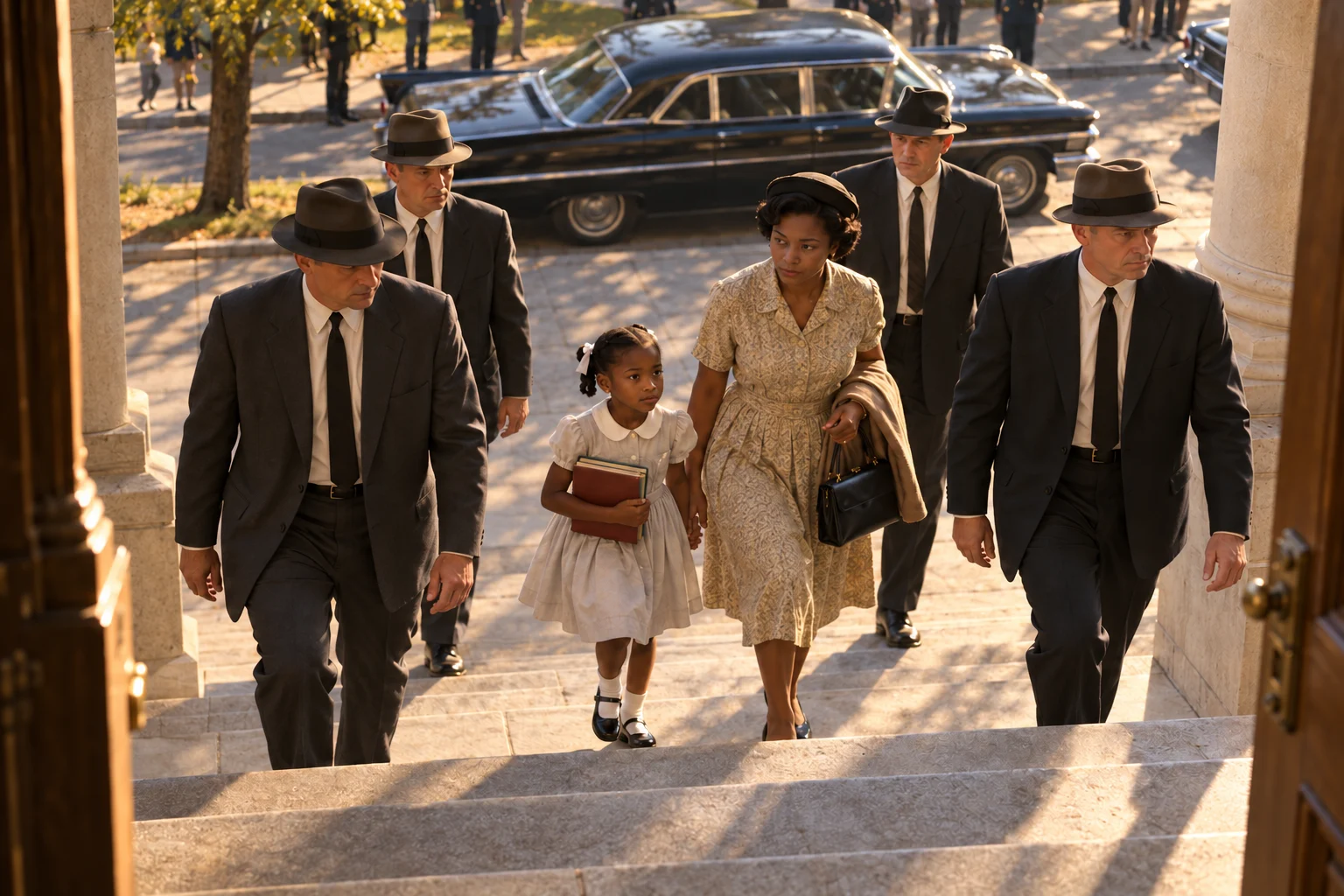
On 14 November 1960, six-year-old Ruby Bridges entered William Frantz Elementary in New Orleans under federal protection. Her first day helped turn a legal requirement to desegregate public schools into a lived, contested reality.
A ruling met with resistance
The United States Supreme Court's 1954 Brown v. Board of Education decision rejected legally segregated public schooling. Implementation was neither immediate nor automatic. Louisiana authorities tried to prevent Black children from attending schools reserved for white pupils, and further federal court action was needed. In New Orleans, Judge J. Skelly Wright ordered desegregation to begin on 14 November 1960. The conflict showed the distance between declaring a constitutional principle and enforcing it in a particular classroom.
A first-grader crosses the threshold
Ruby Bridges was six when she arrived at William Frantz Elementary on the appointed day. Federal marshals escorted her through a hostile environment. She was not the only child desegregating a New Orleans school that morning: three other Black girls entered McDonogh No. 19. The PBS historical account places these actions together. Remembering the other children helps preserve the collective history behind an image often associated with one small girl.
The cost of attending school
White parents organised boycotts, and opposition extended beyond the school entrance. Ruby's father lost his job, while a local grocery shop refused to serve the family. Such pressure tried to make the exercise of a legal right unbearable in ordinary life. Federal protection could secure access to a building, but it could not immediately remove prejudice or economic retaliation. Her attendance therefore depended on the resolve of her family as well as the authority of a court.
A continuing educational story
Some white pupils returned, and other Black children later joined the school. Yet the wider patterns of residential separation and movement to suburban schools complicated integration. Ruby's first day remains significant because it makes enforcement and personal experience visible within constitutional history. Modern educational commemorations, including those described by the San Mateo County Office of Education, connect her example with children's own journeys to school. The illustration is an independent interpretation, not a reproduction of a historical photograph or painting.
We Shall Overcome
Pete Seeger
Seeger's recording of the civil-rights anthem connects the school entrance to the wider movement for racial equality. It is not audio recorded at Ruby Bridges's school that day.
Listen on SoundCloud ↗Follow the evidence.
- PBS American Experience: Ruby Bridges and New Orleans school integration ↗
- San Mateo County Office of Education: Ruby Bridges Walk to School Day ↗
- The Historic New Orleans Collection: Ruby Bridges teaching materials ↗
- SoundCloud: Pete Seeger - We Shall Overcome by Smithsonian Folkways ↗
AI-assisted writing, with institutional and primary sources. Illustration is a reconstruction, not an archival photograph. Published October 31, 2026; updated October 31, 2026. Our approach