The first working ruby laser at Hughes Research Laboratories
On 16 May 1960, Theodore Maiman’s team operated a ruby laser, turning a theoretical approach to light amplification into a working device.
From microwave amplification to light
The laser grew from research into stimulated emission, the process in which incoming radiation can prompt an excited atom to release matching radiation. Earlier masers amplified microwaves. Researchers then sought a corresponding device for optical wavelengths. Several laboratories pursued the problem, drawing on theoretical proposals while confronting the practical challenge of finding a material and energy source that would work together. Theoretical agreement did not determine which experimental design would succeed first. Building a working device required a successful combination of those elements. Lawrence Livermore history
The experiment on 16 May
At Hughes Research Laboratories in Malibu, California, Theodore Maiman and colleagues achieved laser operation on 16 May 1960. The device used a synthetic ruby rod and a powerful flashlamp. HRL’s institutional history identifies fellow researchers Irnee D’Haenens and Charles Asawa in the breakthrough. The successful experiment preceded the public announcement in July, so the laboratory milestone and the press presentation should not be confused. HRL account
How the ruby produced pulses
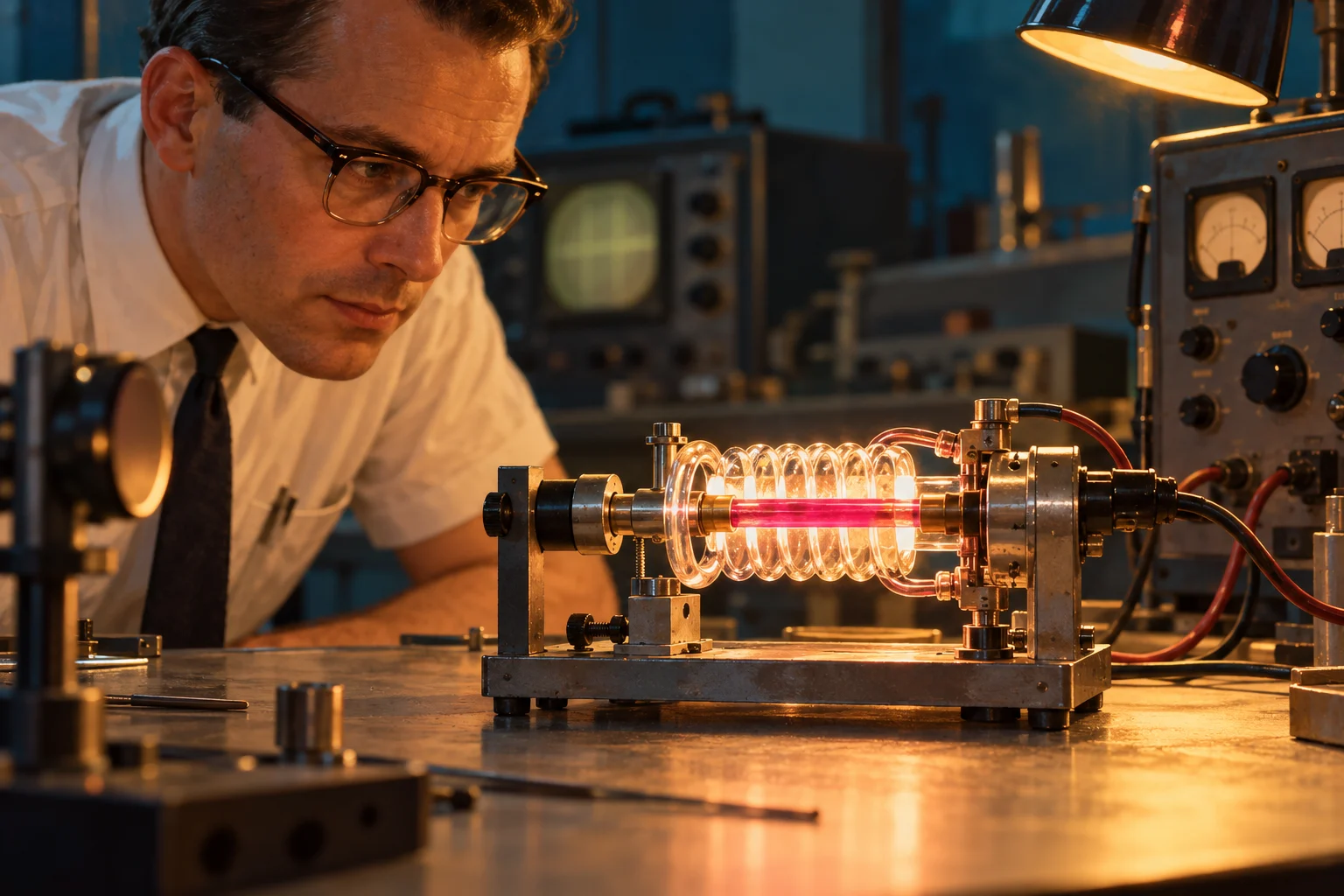
The lamp supplied energy as light, exciting the ruby’s active atoms. Reflective ends allowed light to pass repeatedly through the material and become amplified. Under the right conditions, the device emitted intense pulses with the organized properties characteristic of laser light. The flashlamp was therefore more than illumination for an experiment: it was the energy pump that made the amplification process possible. A laser requires energy input as well as a suitable amplifying material.
A small apparatus, a large field
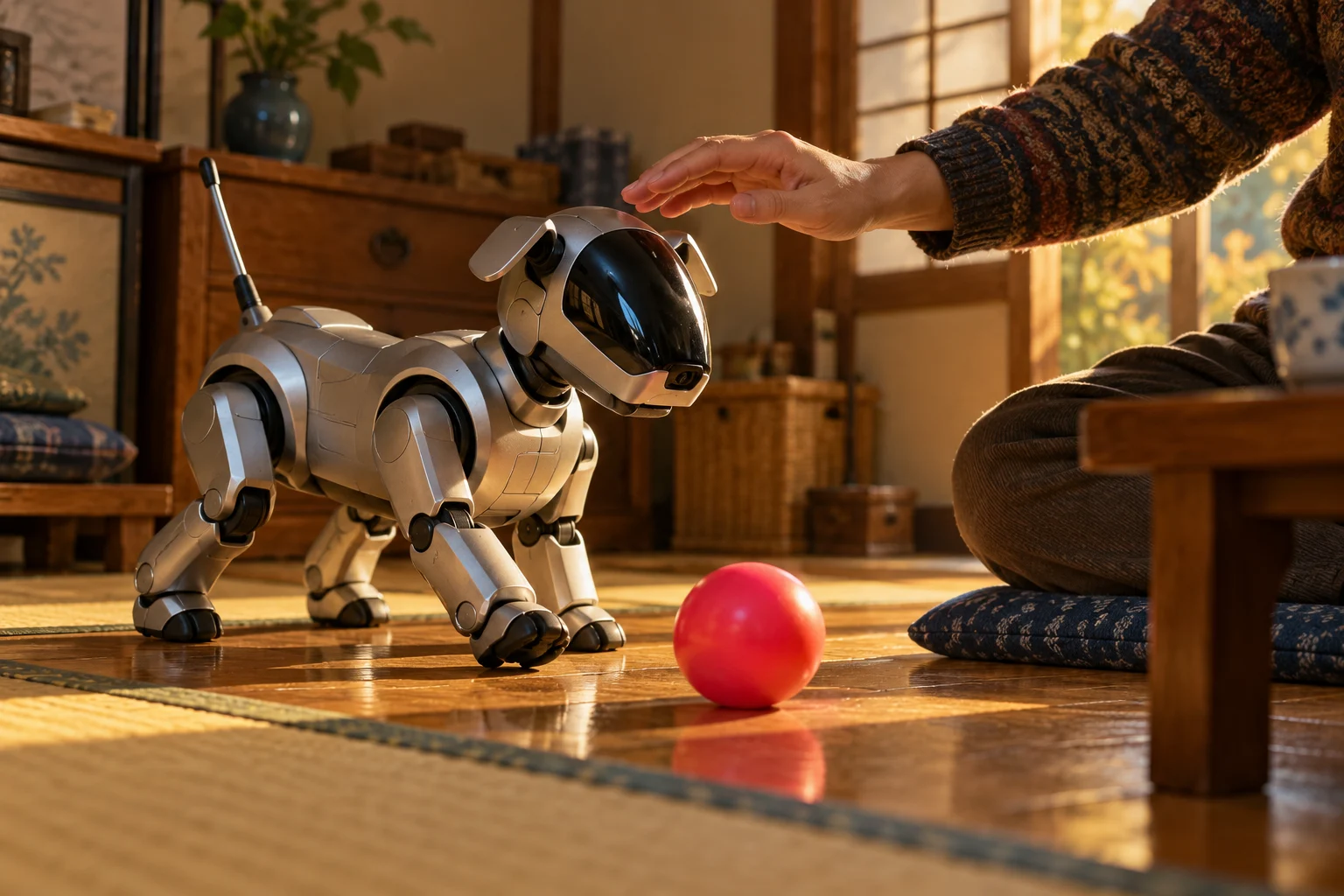
The invention soon stimulated research into many laser materials and applications. Livermore’s history describes its interest in using concentrated laser energy to study matter and pursue fusion research. HRL notes a revealing problem with publicity photographs: a photographer preferred larger components because the original apparatus seemed too small. Those images should not be treated as exact portraits of the first setup. The illustration here similarly conveys the ruby-and-flashlamp arrangement rather than claiming to reproduce a particular surviving photograph. Its historical importance lies in the operating principle demonstrated by the team.
Apache — You Must Be Hank Marvin (The Shadows Guitar Cover)
Jamie Mark Matthews, with bass by Luna Blackburn
A later guitar cover of the instrumental popularized by the Shadows in 1960 supplies a musical connection to the laser’s breakthrough year. It has no documented role in the laboratory experiment.
Listen on SoundCloud ↗Follow the evidence.
- HRL Laboratories: The First Laser ↗
- Lawrence Livermore National Laboratory: The Birth of the Laser and ICF ↗
- HRL: Sixtieth anniversary of the first laser ↗
AI-assisted writing, with institutional and primary sources. Illustration is a reconstruction, not an archival photograph. Published October 31, 2026; updated October 31, 2026. Our approach