Brasília is inaugurated as Brazil’s capital in 1960
Brasília became Brazil’s capital on 21 April 1960. Its inauguration brought government institutions to the interior and gave modernist planning an unusually ambitious national stage.
An older ambition becomes a project
The idea of moving Brazil’s capital inland long predated Brasília’s construction. The Supreme Federal Court’s historical timeline traces proposals through the nineteenth century, including the constitutional reservation of an area on the central plateau. Under President Juscelino Kubitschek, the transfer became a large construction and modernisation project. Moving government from coastal Rio de Janeiro was intended to help integrate and develop the interior, making the location of national institutions part of a wider vision for the country.
The inauguration on 21 April
Brasília was inaugurated on 21 April 1960 amid a series of official ceremonies. Government bodies had to transfer their practical work as well as their symbolic presence. The Supreme Federal Court’s records document debate over whether the new city was ready, followed by the opening of its headquarters on the scheduled date. The National Press also inaugurated its new premises that day. A capital needed courts, offices and the means to publish official decisions, not only impressive buildings. Brazilian Supreme Federal Court: timeline of the move to Brasília.
A city composed at a large scale
Urban planner Lúcio Costa and architect Oscar Niemeyer brought together a city plan and distinctive public architecture. Costa’s intersecting axes organised movement and ceremonial space, while residential superblocks represented ideas about a different form of urban living. Niemeyer’s National Congress combined towers with contrasting curved forms. UNESCO recognises the close relationship between overall layout and individual buildings. The achievement can be understood as an attempt to make architecture, transport, housing and the representation of government belong to a coordinated design. UNESCO World Heritage Centre: Brasília.
An opening rather than a finished city
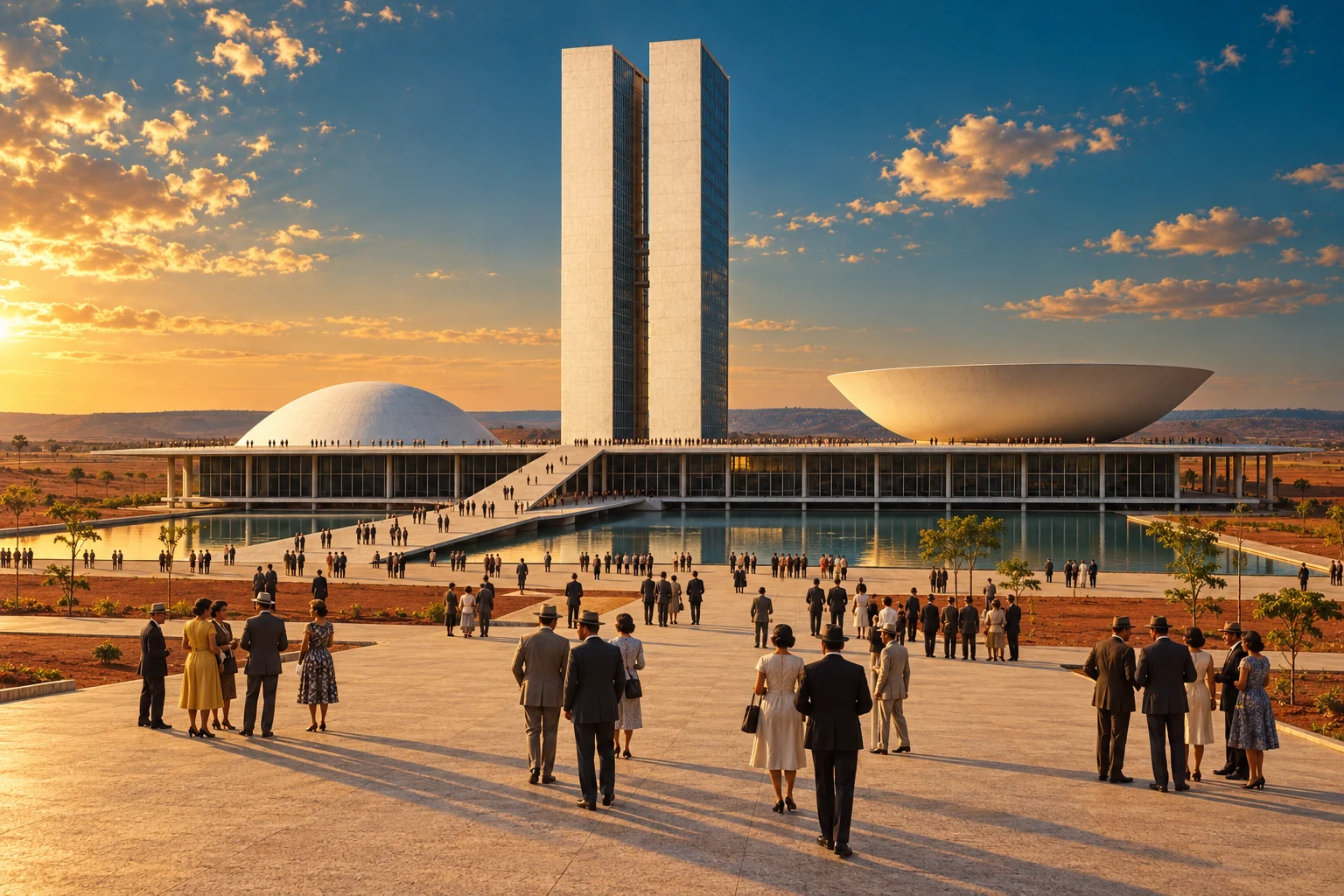
Inauguration established the new capital’s role but did not bring urban development to an end. UNESCO’s assessment discusses continuing services, development pressures and transport needs alongside the preservation of the original plan. Brasília is therefore both a celebrated modernist composition and an inhabited city that keeps changing. Its national significance cannot be reduced to a view of monuments alone. The illustration evokes the Congress and public gathering in 1960, without claiming to reconstruct a particular ceremonial photograph.
Tico Tico No Fuba
Lady Fingers guitar duo
A later guitar-duo performance of Zequinha de Abreu’s Brazilian choro supplies Brazilian cultural context. The piece predates Brasília; this is not music documented at the 1960 inauguration.
Listen on SoundCloud ↗Follow the evidence.
- Brazilian Supreme Federal Court: timeline of the move to Brasília ↗
- UNESCO World Heritage Centre: Brasília ↗
- Brazilian National Press: transfer to Brasília ↗
AI-assisted writing, with institutional and primary sources. Illustration is a reconstruction, not an archival photograph. Published October 31, 2026; updated October 31, 2026. Our approach