The Guggenheim Museum opens with Wright’s spiral galleries
The Guggenheim’s Frank Lloyd Wright building opened in New York on 21 October 1959. Its continuous gallery ramp embodied an unusual visitor itinerary: travel upward by elevator, then look at art while walking gradually downward.
A collection seeking a different home
Solomon R. Guggenheim’s collection developed with the guidance of artist and curator Hilla Rebay, who championed non-objective painting. By the early 1940s, the institution needed a permanent home. Rebay approached Frank Lloyd Wright in 1943 with ambitions extending beyond a conventional sequence of exhibition rooms. The project became a lengthy negotiation between collection, architecture and practical museum requirements. Its Fifth Avenue location beside Central Park offered a setting where the building’s flowing forms could stand apart from Manhattan’s street grid.
Opening the spiral
The new museum opened on 21 October 1959, six months after Wright’s death. The museum’s own building history records the date and his intended top-down experience. Visitors would enter at ground level, take an elevator to the upper galleries and descend a continuous ramp. The arrangement promised a visit without repeatedly doubling back through rooms. The journey through the building was therefore part of the design’s purpose, alongside the display of paintings.
An architectural promenade
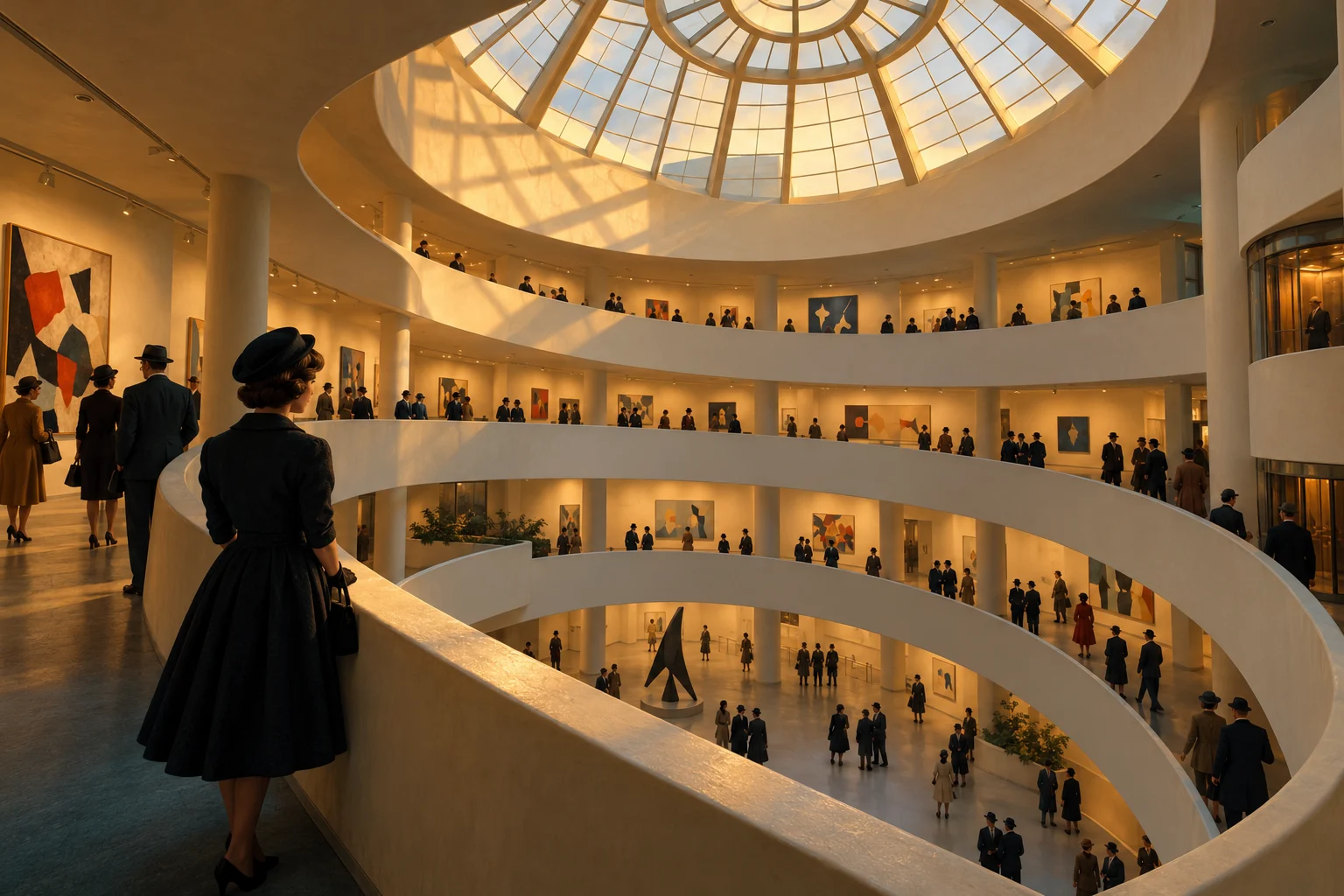
The ramp curls around an open rotunda beneath a skylight. Looking across the central space allows visitors to see other people and distant gallery bays while remaining aware of the whole building. Wright used geometry and forms suggestive of nature to connect these experiences. The resulting museum made movement unusually prominent: a visitor’s view changes as the path turns, and works seen nearby may later be glimpsed from across the void. Architecture helps organize attention as well as circulation.
Admiration, objections and actual use
The building attracted both praise and criticism. Admirers saw an extraordinary synthesis of art and architecture; critics worried that its powerful personality competed with the collection. Wright’s intended route should also be distinguished from a compulsory rule for every visitor or later exhibition. A design proposal does not establish how every person used a building. The accompanying illustration evokes the early rotunda with imagined visitors and artworks; it does not document the exact arrangement of the inaugural exhibition.
Take the "A" Train (Billy Strayhorn / Joya Sherrill)
Lady In Jazz, featuring Françoise Moulineau
A later vocal performance of the New York jazz standard evokes the city's musical setting. Lady In Jazz recorded its album in France in 2011–2012; this is not audio from the museum opening.
Listen on SoundCloud ↗Follow the evidence.
- Guggenheim: Museum welcome packet and building history ↗
- Guggenheim: Architecture teaching resource ↗
- HISTORY: Guggenheim Museum opens in New York City ↗
- Lady In Jazz: Take the A Train ↗
AI-assisted writing, with institutional and primary sources. Illustration is a reconstruction, not an archival photograph. Published October 31, 2026; updated October 31, 2026. Our approach