Sputnik 2 launches Laika into orbit on 3 November 1957
Laika became the first animal to orbit Earth aboard Sputnik 2 on 3 November 1957. The mission carried biological monitoring equipment but lacked a recovery system, making the achievement inseparable from the dog’s death.
From a satellite to a living passenger
Less than a month after Sputnik 1, the Soviet Union launched a much heavier spacecraft with an animal compartment. On 3 November 1957, Sputnik 2 carried Laika into Earth orbit. Earlier animal flights had reached space on suborbital trajectories, so the important distinction was orbiting Earth rather than simply crossing an altitude threshold. NASA’s historical account identifies Laika as the first animal to make that orbital journey.
What the spacecraft could measure
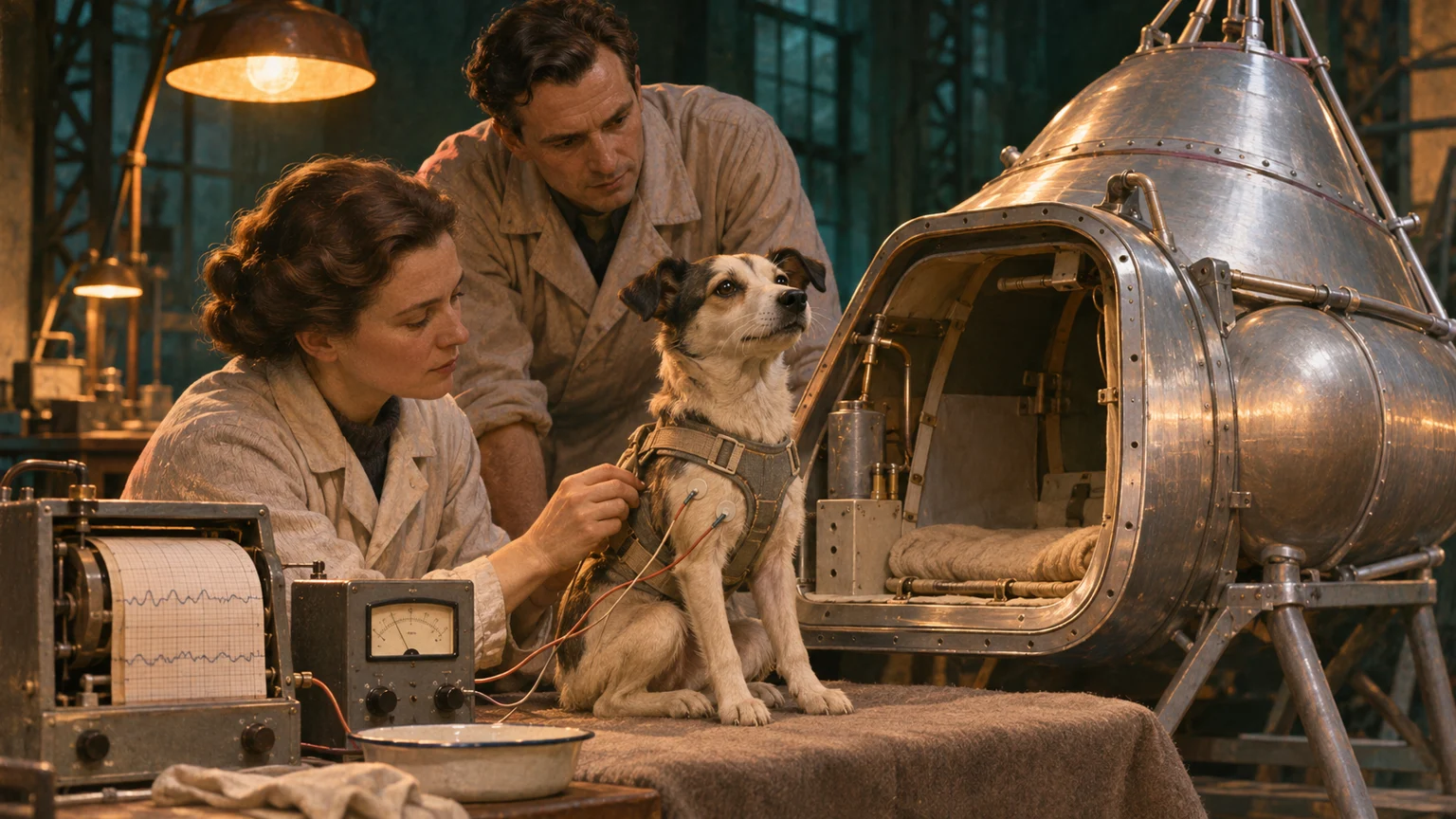
The flight formed part of early efforts to understand whether a living organism could endure launch and weightlessness. Laika’s compartment included life-support arrangements and medical instrumentation. The historical documents collected in NASA’s Exploring the Unknown describe measurements including heart activity and respiration. Data could be transmitted from the spacecraft, allowing researchers to follow some physiological responses without a person aboard. Monitoring and keeping an animal alive were related challenges, but neither alone solved the problem of returning her.
The missing return journey
Sputnik 2 had been prepared hurriedly, and no provision was made to recover its passenger. NASA’s modern account considers it likely that Laika survived only a few hours after reaching orbit, rather than the much longer period suggested in early public accounts. The inadequate environmental-control development is central to that conclusion. The satellite itself continued circling Earth after the biological mission had ended and eventually burned up during re-entry in April 1958. Its continued orbit should not be confused with Laika’s survival.
Achievement and responsibility
The mission supplied evidence relevant to later human spaceflight, but a full account must include the suffering and lack of recovery planning. NASA’s broader animal-flight history places Laika among many animals used in this research. Later orbital flights would demonstrate safe return as well as ascent. The illustration offers a respectful interpretation of preparation and monitoring, not an archival photograph. It keeps attention on the living passenger whose fate makes this milestone scientifically significant and ethically troubling.
Shostakovich Waltz No2 for Piano
Kyle Landry, piano
Landry’s modern piano performance uses a waltz originating in Shostakovich’s 1955–56 film music, providing Soviet-era cultural context. It was not music played aboard Sputnik 2 or recorded on the launch date.
Listen on SoundCloud ↗Follow the evidence.
- NASA: the first animal in orbit ↗
- NASA: a brief history of animals in space ↗
- NASA: Exploring the Unknown, volume VI ↗
- Boston Symphony Orchestra: Shostakovich’s Waltz No. 2 ↗
- SoundCloud: Shostakovich Waltz No2 for Piano ↗
AI-assisted writing, with institutional and primary sources. Illustration is a reconstruction, not an archival photograph. Published November 3, 2026; updated November 3, 2026. Our approach