Ghana's independence and Commonwealth membership in 1957
On 6 March 1957, Ghana became independent and joined the Commonwealth. The paired events illustrate how a relationship rooted in empire could continue as cooperation between sovereign states.
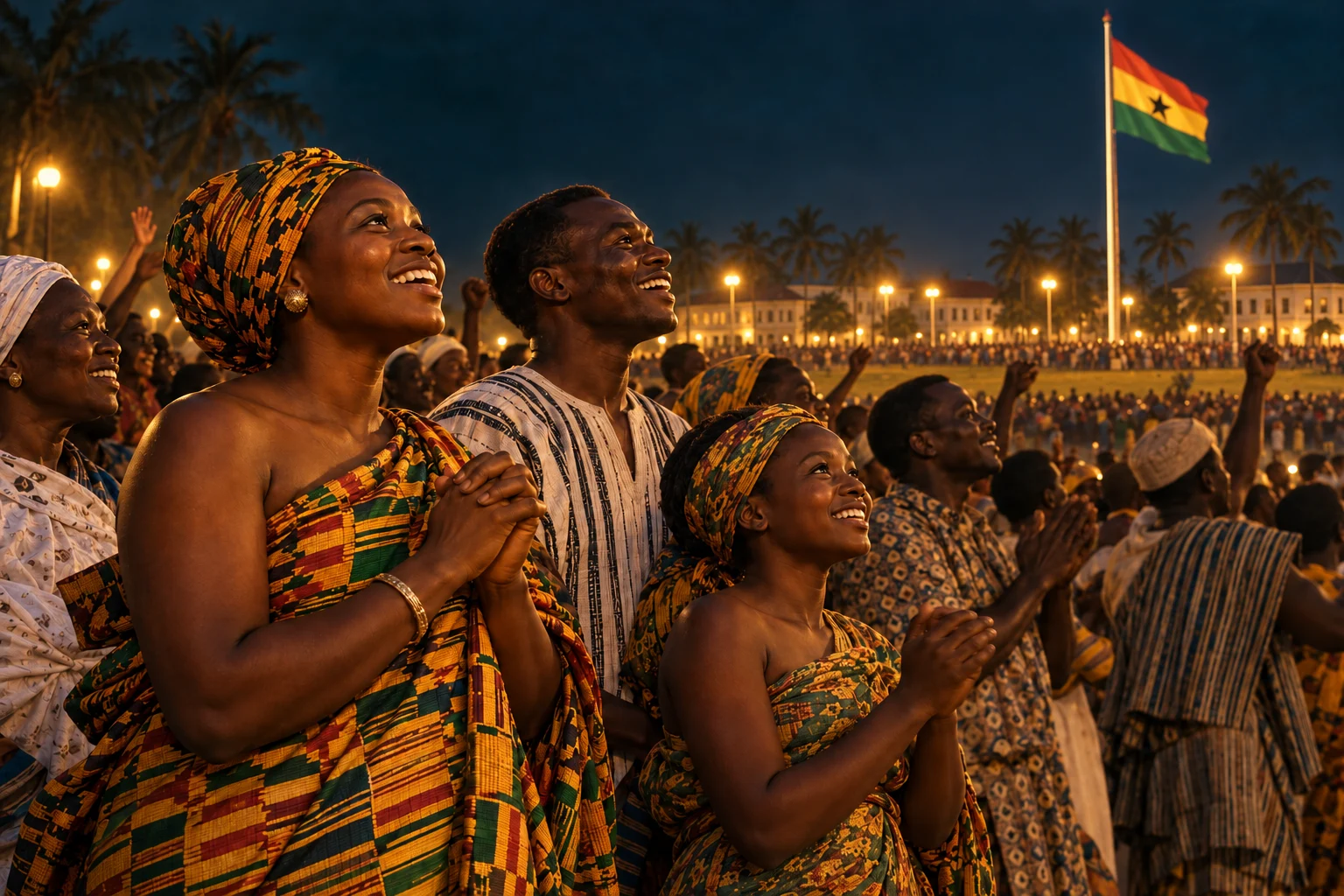
The flag changes in Accra
At the opening of 6 March 1957, Ghana's independence celebrations marked the end of British colonial rule. The Union Jack came down and Ghana's new flag rose. The country previously known under colonial administration as the Gold Coast entered a new constitutional era. The ceremony drew large crowds and international visitors. A Ghana Information Services commemorative volume, preserved by the University of Ghana, records the importance attached to that day by the new country's own public institutions. Stanford King Institute.
An association that had changed
Ghana also became the Commonwealth's ninth member on 6 March. This did not restore British rule under another name. The modern association had developed through negotiations over the independence of former imperial territories. In 1949, the London Declaration allowed India to remain a member after becoming a republic. That change helped establish a Commonwealth whose members could have different constitutional arrangements while cooperating as free and equal states. Membership and colonial subordination were therefore different political relationships. Commonwealth history.
An event watched across borders
Martin Luther King Jr. and Coretta Scott King travelled to Ghana for the celebrations. Stanford's King Institute documents their attendance and the links King drew between African independence and the American struggle against racial discrimination. Their presence shows that Ghana's transition mattered beyond diplomatic protocol. People elsewhere interpreted it through their own campaigns for freedom. Those comparisons did not make different struggles identical, but they helped create conversations and connections across the Atlantic at a significant moment. Stanford King Institute.
Public memory through records and music
Independence survived in more than speeches and official dates. Government publications preserved the celebrations, while popular music carried the excitement into everyday life. E. T. Mensah composed Ghana Freedom Highlife in 1957, connecting the new nation to a lively West African musical culture. These sources reveal different aspects of the occasion: constitutional change, public celebration and cultural expression. The accompanying illustration is an imagined crowd scene, not a photograph establishing the appearance or attendance of a particular family. Highlife archive.
Ghana Land of Freedom — E. T. Mensah cover
Steve Noa
Steve Noa's later cover revisits Mensah's independence-era celebration. Mensah composed Ghana Freedom Highlife in 1957; this is a modern tribute, not audio from the independence ceremony.
Listen on SoundCloud ↗Follow the evidence.
- Commonwealth: Our history ↗
- Stanford King Institute: Ghana Trip ↗
- University of Ghana: Ghana is born, 6th March 1957 ↗
- Daniel Langlois Foundation: E. T. Mensah ↗
AI-assisted writing, with institutional and primary sources. Illustration is a reconstruction, not an archival photograph. Published October 31, 2026; updated October 31, 2026. Our approach