Que Sera Sera makes the first South Pole aircraft landing
On 31 October 1956, the U.S. Navy transport Que Sera Sera landed at the South Pole. The ski-equipped aircraft carried a name borrowed from a contemporary popular song.
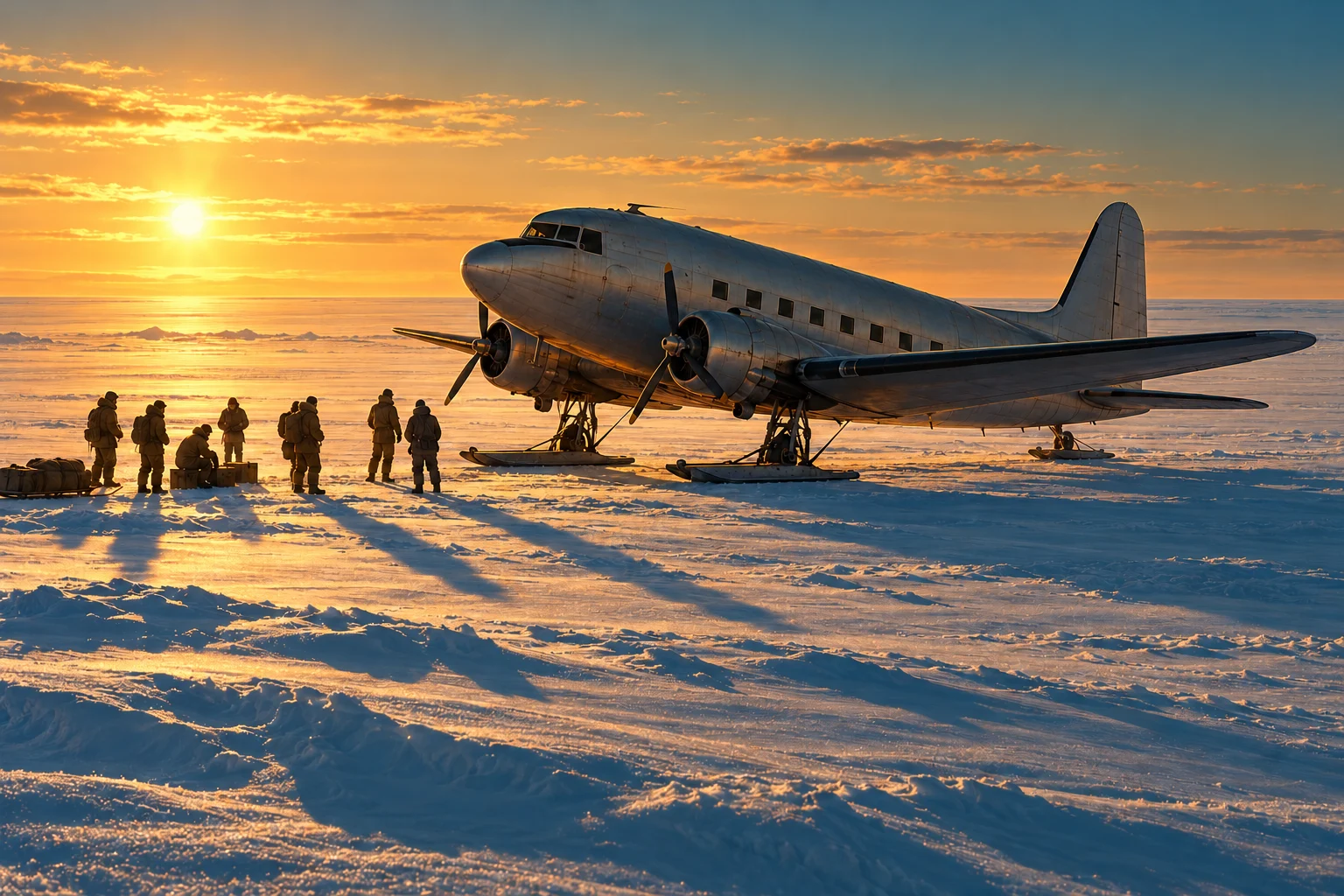
An aircraft adapted for ice
The Douglas R4D-5L was a military relative of the DC-3 transport. For Antarctic work it carried skis and other modifications, turning a familiar aircraft design into a machine suited to an extraordinary environment. The plane that reached the South Pole bore the name Que Sera Sera, after the popular song sung by Doris Day. A piece of everyday musical culture thus accompanied a demanding expedition into a landscape with very little room for mechanical failure.
The landing on 31 October
Pilot Lieutenant Commander Conrad “Gus” Shinn landed the aircraft on 31 October 1956, with expedition commander Rear Admiral George Dufek aboard. Seven men travelled on the flight. This was the first airplane landing at the geographic South Pole, rather than the first flight over it: Richard Byrd and his crew had flown over the pole in 1929. The distinction separates reaching a location from the air from actually putting an aircraft and its occupants onto the ice. National Naval Aviation Museum: R4D-5L collection description.
Getting airborne again
Landing was only part of the challenge. The polar plateau stood at high altitude, where thin air reduced aircraft performance, while skis could freeze to the surface. Rocket-assisted takeoff bottles supplemented the engines for departure. The return flight therefore depended on careful preparation as well as the strength of the transport itself. The nickname’s relaxed association with accepting the future should not obscure how technically demanding the journey was for the people who made it. U.S. Naval Institute: Gooney Bird South.
From expedition to scientific presence
The mission formed part of Operation Deep Freeze, supporting preparations for the 1957–1958 International Geophysical Year. Air transport helped make research stations and sustained scientific work possible in Antarctica. The aircraft survives in the National Naval Aviation Museum, while the Antarctic Program’s institutional history places the flight within that larger logistical effort. The illustration evokes the transport, cold-weather clothing and flat plateau. It is an interpretive scene, not an archival photograph of the landing or the crew’s exact positions. U.S. Antarctic Program: Participant Guide 2024–2025.
Que sera (Doris Day Cover)
Gabriele C. Kunz
A later cover of the song whose title named the aircraft. Kunz performs here; this is not Doris Day’s 1956 recording or audio from the polar expedition.
Listen on SoundCloud ↗Follow the evidence.
- National Naval Aviation Museum: R4D-5L collection description ↗
- U.S. Antarctic Program: Participant Guide 2024–2025 ↗
- U.S. Naval Institute: Gooney Bird South ↗
AI-assisted writing, with institutional and primary sources. Illustration is a reconstruction, not an archival photograph. Published October 31, 2026; updated October 31, 2026. Our approach