The 1956 Women's March against pass laws in Pretoria
On 9 August 1956, thousands of South African women gathered at the Union Buildings in Pretoria to oppose apartheid pass controls. Their organized protest made freedom of movement and women's political agency visible on a national scale.
Documents that controlled daily life
Apartheid pass laws were instruments for controlling Black South Africans' movement, residence and access to work. Extending these controls to women threatened family life and livelihoods as well as individual freedom. Opposition drew on earlier women's campaigns against permits and on newer networks of organization. The South African government's historical account identifies the 1956 march as a protest against tighter control of Black women's movement in urban areas. The issue concerned coercive administration, rather than an ordinary identity document.
The gathering on 9 August
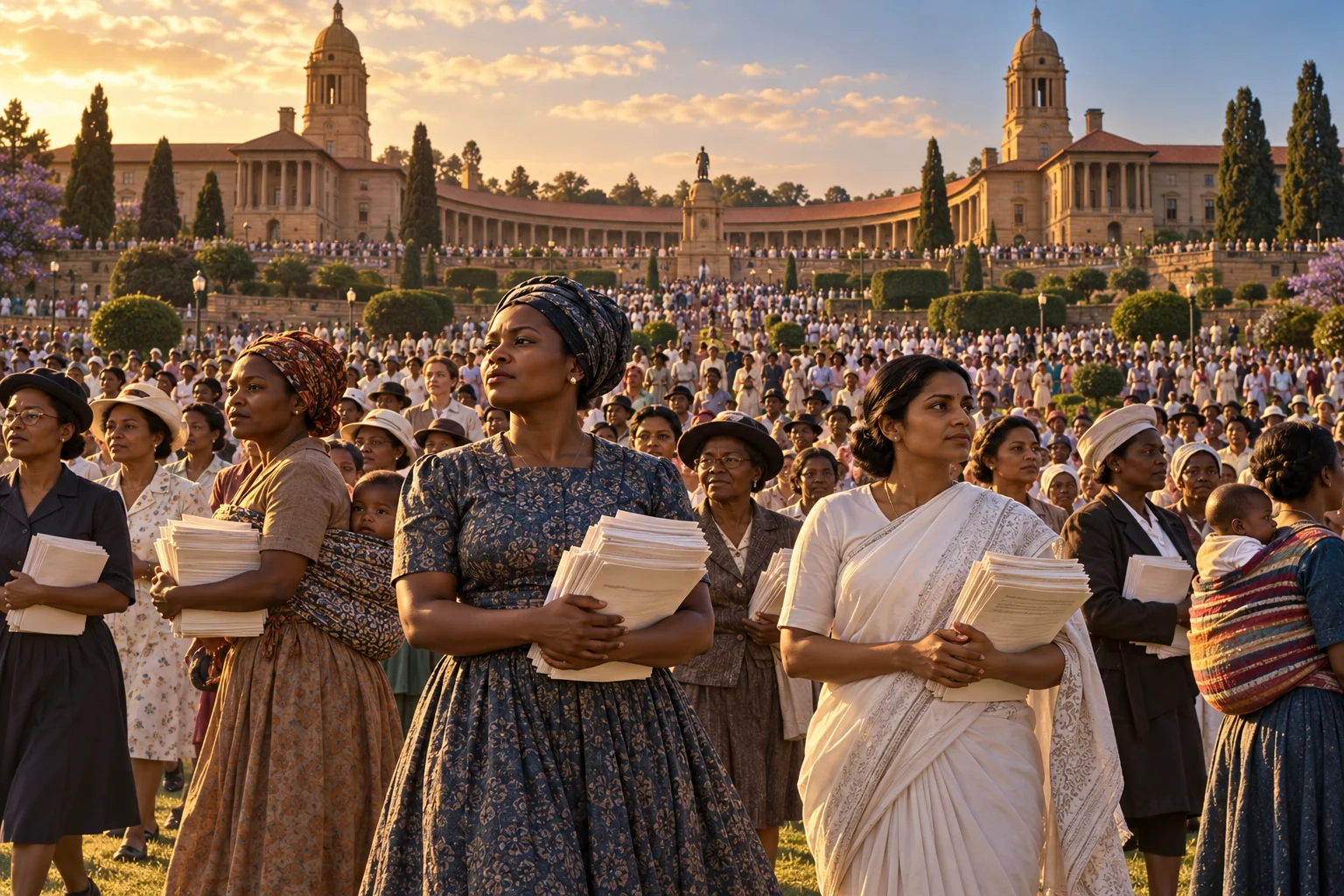
Women travelled from different parts of South Africa to Pretoria on 9 August 1956. They assembled at the Union Buildings carrying petitions, some accompanied by children. The crowd crossed racial and cultural boundaries. Its size is commonly given as about 20,000, though historical estimates vary. South African History Online's detailed account records a range of roughly 10,000 to 20,000. The uncertainty concerns the precise count, not the date or the protest's purpose.
Organization and disciplined protest
The Federation of South African Women played a central role in preparing the demonstration. Prominent leaders included Lilian Ngoyi, Helen Joseph, Rahima Moosa and Sophia Williams-De Bruyn. The prime minister did not meet the delegation, and the petitions were left at his office. A sustained period of silence formed part of the protest. A second SAHO study examines the leadership and the march's place in women's political mobilization, emphasizing the work required to turn opposition into collective action.
Meaning beyond a single day
The march did not immediately end the pass system. Its significance included challenging assumptions that women were marginal to organized resistance and demonstrating coordination across a divided society. The date later became South Africa's National Women's Day. Remembering the march therefore requires attention both to its immediate demand and to its longer place in public memory. The illustration imagines women carrying petitions in the Union Buildings grounds. It is not an archival photograph, and its individual faces do not identify documented participants.
Nkosi Sikelel' iAfrika
Soweto Gospel Choir
A later Soweto Gospel Choir performance connects with the hymn sung by participants before leaving the 1956 demonstration. This recording is not audio captured at the march.
Listen on SoundCloud ↗Follow the evidence.
- South African Government: Women's Day and the 1956 march ↗
- South African History Online: The 1956 Women's March, Pretoria, 9 August ↗
- South African History Online: Women's March, organization and legacy ↗
AI-assisted writing, with institutional and primary sources. Illustration is a reconstruction, not an archival photograph. Published October 31, 2026; updated October 31, 2026. Our approach