The first Eurovision Song Contest in Lugano, 1956
The first Eurovision Song Contest took place in Lugano on 24 May 1956. Seven countries supplied fourteen songs, and an intimate evening of orchestral pop launched an enduring experiment in international broadcasting.
A contest built for broadcasting
The Eurovision Song Contest began as a collaboration between broadcasters rather than a competition between touring bands. Inspired by the Sanremo festival in Italy, its organizers sought a shared entertainment programme that could cross national borders. The first contest brought representatives of Belgium, France, West Germany, Italy, Luxembourg, the Netherlands and Switzerland to the Teatro Kursaal in Lugano. Its setting was a small theatre, far removed from the large arenas associated with later editions.
An evening with fourteen entries
On 24 May 1956, each participating broadcaster supplied two songs. A country could use the same performer for both or send different singers. Switzerland chose Lys Assia for its German-language Das alte Karussell and French-language Refrain. Soloists sang with a 24-piece orchestra, and groups were excluded. These arrangements are documented in the official event history. They show that several rules now regarded as essential to Eurovision were still unsettled at its beginning.
A winner without a published scoreboard
The voting arrangements were equally unfamiliar. Two jurors represented each country, and juries could support their own entries. Swiss representatives also voted for Luxembourg when its jurors could not attend. Assia won with Refrain, but the organizers did not publish a complete final ranking. The absence of a public scoreboard has encouraged speculation about the other placings. It does not, by itself, establish that the result was manipulated; a missing record and proof of misconduct are different things.
What survives of the first night
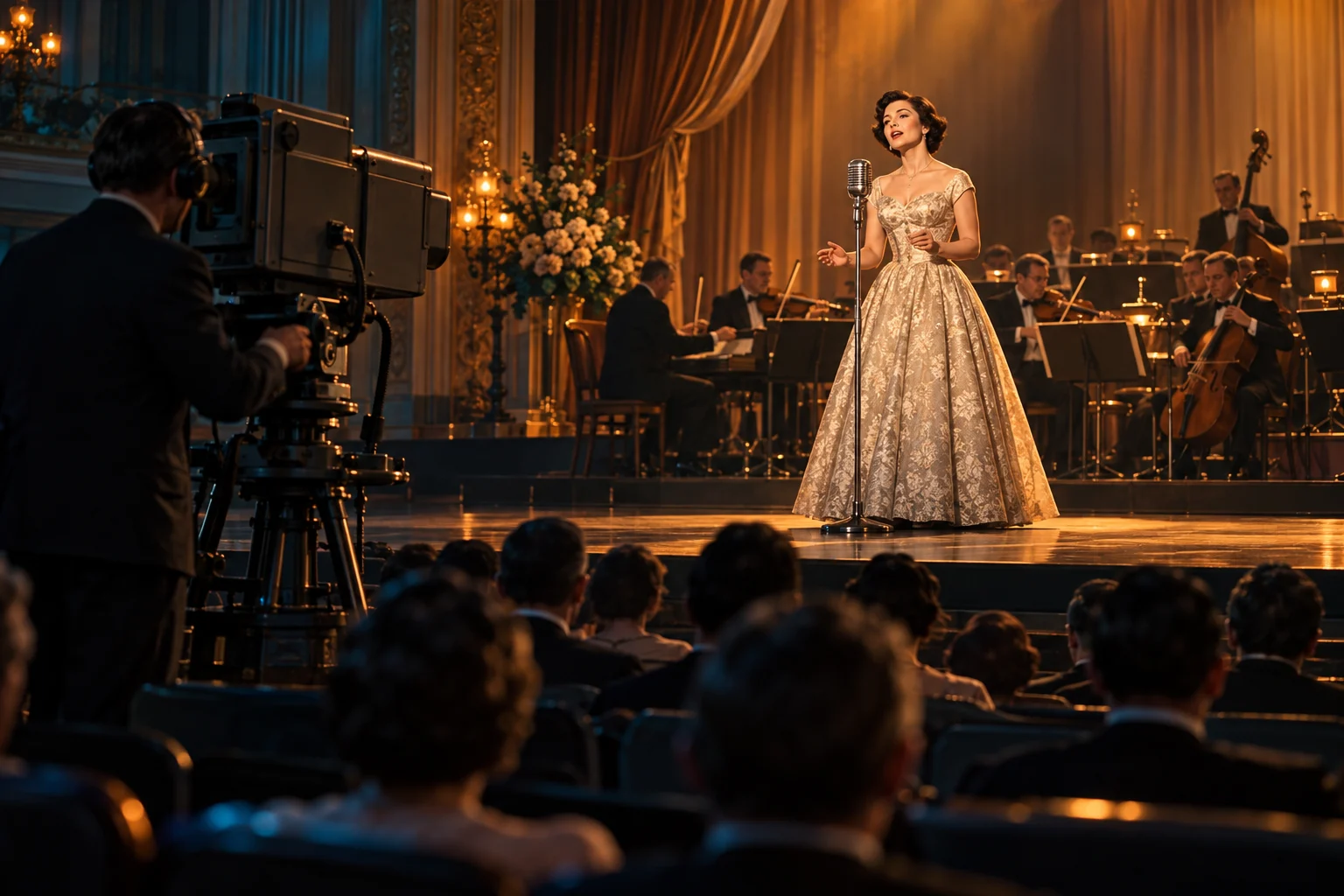
The surviving visual record is incomplete. The EBU identifies footage of Assia repeating the winning song as a rare surviving glimpse of the evening and announced its restoration in 2026. That reprise should not be mistaken for a complete film of the competition. Photographs and audio preserve other aspects of the occasion. The accompanying illustration imagines the period atmosphere and broadcasting equipment; it is not an archival view or a reconstruction of a particular surviving film frame.
Refrain: acoustic cover of 1956s Eurovision Song Contest winner
Emily's Escape
An acoustic cover of Lugano's winning song, uploaded for Eurovision's sixtieth anniversary. This is a later performance, not the 1956 broadcast.
Listen on SoundCloud ↗Follow the evidence.
- Eurovision: Lugano 1956 ↗
- NDR: The first Eurovision in Lugano ↗
- EBU: Seventy years since the first contest ↗
- Emily's Escape: Refrain acoustic cover ↗
AI-assisted writing, with institutional and primary sources. Illustration is a reconstruction, not an archival photograph. Published October 31, 2026; updated October 31, 2026. Our approach