Godzilla’s 1954 Japanese Release and the Creation of Its Roar
Godzilla opened nationwide in Japan on 3 November 1954. Alongside its miniature effects and creature performance, the film introduced a distinctive roar whose starting point was a double bass played in an unconventional way.
The film reaches Japanese audiences
Ishirō Honda’s Godzilla received its nationwide Japanese release on 3 November 1954. The film combined a story of a giant creature with anxieties about nuclear weapons and their consequences. Honda’s official site preserves his statement that the fiction should convey the fear and despair of destruction. The film’s historical meaning therefore extends beyond the novelty of a monster, even when attention turns to the ingenious craft that made it convincing. Honda archive
Building a voice for an invented creature
A recognizable screen creature needs a sound that seems to belong to its body. For the original Godzilla, composer Akira Ifukube proposed using a musical instrument after animal sounds proved unsatisfactory. The basis of the roar came from dragging a resin-coated leather glove against a loosened double-bass string. The friction produced an unusual vibrating sound that could become part of the creature’s recorded voice. A familiar instrument supplied material for an unfamiliar character. NPR interview
What the sound-design evidence establishes
The NPR account includes explanations by Ethan Van der Ryn and Erik Aadahl, sound designers for the 2014 film, who describe the earlier technique while discussing their own work. This is a later professional account, not a recording log from 1954. It supports the central double-bass explanation without justifying a detailed reconstruction of every recording and processing step. Different descriptions of the roar should not be treated as proof that its creation involved an actual roaring animal.
A release date and a production history
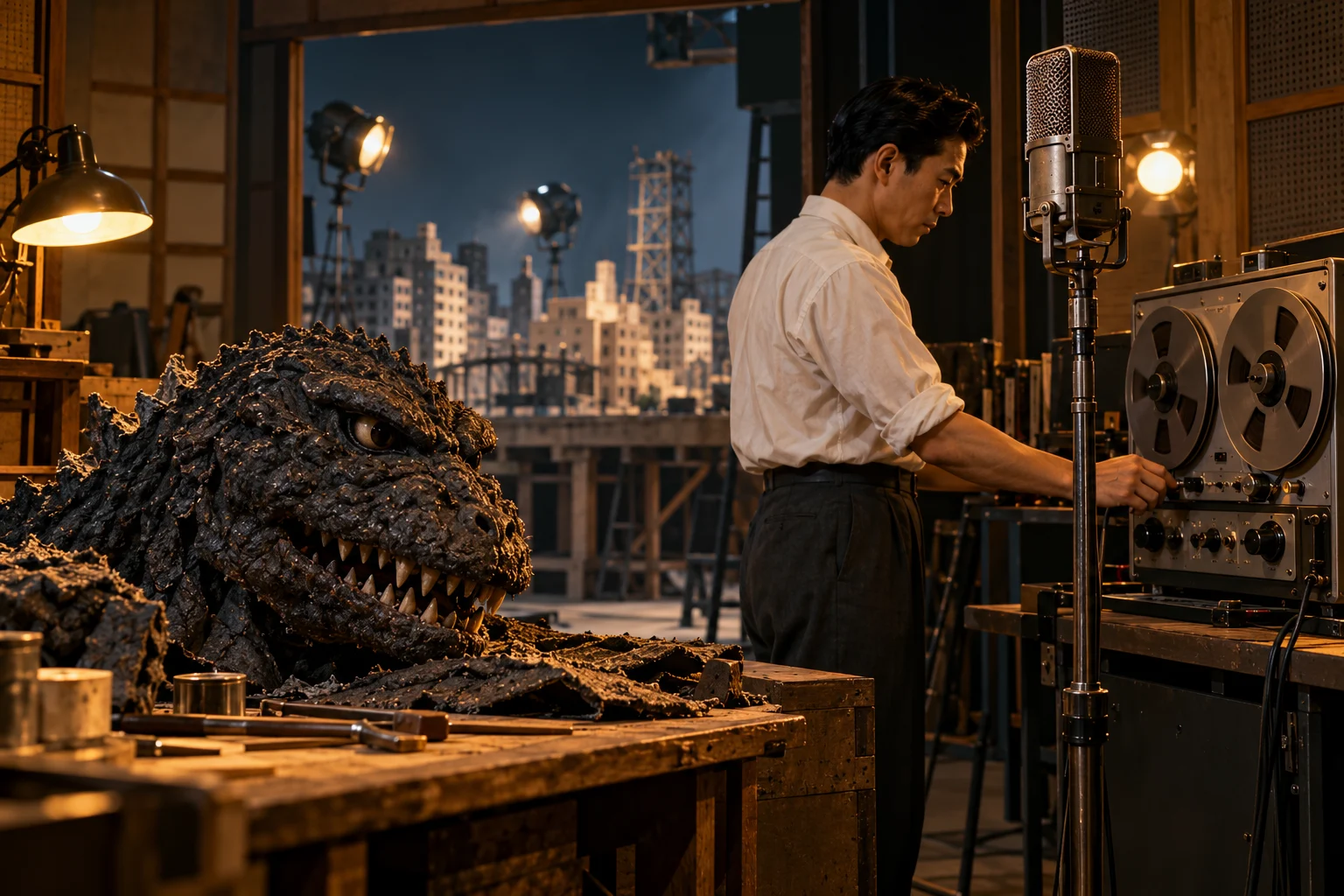
The date used here marks the film’s nationwide release, rather than a claim that its roar was recorded that day. An earlier Nagoya screening is sometimes identified as the premiere, so release and premiere should not be used interchangeably. Toho and Honda’s official film information identify 3 November as the Japanese release date. The illustration imagines a studio’s working atmosphere; its equipment and arrangement do not constitute evidence of a particular recording session. Toho
Godzilla Theme "Epic Rock" Cover
Little V Mills
Mills’s modern rock cover is a later musical tribute to Godzilla. It connects with the film’s enduring screen legacy and is not the original 1954 recording.
Listen on SoundCloud ↗Follow the evidence.
- Ishirō Honda official site: Godzilla release and production ↗
- NPR interview: crafting Godzilla’s iconic sound ↗
- Toho: Godzilla, 1954 ↗
AI-assisted writing, with institutional and primary sources. Illustration is a reconstruction, not an archival photograph. Published October 31, 2026; updated October 31, 2026. Our approach