Elvis records That’s All Right with a drummerless trio
Elvis Presley recorded That’s All Right in Memphis on 5 July 1954. The performance that launched his commercial recording career used acoustic guitar, electric guitar and double bass, with no drum kit or additional instrumental backing.
A blues song before an Elvis record
That’s All Right was written and recorded by Arthur “Big Boy” Crudup before Elvis Presley brought it into Sam Phillips’s Memphis studio. Remembering that origin places the session within an existing musical tradition rather than treating it as creation from nothing. Presley had been seeking a way to make an impression, and the audition included ballads that did not produce the desired breakthrough. The eventual recording emerged from musicians trying something different while they were together in the room.
The session of 5 July
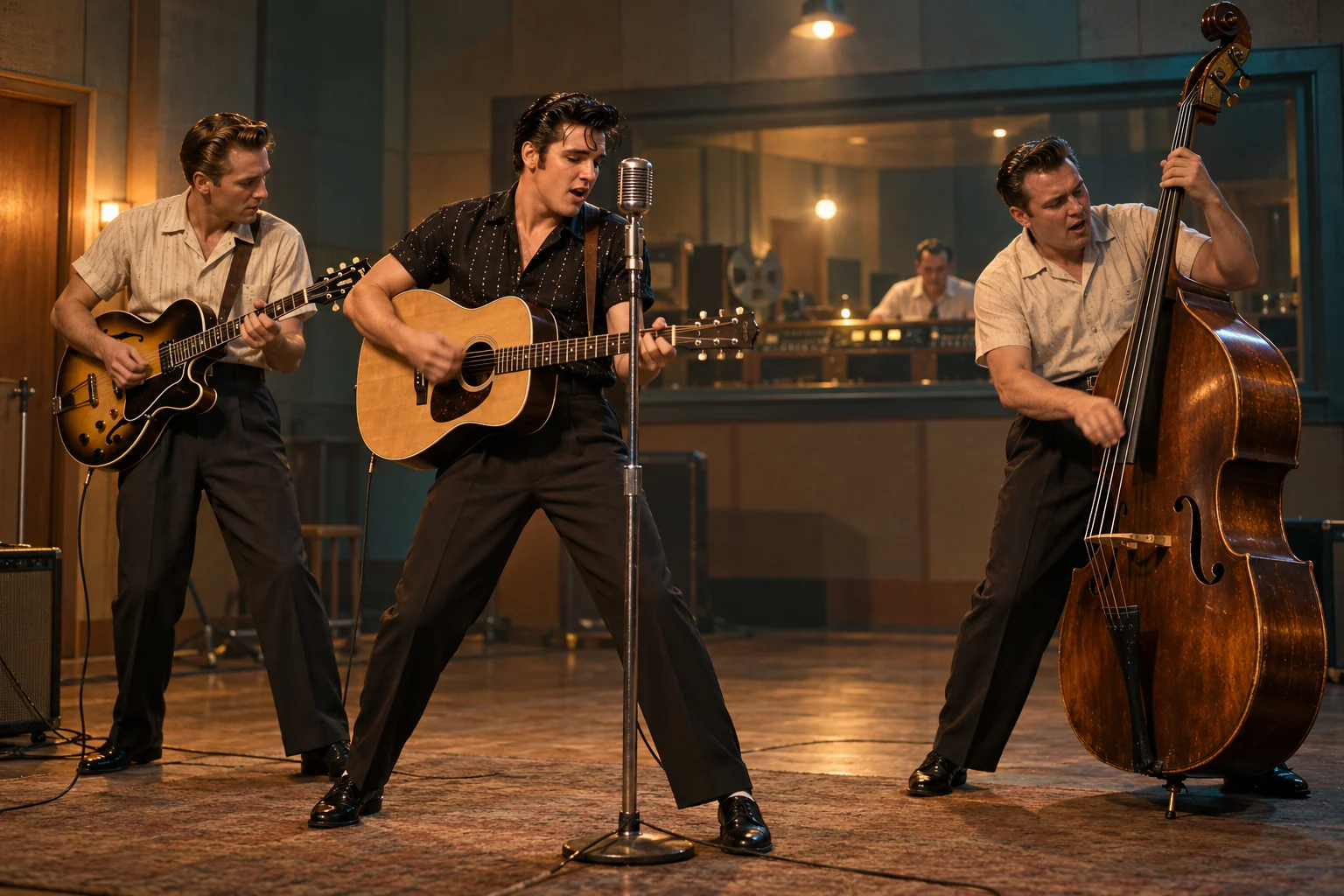
The decisive performance was recorded on 5 July 1954. Presley supplied voice and acoustic rhythm guitar, Scotty Moore played electric guitar, and Bill Black played double bass. Graceland’s description of the surviving acetate explicitly identifies those instruments and states that there were no others. The acetate’s provenance provides material evidence for a small ensemble whose rhythmic energy can suggest a larger band. A drum kit was not required to make the performance feel propulsive.
An informal change that became a record
The official Elvis recording history describes Presley beginning the blues during a break, after hesitant attempts at sentimental material. Phillips recognized something worth recording in the change of approach. The resulting single, coupled with Blue Moon of Kentucky, was released on 19 July. Recording and release are therefore separate events, two weeks apart. The session’s significance lies partly in the musicians’ responsiveness: a fresh treatment of familiar material was recognized as valuable before it disappeared into another informal moment.
What the breakthrough does and does not establish
This record helped launch Presley’s career and became an important rockabilly landmark. Describing it as the single moment that invented rock and roll would obscure the Black blues and other musical traditions on which it drew. Its memorable economy is a firmer claim: three instrumental roles produced a distinctive sound. The illustration imagines the studio ensemble, rather than reproducing a verified photograph of the take. The soundtrack is a later cover and should not be used to identify the original session’s personnel.
That's Alright Mama (Live Elvis Presley Cover)
Owen Martin
Martin's later live cover connects directly to the Arthur Crudup song Elvis recorded at Sun. It is a separate performance and is not presented as the original studio trio.
Listen on SoundCloud ↗Follow the evidence.
- Graceland: The original That’s All Right acetate ↗
- Elvis Presley official site: That’s All Right ↗
- Graceland: Seventieth anniversary of the recording ↗
- Owen Martin: That’s Alright Mama live cover ↗
AI-assisted writing, with institutional and primary sources. Illustration is a reconstruction, not an archival photograph. Published October 31, 2026; updated October 31, 2026. Our approach