Hillary and Tenzing reach Everest with bottled oxygen
On 29 May 1953, Edmund Hillary and Tenzing Norgay completed the first confirmed ascent of Mount Everest. Their success combined climbing experience, supplementary oxygen and a large expedition’s work along the route from Nepal.
The mountain and its thin air
Everest presents a physiological problem as well as a climbing problem. Air pressure falls with altitude, so a breath near the summit provides much less oxygen than a breath at sea level. The atmosphere has not lost all its oxygen; the pressure available to drive it into the body is lower. NASA’s account emphasizes that the expedition’s heavy oxygen equipment supplemented the climbers’ needs without eliminating the mountain’s dangers.
The ascent on 29 May
Edmund Hillary, a New Zealander, and Tenzing Norgay, an experienced Sherpa mountaineer, formed the successful summit pair in John Hunt’s British expedition. They approached from Nepal by the South Col and southeast ridge. On 29 May 1953 they climbed the final ridge and reached the top at about 11:30 a.m. Their achievement is the first confirmed ascent. Earlier attempts, including the disappearance of George Mallory and Andrew Irvine, have produced questions that cannot be resolved simply by assuming success.
A summit supported from below
The celebrated pair depended on a chain of preparation. Expedition members and Sherpa climbers established camps, moved food and equipment, and carried oxygen up the mountain. A high camp put the final objective within reach. The Royal Geographical Society describes the climb’s practical details, including frozen boots thawed before departure and the difficult rock obstacle below the summit. Such details make clear that improved equipment worked together with judgment and physical effort; it did not turn the ascent into a mechanical certainty.
Recognition and perspective
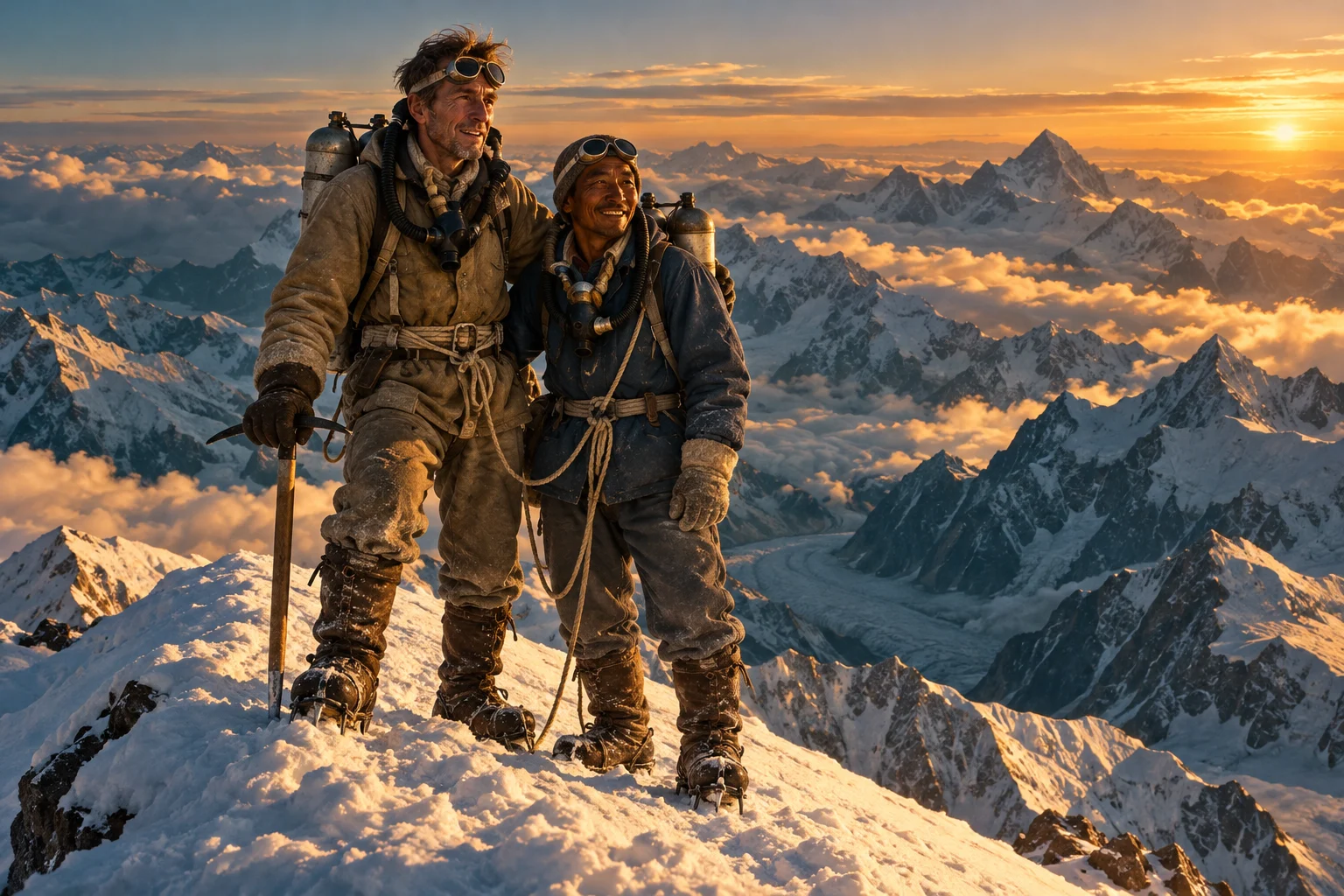
News of the ascent attracted enormous international attention. Hillary and Tenzing became public figures, but describing the expedition only through a single national hero obscures both their partnership and the labour that sustained it. Tenzing brought extensive Himalayan experience to the final climb. The event also demonstrates how exploration depended on understanding human limits. The illustration accompanying this article is an imagined historical scene emphasizing the climbers and their equipment, rather than a claim to reproduce the documented summit photograph.
Resham Firiri
Dan Sayers
Sayers's later performance of a Nepali folk song provides a connection to the mountain's Nepalese setting. His upload describes learning it on an Annapurna visit; this is not music from the 1953 expedition.
Listen on SoundCloud ↗Follow the evidence.
- NZ History: Hillary and Tenzing reach the summit ↗
- Royal Geographical Society: Mount Everest ↗
- NASA Earth Observatory: Mount Everest ↗
- Dan Sayers: Resham Firiri ↗
AI-assisted writing, with institutional and primary sources. Illustration is a reconstruction, not an archival photograph. Published October 31, 2026; updated October 31, 2026. Our approach