Premiere of John Cage’s 4′33″ at Woodstock
On 29 August 1952, David Tudor premiered John Cage’s 4′33″ near Woodstock, New York. The pianist produced no intentional notes, directing attention instead towards environmental sound and the act of listening.
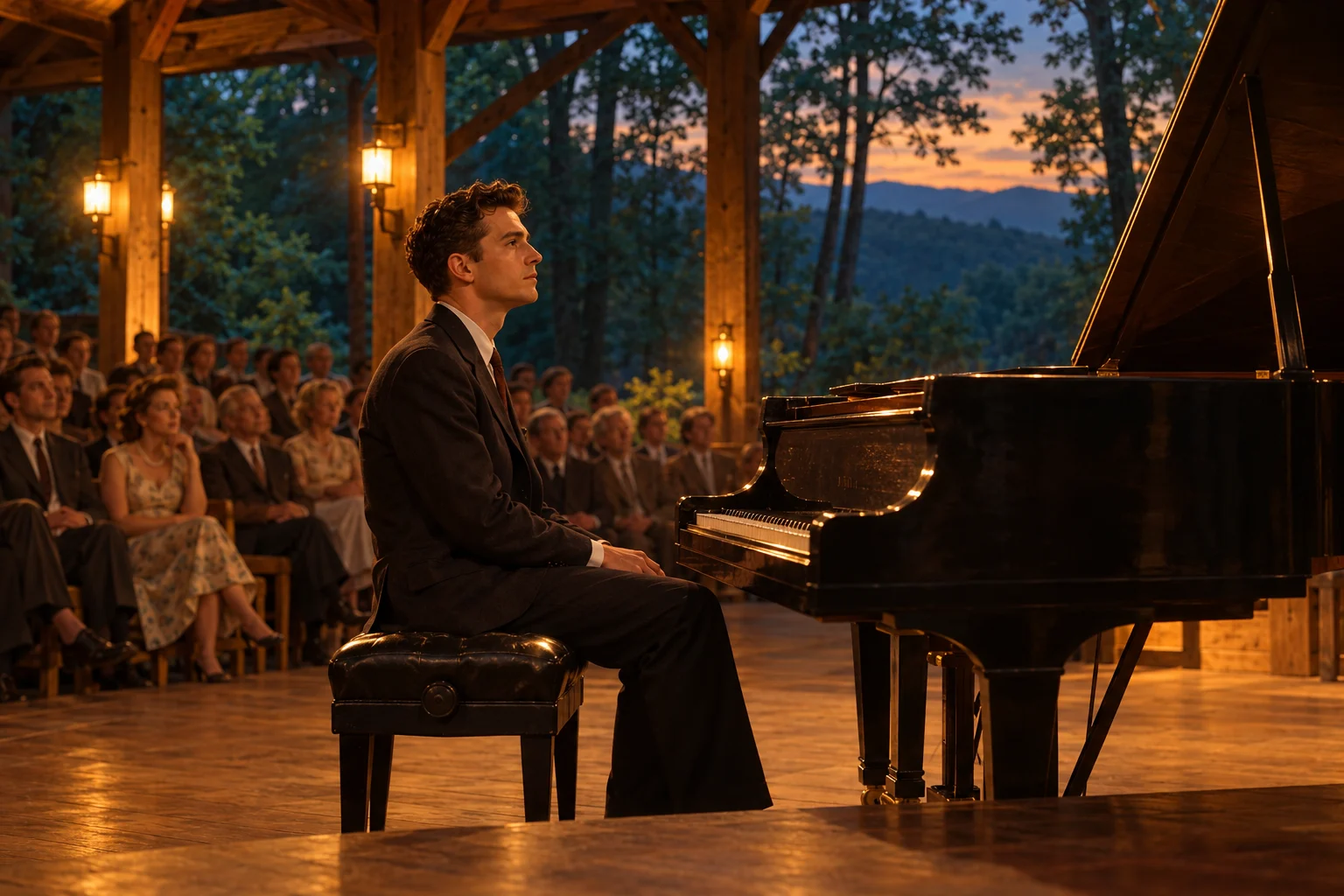
A piano recital with different expectations
A pianist entering a recital normally promises a sequence of deliberately produced notes. John Cage’s 4′33″ used that expectation as its starting point. The work asked a performer to remain silent within a defined span of time, making the surrounding acoustic world newly noticeable. Cage had considered a silent composition before 1952, and his developing interest in chance and the relationship between sound and silence helped give the idea a precise musical form. The John Cage works catalogue
The performance on 29 August 1952
David Tudor gave the first performance at the Maverick Concert Hall near Woodstock, New York, on 29 August 1952. The piece comprised three movements, together lasting four minutes and thirty-three seconds. Tudor marked their progression using the piano’s keyboard lid while refraining from playing notes. The event had the external framework of a recital performance, but the usual relationship between performer and audible material had changed. The setting and audience supplied sounds the score did not prescribe. IRCAM’s premiere record MoMA’s account
What the audience could hear
In a later recollection quoted by MoMA, Cage described wind outside, rain on the roof and sounds made by members of the audience. These details are remembered testimony, not a surviving sound recording supplied with this package. They explain why describing the work as absolute silence is misleading. The performer’s restraint allowed listeners to notice an environment that continued sounding throughout the measured interval, whether or not they welcomed the experience. MoMA on the premiere’s sounds
A composition that frames attention
The work became an enduring challenge to assumptions about what music contains and where it begins. Its significance need not depend on treating every environmental sound as identical to a composed melody. It established a deliberate situation for listening, with timing and performance making otherwise incidental sounds central. The original score is lost; later notations preserve different ways of representing the work. The accompanying timber-hall scene is a modern interpretation, not a photograph or an exact reconstruction of the premiere. The work’s history and interpretations
In a Landscape (1948)
Adam Tendler
Adam Tendler’s 2014 recording of another Cage piano work provides an audible connection to the same composer’s exploration of attention and resonance. It is not a recording of the 1952 premiere of 4′33″.
Listen on SoundCloud ↗Follow the evidence.
- MoMA — 4′33″ in proportional notation ↗
- John Cage Complete Works — 4′33″ ↗
- IRCAM — 4′33″ premiere ↗
- Adam Tendler — In a Landscape ↗
AI-assisted writing, with institutional and primary sources. Illustration is a reconstruction, not an archival photograph. Published October 31, 2026; updated October 31, 2026. Our approach