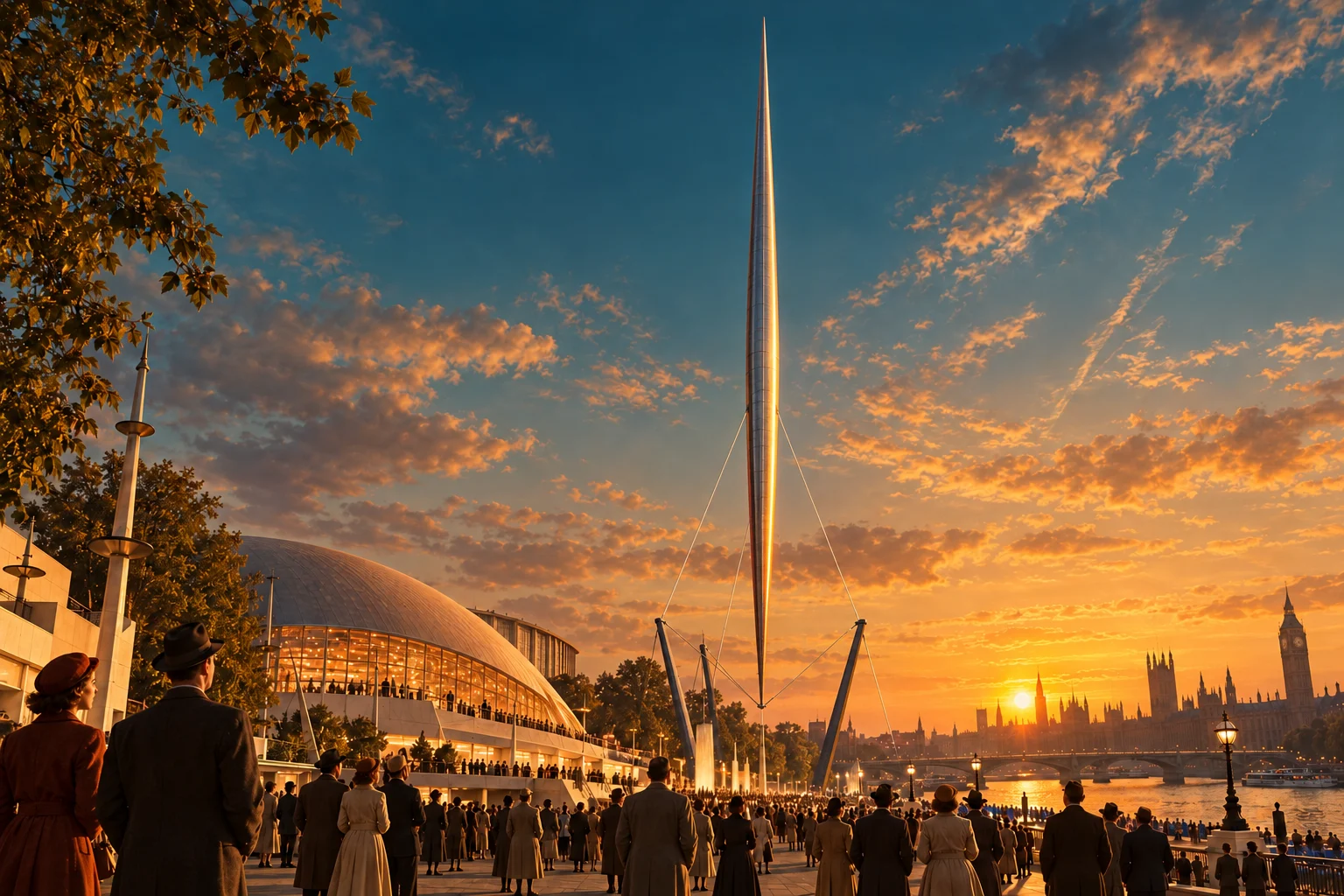
Skylon greets visitors at the opening of the Festival of Britain
The Festival of Britain’s South Bank Exhibition opened on 3 May 1951 with the Skylon as a striking vertical landmark. A cable-supported structure held its tapered body above the ground, giving visitors the impression that the tower floated.
A festival of possible futures
The Festival of Britain took place six years after the Second World War and a century after the Great Exhibition of 1851. It showcased manufacturing, science, art and design while presenting ideas for rebuilding everyday life. London’s South Bank formed its best-known exhibition site, but the wider festival was national in scope. Buildings, furnishings, textiles and displays turned modern design into something visitors could encounter directly, rather than a promise confined to architectural drawings or official speeches.
The opening and its vertical landmark
The South Bank Exhibition began on 3 May 1951. Alongside the Dome of Discovery and the Royal Festival Hall stood the Skylon, designed by architects Philip Powell and Hidalgo “Jacko” Moya with engineer Felix Samuely. Historic England’s archive describes it as the winning design for a vertical feature. Its shape provided an immediately recognizable counterpart to the low dome nearby. Both structures helped give the exhibition a visual identity that visitors could remember after the temporary displays had gone.
How a heavy structure looked weightless
The Skylon’s tapered body did not rise directly from a solid pedestal. Cables and supporting members held it above the ground, leaving a visible gap below its lower point. The V&A’s festival account describes its apparent flotation on cables. The feat was not levitation: forces were carried through a real supporting structure. Its success as a spectacle depended on making those supports visually subordinate to the gleaming central form, so engineering and perception worked together.
A temporary object with a long memory
The exhibition closed in September, and most of its structures, including the Skylon and Dome of Discovery, were subsequently dismantled. The Royal Festival Hall endured as a major cultural venue. Visitor memories collected by the Southbank Centre repeatedly single out the Skylon’s strange appearance, showing how a temporary design could become an enduring image of the occasion. The illustration imagines visitors looking upward at the feature; it is an artistic evocation, not an archive photograph of the first day.
Vaughan Williams: The Lark Ascending
Thomas Gould; London Firebird Orchestra; Achim Holub
English concert music supplies cultural context for the festival's celebration of British arts. This performance was recorded at St Paul's, Covent Garden, on 20 March 2012; it is not festival-opening audio.
Listen on SoundCloud ↗Follow the evidence.
- Historic England: Skylon and Dome of Discovery archive record ↗
- Victoria and Albert Museum: The Festival of Britain ↗
- Southbank Centre: Festival archive and visitor memories ↗
- Southbank Centre: History ↗
- Thomas Gould: The Lark Ascending ↗
AI-assisted writing, with institutional and primary sources. Illustration is a reconstruction, not an archival photograph. Published October 31, 2026; updated October 31, 2026. Our approach