The Manchester Baby runs its first program: June 21, 1948
On June 21, 1948, the Manchester Small-Scale Experimental Machine successfully executed a program held in electronic memory. Nicknamed the Baby, it demonstrated a practical electronic stored-program computer. Its immediate purpose was to test a memory technology that could support more capable computing machines.
A working experiment in software
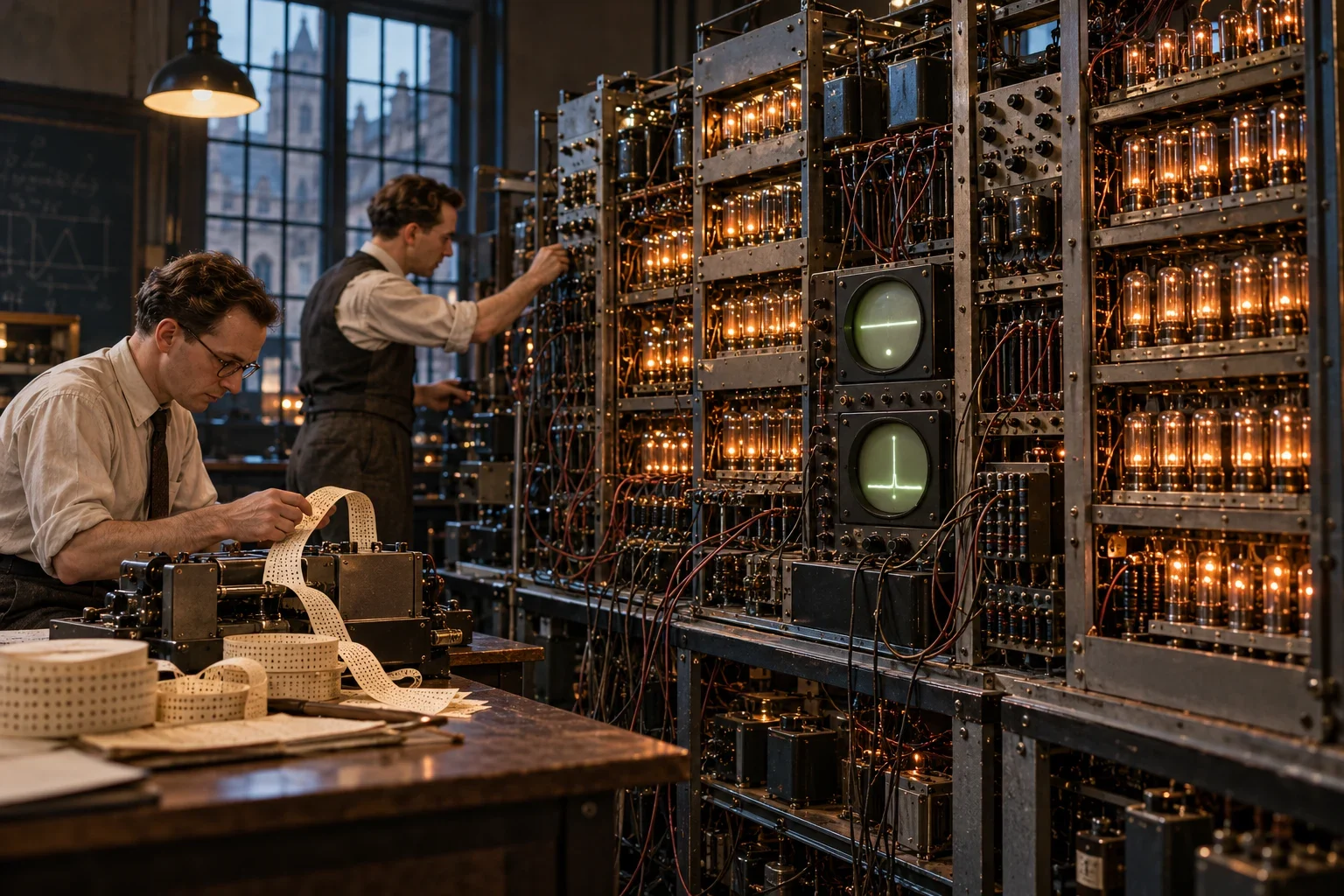
The Baby’s first successful run established that an electronic computer could execute instructions stored in its own memory. Tom Kilburn’s program calculated the highest factor of a number. Operators entered the program through hand-operated keys before allowing the machine to execute it. The experiment was modest in scale, but its arrangement was consequential: instructions no longer had to exist only as external settings or physical connections. The Computer History Museum describes the run as an early working example of software, emerging from the practical problem of reliable electronic storage.
Why memory was the central problem
The machine’s name can make it sound like a miniature version of a modern computer, but it was a research apparatus built around a difficult engineering question. Frederic Williams, Kilburn and Geoff Tootill developed it to test storage based on cathode-ray tubes. Its distinguishing achievement was the combination of electronic processing with electronically stored instructions and data. That precise description is more useful than calling it simply the first computer, a phrase that ignores earlier calculating machines and other important approaches to programmable computing.
From a laboratory test to a computing tradition
The Baby was a starting point for further Manchester computer development rather than a finished commercial product. The university’s work helped establish a lasting relationship with Ferranti, leading to the Ferranti Mark 1 in 1951 and later machines such as Atlas. Manchester also developed a major academic computing department. The original Baby did not survive, but a working reconstruction allows its principles to be demonstrated. Its historical importance rests on proving an architecture that could be developed into useful machines, not on resembling today’s computers in size or convenience.
Nature Boy — jazz piano trio
Jon Spanyol Trio
A later jazz-trio interpretation of Nature Boy, the song popularised by Nat King Cole in 1948. The composition connects the breakthrough to its musical era; this is not music made by the Baby computer.
Listen on SoundCloud ↗Follow the evidence.
- University of Manchester: Baby’s 65th birthday ↗
- Computer History Museum: Core, May 2001 ↗
- University of Manchester Department of Computer Science: History and heritage ↗
AI-assisted writing, with institutional and primary sources. Illustration is a reconstruction, not an archival photograph. Published October 31, 2026; updated October 31, 2026. Our approach