The H-4 Hercules flying boat’s only flight on 2 November 1947
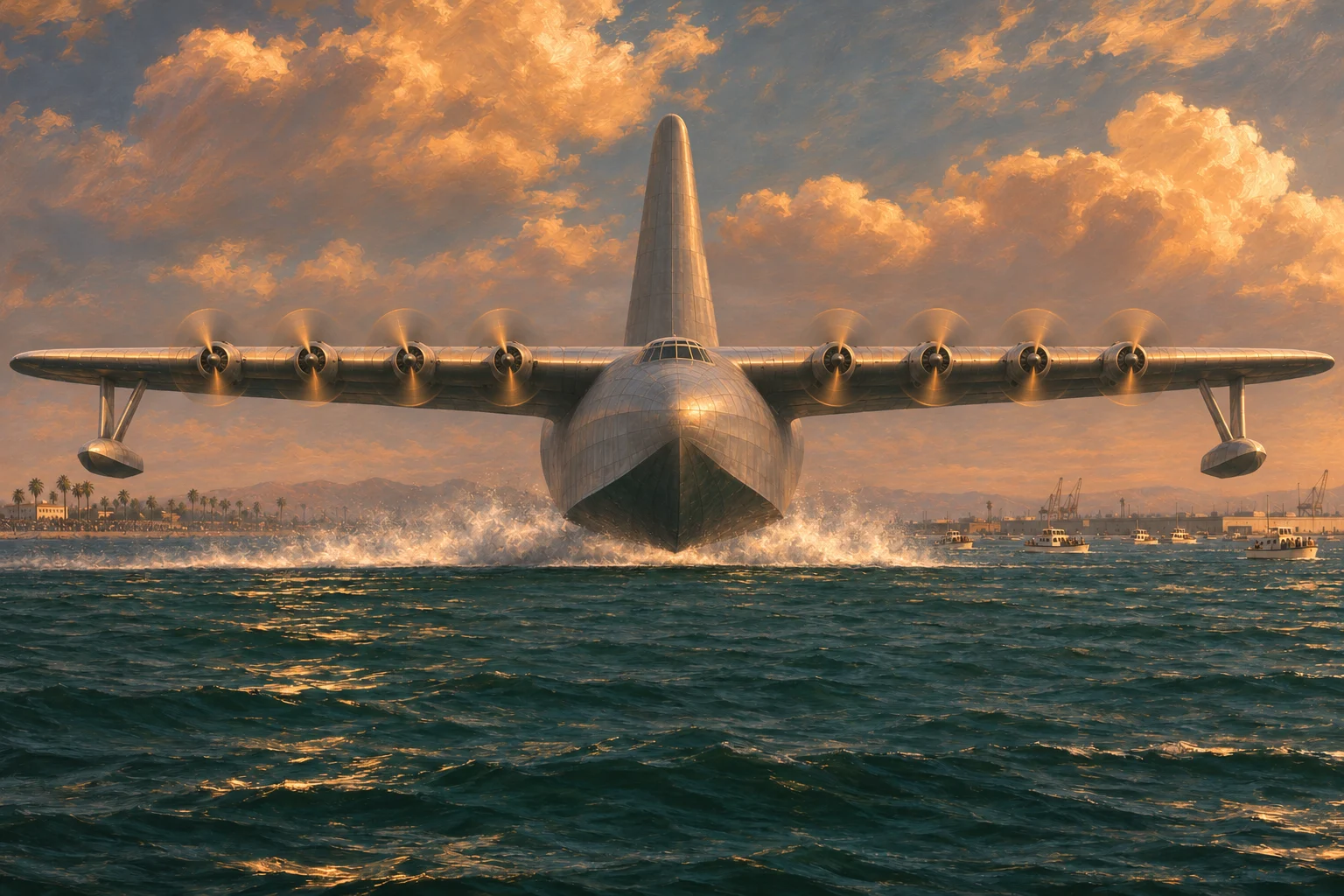
Howard Hughes flew the H-4 Hercules over Long Beach Harbor on 2 November 1947. The enormous aircraft, popularly called the Spruce Goose, was constructed mainly from laminated birch and never made a second flight.
A wartime transport proposal
The Hughes flying boat originated in a wartime problem: moving large numbers of people and substantial cargo across oceans while avoiding submarine attacks on shipping. Industrialist Henry Kaiser brought the proposal to Howard Hughes, whose company undertook its design and construction. Restrictions on strategic materials helped push the project toward wood. The resulting aircraft was exceptionally ambitious in scale, but its development outlasted the war that had supplied the original urgency. Its history is therefore as much about production and changing requirements as about aerodynamic possibility. North American Aerospace Museum
The wood behind the nickname
Despite its enduring nickname, the aircraft was built predominantly from birch rather than spruce. Laminated wood formed its airframe and surfaces through a construction approach associated with the Duramold process. The distinction is a memorable reminder that a popular name is not necessarily a technical description. Eight large piston engines provided power, while the hull allowed the aircraft to operate from water. Its immense wings and wooden construction together made it an unusual response to the demands placed on a large transport aircraft. American Society of Mechanical Engineers
The flight at Long Beach
On 2 November 1947, Hughes took the controls during tests on Long Beach Harbor. The H-4 left the water and made a brief, low flight before returning to the surface. Institutional summaries agree on the date, location, pilot and fact that it was the aircraft’s only flight. They differ in the distance and height they report. Those measurements are therefore best treated cautiously rather than combined into a falsely exact account. The essential event is secure: the giant flying boat did become airborne, but did not enter a continuing flight programme. American Society of Mechanical Engineers
A preserved aircraft rather than a service fleet
Afterward the aircraft was maintained in a hangar for decades, and it eventually became a museum exhibit. No operational fleet followed. Its preservation allows visitors to encounter the physical scale of a project that otherwise might be remembered only through its nickname and a short piece of film. The accompanying illustration interprets the brief takeoff in a cinematic landscape; it is not an archival photograph or evidence for a particular altitude. The historical interest lies in the combination of extraordinary construction, a single demonstrated flight and a much longer life on the ground. North American Aerospace Museum
Come Fly With Me — live
Tony Bignell
Bignell’s later live performance supplies a playful aviation association. The song and this recording postdate the 1947 flight; neither is presented as music heard during the test.
Listen on SoundCloud ↗Follow the evidence.
- North American Aerospace Museum: the only flight on 2 November 1947 ↗
- American Society of Mechanical Engineers: construction and flight ↗
- North American Aerospace Museum: aircraft collection overview ↗
AI-assisted writing, with institutional and primary sources. Illustration is a reconstruction, not an archival photograph. Published November 2, 2026; updated November 2, 2026. Our approach