India becomes an independent dominion on 15 August 1947
India’s independence on 15 August 1947 ended British colonial rule but did not immediately create a republic. The new country initially operated as an independent dominion while preparing its own republican constitution.
The end of colonial government
India’s independence followed decades of organized resistance, political negotiation and disputes over how power should be transferred. British reforms had expanded some forms of Indian participation while leaving ultimate colonial authority in place. After the Second World War, negotiations accelerated. The Indian Independence Act received royal assent on 18 July 1947, establishing the legal framework for the transfer and the creation of the independent dominions of India and Pakistan.
What changed on 15 August
On 15 August 1947, India became independent. Jawaharlal Nehru became its first prime minister, while Lord Mountbatten served as governor-general. Dominion status meant the country retained the monarch as its constitutional head of state, represented locally by the governor-general. It did not mean that India remained a colony. The distinction matters because sovereignty and the replacement of a monarchy by a republic are different constitutional changes, even when they are closely connected in national memory.
Freedom accompanied by partition
The transfer of power divided British India and partitioned Punjab and Bengal. Communities faced displacement, uncertainty and devastating violence. The new international boundaries separated people whose families, livelihoods and cultural connections had crossed those regions. Independence was therefore experienced very differently across the subcontinent. Celebrations of freedom belong in the account, but so do the suffering and upheaval accompanying partition. A constitutional description alone cannot capture the human consequences of the transition.
The later republican settlement
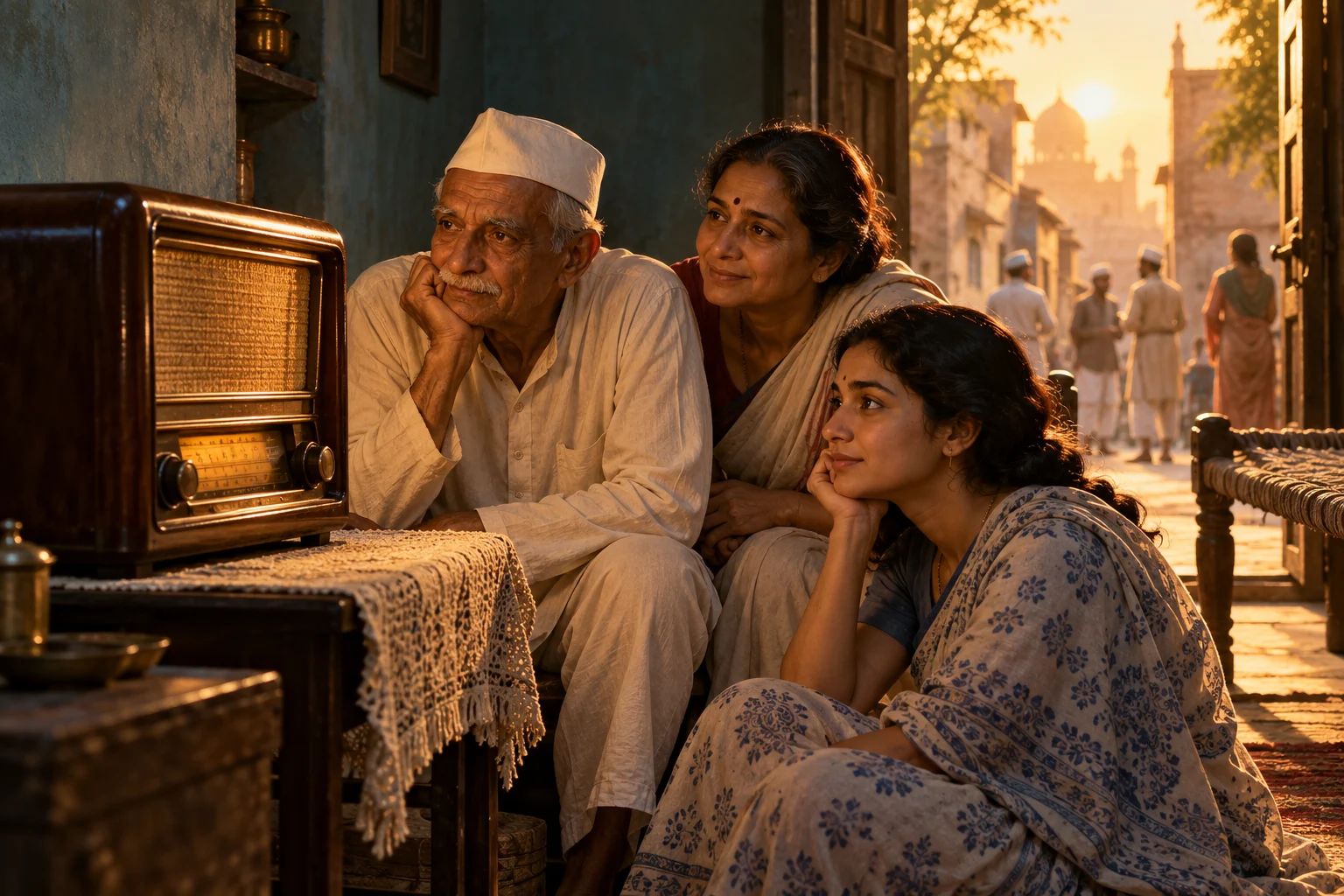
India subsequently completed the detailed constitutional work of making its own constitution and became a republic on 26 January 1950. That later milestone is commemorated as Republic Day, distinct from Independence Day in August. Keeping the two occasions separate explains how independence could be immediate while the new constitutional settlement required further work. The accompanying illustration imagines a family listening to radio news during the transition. The people, home and moment of listening are illustrative choices, not an identified household preserved in an archival photograph.
Vande Mataram (Instrumental Fusion Cover)
Soham Bansal
Bansal’s keyboard rendition of a song associated with India’s freedom movement was uploaded for Independence Day in 2017. It is a later commemorative performance, not a 1947 broadcast.
Listen on SoundCloud ↗Follow the evidence.
- UK Parliament: The Raj and independence, 1914–47 ↗
- Parliamentary Archives: The 1947 Indian Independence Act ↗
- Indian Ministry of Defence: About Rashtraparv ↗
- Soham Bansal: Vande Mataram instrumental fusion cover ↗
AI-assisted writing, with institutional and primary sources. Illustration is a reconstruction, not an archival photograph. Published October 31, 2026; updated October 31, 2026. Our approach