Kon-Tiki leaves Callao with six men and a parrot
The Kon-Tiki raft departed Peru on 28 April 1947. Its memorable passenger list accompanied an experiment whose historical interpretation remains more complex than the crossing itself.
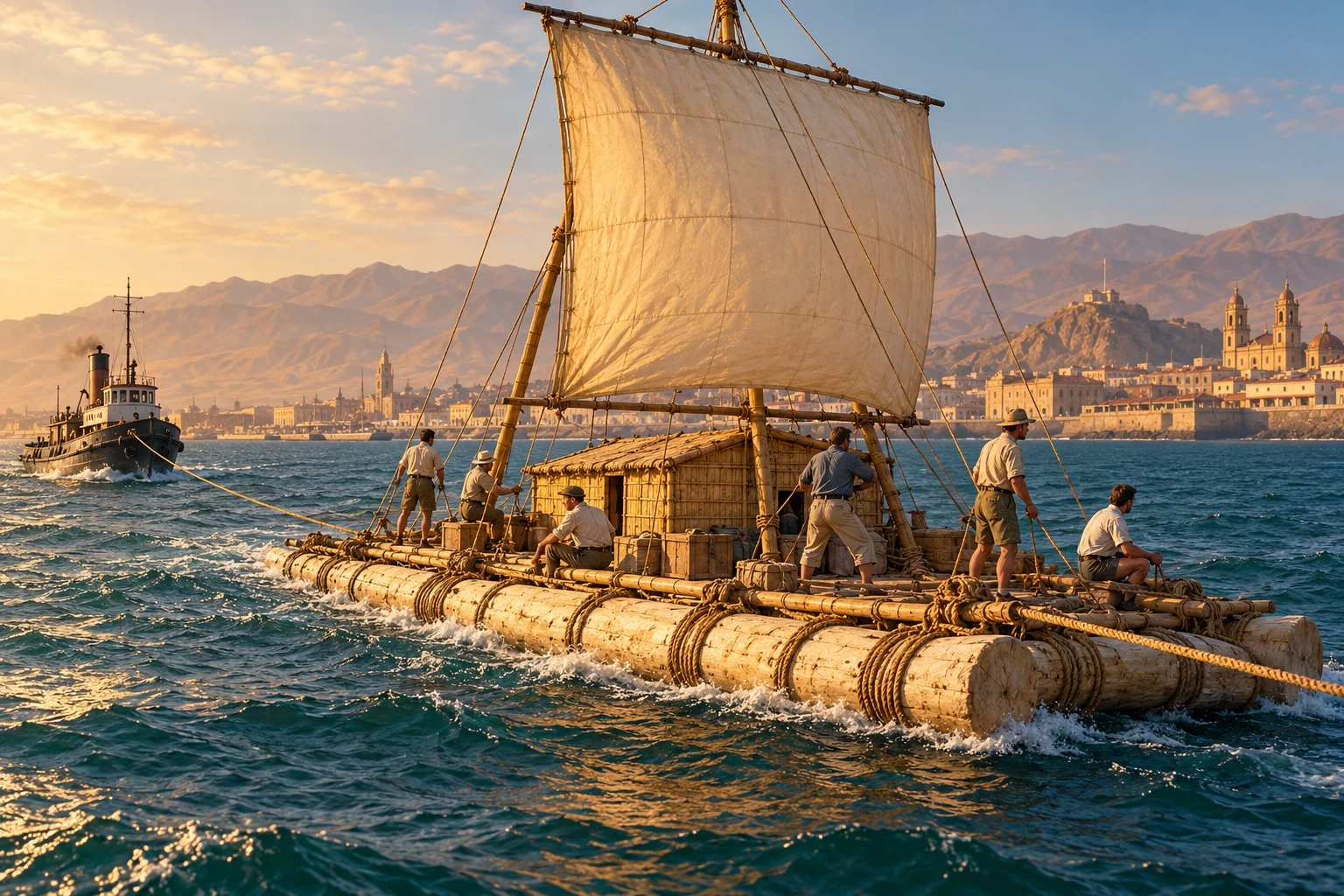
An experiment sets sail
Thor Heyerdahl wanted to test whether a South American balsa raft could cross the Pacific toward Polynesia. On 28 April 1947, Kon-Tiki left Callao, Peru, carrying six men and a parrot. The Kon-Tiki Museum explicitly records that departure and passenger list. The bird provides a small domestic detail within an expedition usually remembered for its vast ocean setting and ambitious migration theory. Museum history
Old materials and modern support
The crew obtained balsa timber in Ecuador and constructed the raft in Peru. Yet the expedition was not an isolated survival exercise using only ancient equipment. It also carried modern provisions, navigational instruments and radio equipment. These distinctions matter when assessing an experiment: the vessel could test the seaworthiness of a particular construction without recreating every condition of an undocumented prehistoric voyage.
What the crossing demonstrated
After 101 days, the raft reached the reef at Raroia in Polynesia. The achievement demonstrated the feasibility of an east-to-west passage by balsa raft under the expedition’s conditions. It could not, by itself, establish that such a passage had occurred in prehistory, identify the voyagers involved or explain the whole settlement of Polynesia. An engineering possibility and a historical account require different kinds of evidence. This is the essential limit when interpreting the successful voyage. The distinction remains useful when reading accounts of experimental voyages: demonstrating that an action is possible is different from showing that it actually happened centuries earlier.
Evidence beyond a raft
Later genetic research has investigated contacts between Polynesian and Indigenous American populations. A 2020 Nature study reported evidence of prehistoric contact around AD 1200, involving an American population related to people in present-day Colombia. That result concerns contact and ancestry, rather than blanket confirmation of Heyerdahl’s settlement model. Archaeology, language, navigation and genetics address questions that one twentieth-century crossing could not settle alone. The illustrated departure is newly made and does not claim to reproduce an archival photograph or the raft’s exact position on launch day. Genetic research
The Shadows - Kon-Tiki (Cover Version)
Stephen Hook
Hook’s later guitar cover of the Shadows’ 1961 instrumental links directly through its Kon-Tiki title. It is a later musical association, not music recorded aboard the 1947 raft.
Listen on SoundCloud ↗Follow the evidence.
- Kon-Tiki Museum: Kon-Tiki expedition, 1947 ↗
- Nature: Native American gene flow into Polynesia predating Easter Island settlement ↗
AI-assisted writing, with institutional and primary sources. Illustration is a reconstruction, not an archival photograph. Published October 31, 2026; updated October 31, 2026. Our approach