The War of the Worlds broadcast: October 30, 1938
On October 30, 1938, Orson Welles and the Mercury Theatre presented a radio adaptation of H. G. Wells’s alien-invasion novel. Its simulated news bulletins alarmed some listeners, but the familiar account of nationwide mass panic exaggerates what the evidence establishes.
A fictional emergency on the air
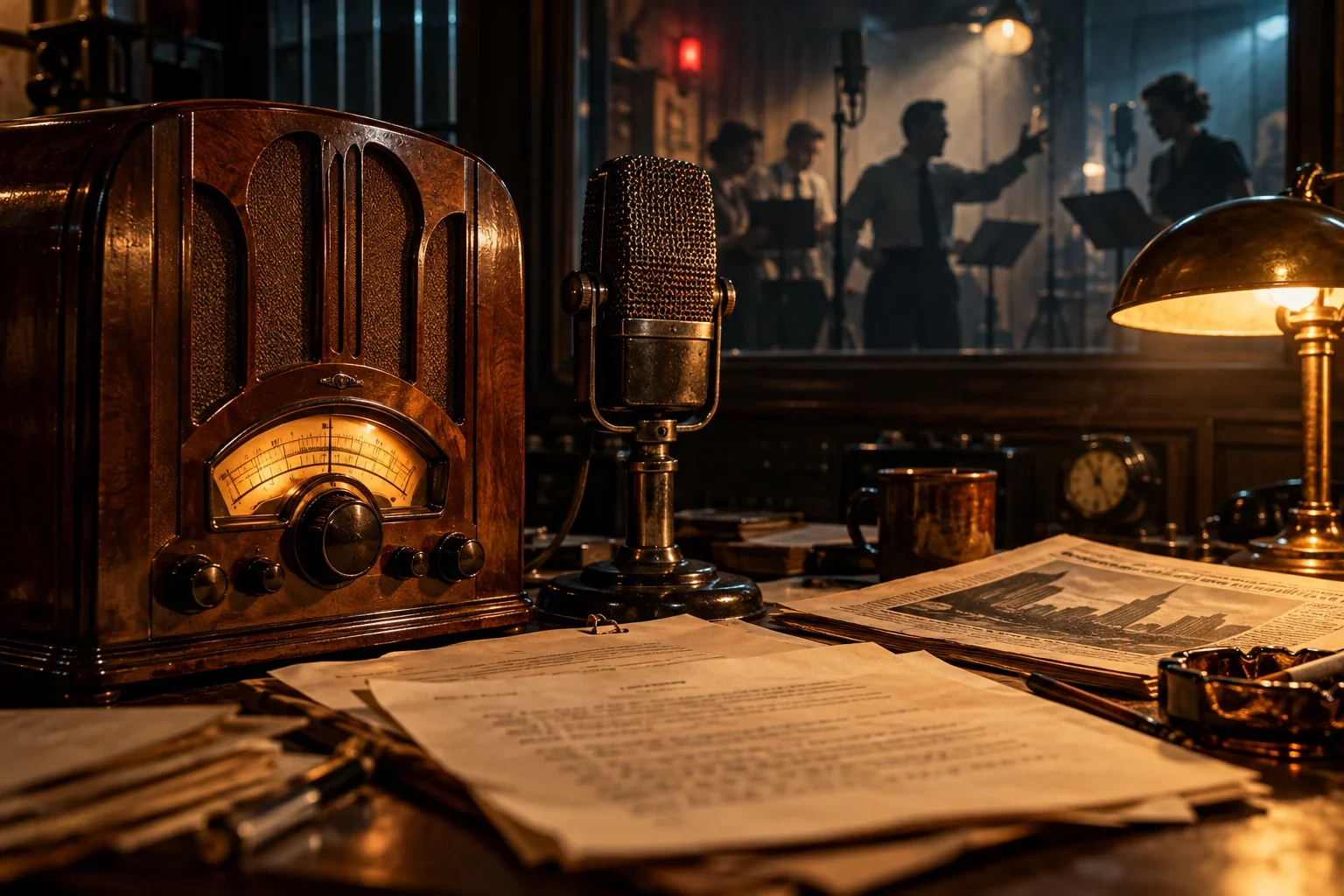
The production translated a novel into the language of live broadcasting. Music from a fictional orchestra gave way to interruptions describing unusual activity on Mars and then an invasion in New Jersey. Howard Koch’s adaptation supplied the dramatic framework, while actors performed reporters, scientists and officials. Familiar places and authoritative voices helped make the imaginary emergency convincing. The broadcast nevertheless included announcements identifying it as drama. Its effect depended partly on how much listeners heard and whether they recognized the conventions being imitated.
Fear, headlines and the larger legend
Some people were frightened, and surviving complaints document genuine distress. That does not establish that the country collectively panicked. The Library of Congress notes that a telephone survey conducted that evening found a small audience for the programme, with most listeners recognizing fiction. Sensational newspaper coverage helped turn scattered reactions into an enduring national story. The distinction matters: evidence that particular listeners misunderstood a broadcast cannot safely be expanded into precise claims about millions of terrified people or universal public gullibility.
What the surviving letters reveal
The National Archives preserves letters, telegrams and petitions sent to the Federal Communications Commission after the broadcast. Their writers did not all agree. Some demanded punishment or restrictions; others defended broadcasting freedom and the production itself. These records reveal arguments about the responsibilities of an influential medium as well as personal reactions to one programme. They also show why historical interpretation requires comparison: correspondence captures what individual writers reported, while audience research and newspaper coverage address different parts of the event’s subsequent reputation.
La Cumparsita
Franck Pourcel
The fictional orchestra in the 1938 broadcast opened with La Cumparsita. This later instrumental performance by Franck Pourcel uses the same composition; it is not the original CBS performance.
Listen on SoundCloud ↗Follow the evidence.
- National Archives: Letters to the FCC about the War of the Worlds broadcast ↗
- Library of Congress Magazine, July/August 2016: The War of the Worlds, pages 8–9 ↗
AI-assisted writing, with institutional and primary sources. Illustration is a reconstruction, not an archival photograph. Published October 31, 2026; updated October 31, 2026. Our approach